
Want color that climbs up instead of spreading out? A trellis turns a bare fence, wall or corner into a column of flowers, and the vine you pick makes all the difference.
There are plenty of climbing plants and flowering vines for trellis systems. Each one climbs in its own way, grows to its own size and has its own needs for sun and support. Get those three things right and the trellis almost takes care of itself.
Near a garden entrance, a vine with flowers in multiple colors to attract butterflies, bees and hummingbirds adds movement as well as color. Plants that grow up a lattice also give you vertical interest and a lush green backdrop in a small space.
Trellis materials can be as simple or as creative as you like. Some good options:
- Wood trellis (cedar or pressure-treated wood)
- Old fishing net
- Cucumber trellis
- Willow trellis
- Antique headboard trellis
- Pipe fittings or PVC pipe
- Stakes and posts
- Metal trellis, trellis wire or powder-coated steel
A wood trellis looks great, but a metal frame or trellis wire is the sturdier choice for heavy vines. More about: Is pressure treated wood safe for vegetable gardens?
Below are 13 of the best flowering vines for a trellis, how each one climbs, and a few popular vines to skip because they are invasive, with native vines to plant instead.
How Trellis Vines Climb
Before you buy, check how the vine holds on. Vines fall into four groups:
- Twining vines wrap their stems around a support. They grow best on wires, trellises or arbors. Mandevilla, morning glory, black-eyed Susan vine and wisteria are twiners.
- Tendril vines grab on with slim, flexible tendrils, and also do best on wires, trellises or arbors. Passion vine climbs this way.
- Clinging vines such as trumpet creeper attach with specialized roots that act like suction cups. Climbing hydrangea clings with aerial rootlets too. Don’t use a clinging vine on a wooden building or fence because it will damage the wood.
- Sprawling vines have no way to hold on by themselves and must be tied to a trellis or arbor. Climbing roses are not self-clinging, and bougainvillea is a scrambler.
Thin supports suit twiners and tendril vines best, because the stems and tendrils need something they can wrap all the way around.
13 of the Best Flowering Trellis Climbing Plants and Vines
Fast growers can take over a small trellis. A few of the most popular vines, including English ivy, Chinese and Japanese wisteria, Japanese honeysuckle, Oriental bittersweet and chocolate vine (Akebia quinata), are invasive, so they are not on this list. You will find them, and native vines to plant instead, further down. One vine that is on the list, common morning glory (#7), is also on invasive lists, so read its warning before you plant it.
Here are the best climbing flowers for a trellis.
#1 – Jewel of Africa Nasturtium
These flowering Nasturtium vines are the climbing form of common nasturtium. ‘Jewel of Africa’ is a climber up to 8 feet tall with red, yellow, orange and cream flowers and white-spotted leaves.
Nasturtium is a warm-weather annual, so you sow it again each year. It grows best in poor to average, well-drained soil in full sun, with some afternoon shade in hot summers, and that fertilizing gives you more leaves but fewer flowers. The tall types will eventually need staking or a trellis, and nasturtium can be grown year-round in most of Florida but dies back in a freeze. A bonus: the leaves, buds, flowers, pods and seeds are all edible.
#2 – Mandevilla
Mandevilla plant vines are tropical twiners. They have woody, twining stems that like to grow on poles, wires or lattice, spiraling in one direction. Give the young stems something thin to wrap around and they will do the rest.
Flowers come in pink, red and white, among other colors. The popular ‘Alice Dupont’ has medium pink flowers up to 2 inches wide and 2 inches long, and larger varieties can send stems up to 20 feet long in a single season. Mandevilla needs full sun to flower well. Flowers are most abundant in summer, with some all year in USDA zones 10 and 11.
The milky sap can irritate skin and may be toxic if eaten, so wear gloves when you prune. In colder areas, grow it in a container you can bring inside. NOTE: Mandevilla vines can be overwintered.
#3 – Trumpet Creeper (Campsis radicans)
This flowering vine’s trumpet-shaped flowers earned it the name Trumpet creeper vine. It comes in yellow, orange and red, and the flowers attract hummingbirds.
Trumpet creeper is native to the central and eastern United States. It climbs by aerial rootlets and reaches 30 to 40 feet, so NC State Extension says it must be grown on a sturdy structure because mature plants are heavy. It blooms best in full sun, though the leaves grow fine in partial shade, and it flowers on new growth, so early spring pruning won’t cost you blooms. Give it a sturdy metal arbor or a large vine for pergolas structure rather than a light wooden trellis.
Two cautions. It suckers from underground runners and self-seeds freely, so plant it where you can mow the suckers. And its other common name, cow-itch vine, comes from the skin redness and itching some people get from touching the leaves.
#4 – Henryi Clematis
‘Henryi’ is a large-flowered white clematis. The Royal Horticultural Society describes single flowers 6 to 8 inches (15 to 20 cm) wide, with eight pointed white sepals around brownish anthers, from late spring to late summer.
It reaches about 8 to 13 feet (2.5 to 4 meters), grows in full sun or partial shade, and belongs in clematis pruning group 2 (more on that in the pruning section below).
#5 – Clematis
For a Clematis vine for your arbor or trellis, choose by size. Clematis can grow 1 to 18 feet long, depending on the species and the support. Most like full sun, with afternoon shade where summers are hot, and their roots shaded with mulch or a groundcover planting.
Bloom time depends on the type. Some clematis bloom in early spring on old wood, large-flowered hybrids bloom in late spring, and others bloom in summer or fall on new wood. Handle them gently: the stems are fragile. Clematis is also poisonous to people, dogs, cats and horses if eaten.
Learn about Clematis Jackmanii growing and care.
#6 – Zephirine Drouhin Rose
This heirloom Bourbon climbing rose is a favorite for good reasons. ‘Zephirine Drouhin’ is almost prickle-free, has a strong, fruity fragrance, blooms from spring to fall and grows up to 12 feet as a climber. Its fragrant pink blooms make it a good pick next to a patio or walkway.
It tolerates shade and poor soils but flourishes in full sun, so a part-shade spot works but is not ideal. It is considered disease resistant, though it can still get black spot and powdery mildew.
Climbing roses don’t cling on their own. They need a trellis or horizontal wires to tie the shoots to. Don’t prune a climbing rose for its first two to three years so the flowering canes can develop.
#7 – Morning Glory
Morning Glory earns its name. The flowers of common morning glory open in the morning and close in the afternoon. It is a twining annual that can reach 6 to 10 feet in one season, blooms from early summer to fall and wants full sun. Grow it from seed.
Florida gardeners, take note: the UF/IFAS Assessment of Non-native Plants rates common morning glory (Ipomoea purpurea) as a high invasion risk, predicted to be invasive and not recommended in north, central and south Florida. It turns up on other invasive-vine lists too, is considered invasive in some places of the world, and is listed as a problem for cats, dogs and horses.
#8 – Bougainvillea
For a hot, sunny spot, the Bougainvillea plant is hard to beat. Its color comes from bracts (modified leaves) around tiny true flowers, in fuchsia, red, white, yellow and orange.
Bougainvillea is not a true climber. It is a woody vine with a scrambling habit, so you tie it to the trellis or fence. Sun is the key: it requires full sun, and without some direct sun it won’t flower. It also does better with soil kept a little dry and needs protection from frost and freeze. It is hardy in USDA zones 9b to 10b; in colder areas, grow it in a container.
Wear heavy gloves, because many cultivars have sharp thorns. Prune in late winter or early spring after it flowers, or at the start of the rainy season, and go easy on nitrogen, which gives you leaves instead of blooms.
#9 – Blue Moon Wisteria
‘Blue Moon’ is a cultivar of Kentucky wisteria (Wisteria macrostachya), a native American wisteria now listed under Wisteria frutescens. University of Illinois Extension calls ‘Blue Moon’ a cultivar from Minnesota with fragrant blue flowers that is extremely hardy.
Kentucky wisteria grows 20 to 25 feet, flowers in June with some rebloom late in the season, and is less aggressive than some other wisterias. It still becomes a large, heavy vine that needs a very substantial support. Plant it in full sun and slightly acidic, moist, well-drained soil.
Be patient: three or more years before the first flowers is not uncommon. If yours won’t bloom, the usual reasons are frost damage to the flower buds, too much shade, a plant that is too young, improper pruning or too much fertilizer. More on growing wisteria vines.
#10 – Black-Eyed Susan Vine
Many people love to grow black-eyed Susan vine (Thunbergia alata) for its cheerful flowers with a dark center. Despite the name, it is no relation to the black-eyed Susan daisy (Rudbeckia hirta).
It is a tender tropical evergreen that is best grown as an annual. It is a twining vine 3 to 8 feet long that does best with support, so plant it by an arbor, trellis or fence, or let it trail from a hanging basket. Give it full sun with some afternoon shade, and rich, well-drained soil. Flowers are yellow or orange, and cultivars such as ‘Bright Eyes’ are white. It reseeds easily and can be weedy in frost-free areas.
#11 – Bridal Veil Vine Plant Stephanotis
The “Bridal Veil Vine Plant” or Madagascar Jasmine (Stephanotis floribunda) is always in demand for its clusters of pure white, waxy, intensely fragrant flowers.
It is an evergreen woody vine that can grow to more than 20 feet and will need to be trellised. In summer it wants full sun, plenty of water and high humidity. It does best between 68 and 90 degrees F and must come back indoors when the temperature approaches 39 degrees F, so in most of the country it is a container plant or houseplant on a small trellis.
#12 – Climbing Hydrangea
Climbing hydrangea is a clinging vine with rich green leaves, white midsummer flowers, yellow fall color and peeling bark in winter. It can grow to 60 feet and is hardy in USDA zones 4 to 8.
It is a vine for a big, sturdy structure. Climbing hydrangea (Hydrangea petiolaris) is somewhat slow to establish and slow to start flowering. Train the shoots onto wires or a trellis along a wall or sturdy fence at first; after a season they form self-clinging aerial roots. Prune it after flowering.
It is also one of the few flowering vines for shade. It grows on north-, east-, south- or west-facing walls, in partial shade, or in sun if the soil stays reliably moist.
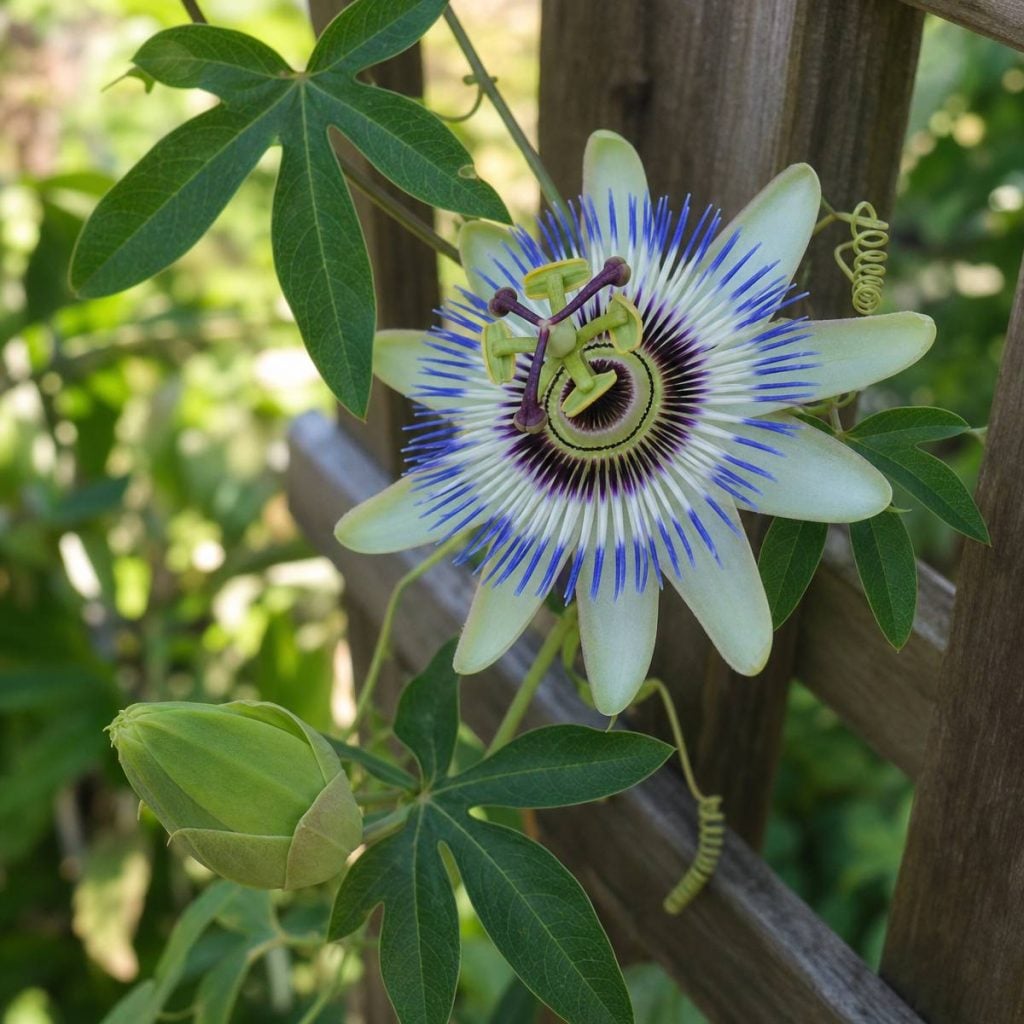
#13 – Passiflora Vine
The passion vine boasts a complex flower structure that always turns heads. No other flower looks quite like a passion flower.
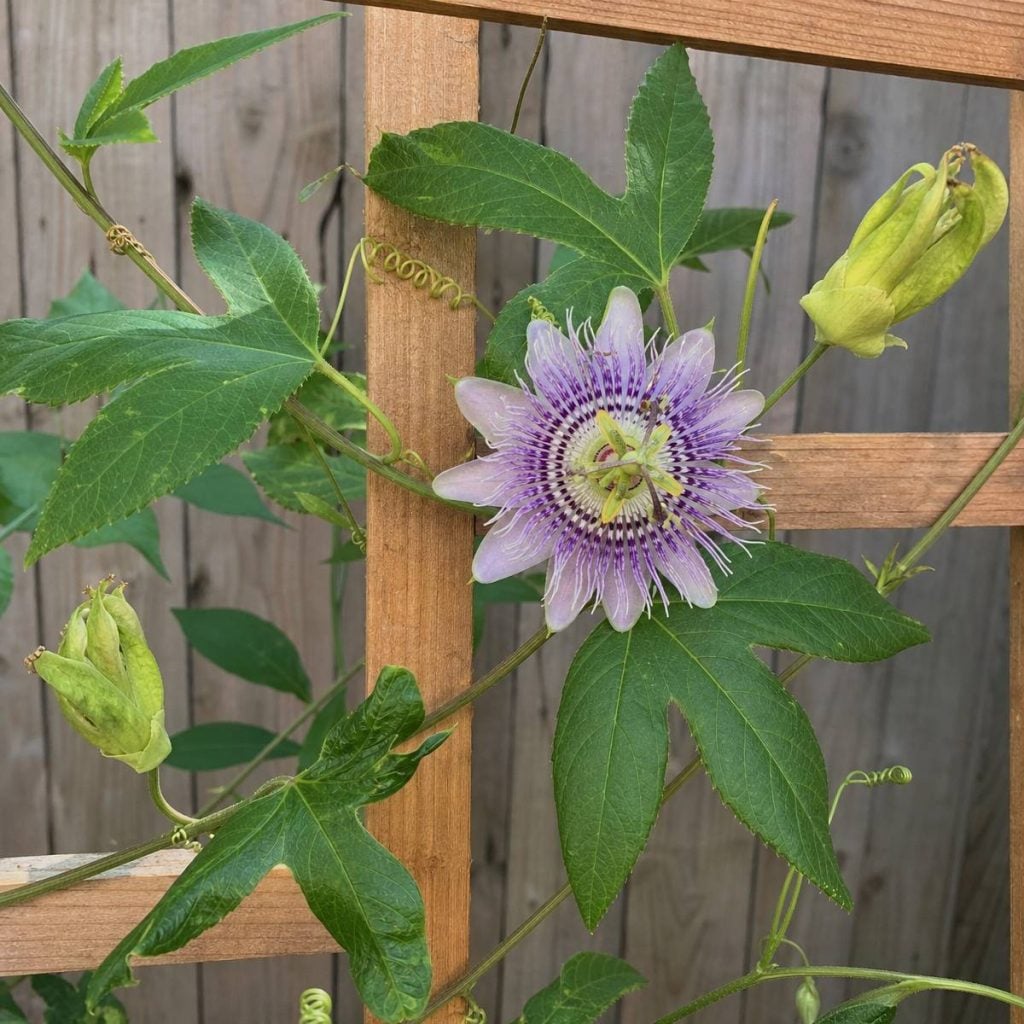
Passiflora caerulea, the blue passion flower, is a common garden-center choice. It grows 10 to 40 feet tall, with blue and white flowers from early summer to early fall followed by orange fruits. Its tendrils cling to trellises, arbors or fences without damaging the surface. It suits USDA zones 6a to 10b, and partial shade to full sun.
The leaves and stems are poisonous to people and pets. For a native choice, maypop (Passiflora incarnata) is native to the southeastern and south-central United States, climbs by tendrils and is hardy in zones 5 to 9.
Runner-Up Flowering Vines for a Trellis
Other flowering vines and climbers that do well on trellises include:
- Tomato plants (tie them in; they don’t climb on their own)
- Jasmines (check your local invasive list first: Gold Coast jasmine, Jasminum dichotomum, is listed as invasive in central and south Florida)
- Cobaea (Cup and saucer vine)
- Clytostoma Callistegioides (lavender trumpet vine)
- Sweet Pea
- Quisqualis Indica – Rangoon Creeper (Rangoon creeper (Combretum indicum, syn. Quisqualis indica) is rated Moderate Risk/Evaluate in north, central and south Florida: it received an intermediate score, and not enough information was available to reach a conclusion)
- Silver Lace Vine (Polygonum aubertii) (very vigorous; it can be invasive in some areas and needs regular pruning)
- Snail Vine
- Grape vine
- Dutchman’s Pipe (the native Aristolochia macrophylla; all parts are highly poisonous if eaten)
- Beans
- Cucumbers
Vines to Skip: Invasive Climbers and Native Alternatives
Some of the most widely sold vines are the ones extension services ask you not to plant. Clemson Extension says many exotic vines, such as English ivy and Japanese or Chinese wisteria, are not recommended for the landscape because of their invasive characteristics, and it lists Japanese honeysuckle, Oriental bittersweet, five-leaf akebia, sweet autumn clematis and common morning glory as invasive too.
- English ivy (Hedera helix). It is an invasive species in North Carolina that climbs trees and shrubs and will eventually kill them. It is predicted to be invasive and not recommended anywhere in Florida, and the USDA National Invasive Species Information Center says it competes with native plants. Already have it? Here is how to kill English ivy.
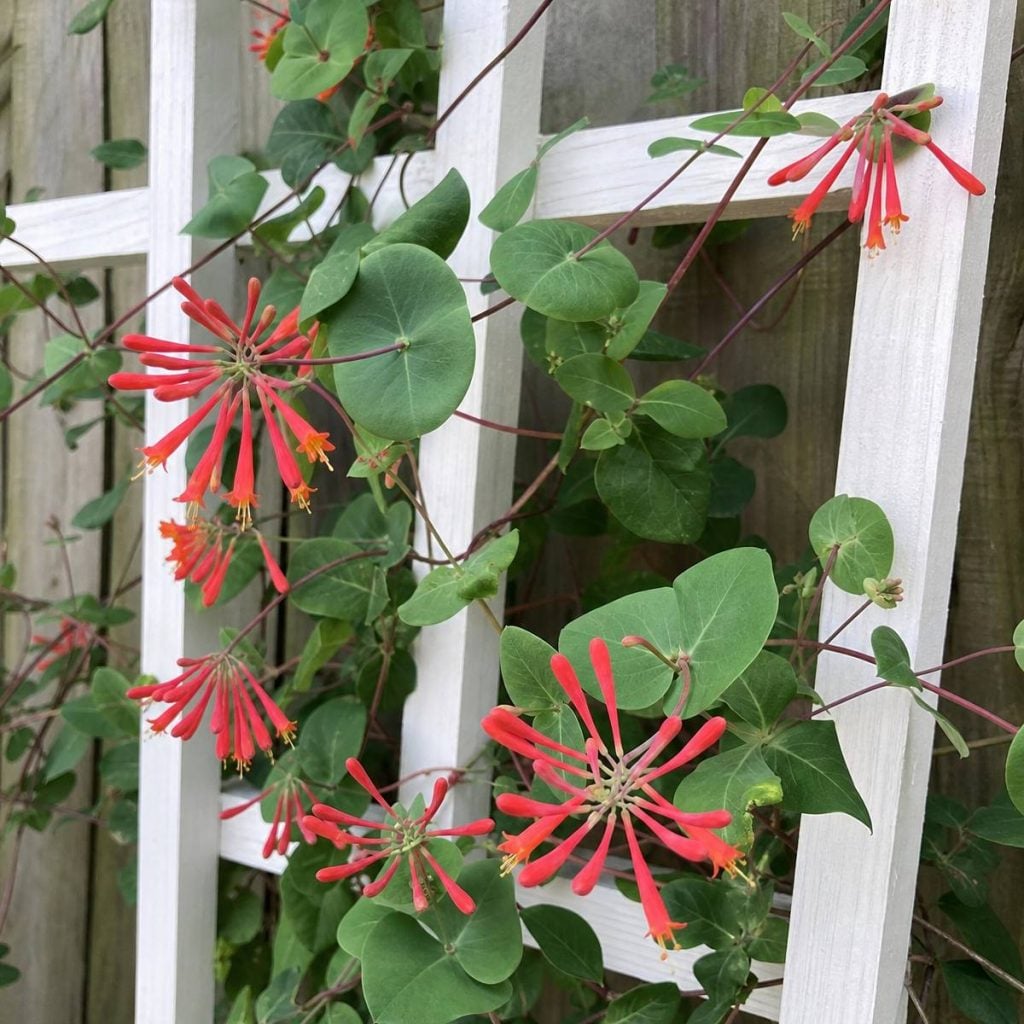
- Japanese honeysuckle (Lonicera japonica). It is classified as highly invasive, and it is prohibited in Florida. Plant native coral honeysuckle (Lonicera sempervirens) instead. It grows in USDA zones 4 to 10, its red tubular flowers attract hummingbirds and butterflies, its stems reach up to 15 feet, and it works well on trellises and fences.
- Chinese and Japanese wisteria. Chinese wisteria is listed as invasive in all of Florida, and in North Carolina Chinese wisteria is an invasive weed and Japanese wisteria aggressive and invasive. For a wisteria look, try native American wisteria, such as ‘Amethyst Falls’, though it is hardy only in USDA zones 5 to 9. Kentucky wisteria ‘Blue Moon’ (#9 above) is another native option.
- Oriental bittersweet (Celastrus orbiculatus). This invasive Oriental bittersweet should not be used in the landscape and readily hybridizes with native American bittersweet. The native Celastrus scandens is the alternative. Its leaf tips taper to a point (the invasive one’s are rounded), and you generally need one male plant for six to nine female plants to get the red fruit.
- Chocolate vine (Akebia quinata). It is an invasive species in North Carolina that can reach 40 feet and is difficult to manage even with heavy pruning.
More native vines for a trellis:
- Carolina jessamine (Gelsemium sempervirens). It is a native evergreen vine with fragrant yellow flowers in late winter to early spring, great on arbors, trellises and pergolas. Be aware that all parts of the plant are poisonous and the sap can irritate skin.
- Crossvine (Bignonia capreolata). This native vine climbs by tendrils and blooms in late winter to early spring, an important early food source for hummingbirds. It spreads by seed and root suckers, so pull suckers where you don’t want them.
- Virgin’s bower (Clematis virginiana). This white-flowered native clematis is a twining vine for USDA zones 6 to 8. Like other clematis, it is poisonous if eaten.
Tips and (Abuses): Using Climbing Trellis Plants
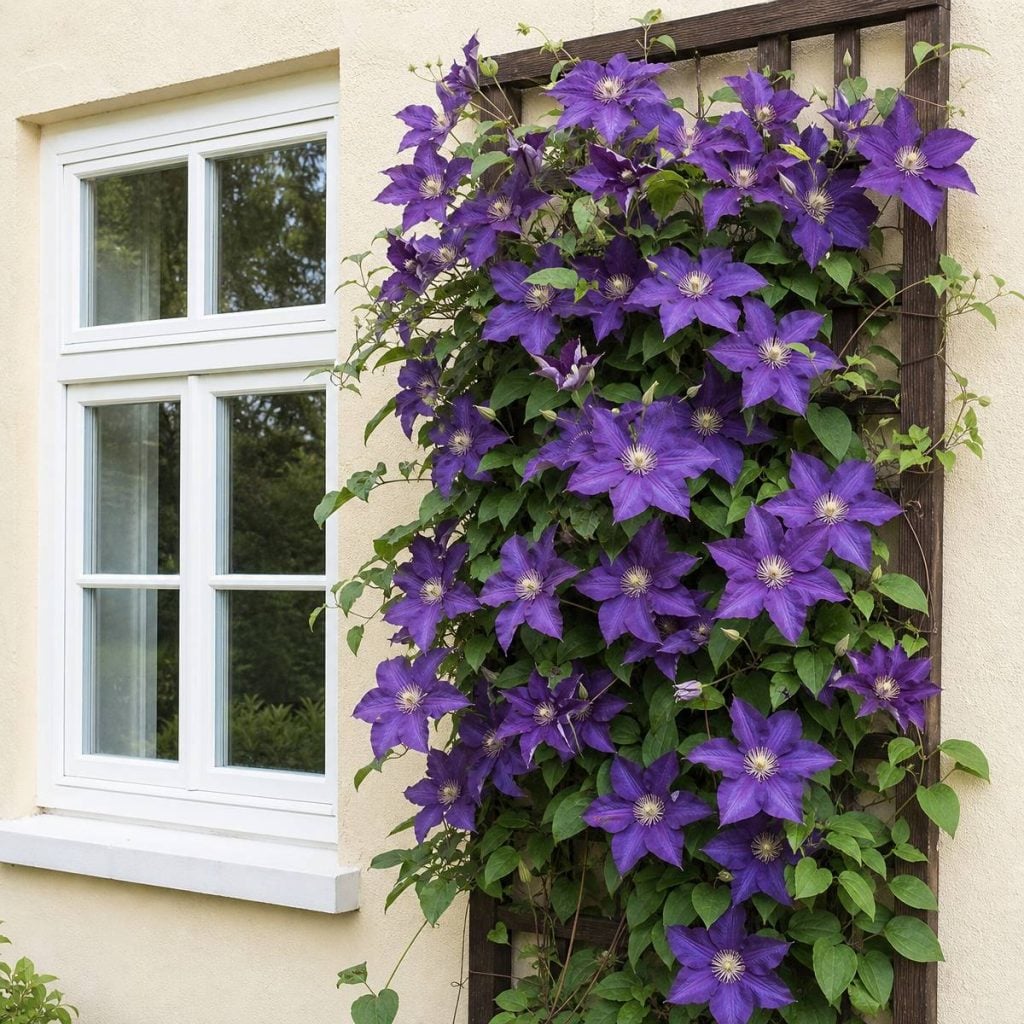
Sometimes trellis vines are used in the wrong place. A beautiful flowering vine in the wrong spot is just a weed. A few things to avoid:
- Don’t bury pleasing architecture under heavy vines. Decorative doorways, attractive cornices, well-made fences and pergolas look worse when completely smothered.
- Don’t plant a vine to hide something that should be removed or repaired. A deciduous vine only hides an eyesore for part of the year.
- Try an untested vine out back before you put it by the front door.
- Keep fan-shaped trellises near the sides and boundaries of the yard, not in the middle of the lawn.
- While a slow perennial vine fills in, tuck a fast annual vine in beside it, but don’t let the annual smother the permanent vine.
- If a wooden trellis needs repainting every few years, grow twining vines or tied-in climbers you can take down. Clinging vines on wooden buildings or fences damage the wood.
- Choose colors that suit the house. Bright flowers stand out against neutral or soft-toned walls, while crimson roses and purple Jackmanii clematis can clash with red brick.
- Don’t cover a small porch with a rampant, large-leaved vine that shuts out light and air.
- Plant clematis away from foot traffic and pets. The stems are fragile.
Tips for Training Trellis Plants and Vines
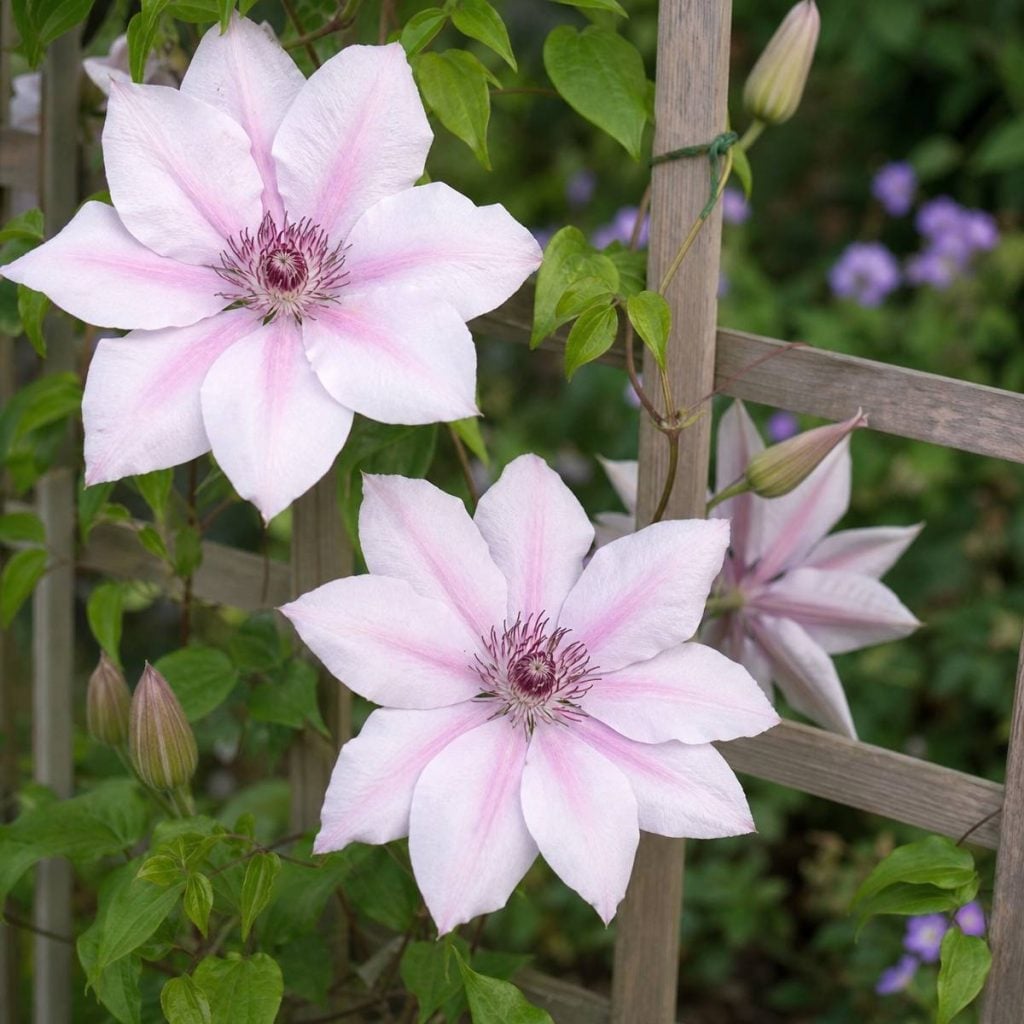
Judge a vine by how many branches it has, not by how long they are. A few simple observations about how vines grow tell you how to train them:
- Know how your vine climbs. Twiners and tendril vines need thin supports, clinging vines need a solid surface, and sprawlers like climbing roses and bougainvillea must be tied in.
- Help young plants reach the support. Tie stems to the support after planting and bridge any gap with temporary bamboo canes.
- Train some shoots sideways. For climbing roses, keep the main shoots as horizontal as possible, even twisting them gently around pillars and pergola posts, to encourage flowering shoots low down.
- Vines tend to grow from the top buds and leave the base bare. Tying a few long shoots low or sideways keeps flowers and leaves from top to bottom.
- Tie stems where you want them. Many vines cover only half a trellis unless some branches are tied into place.
- Be patient with woody climbers. Climbing hydrangea is slow to establish and slow to flower, and wisteria can take three or more years to bloom.
- Some old branches die out over time. That is normal renewal; cut them out.
How to Prune Climbing Trellis Flowers and Vines
With those observations in mind, the rules are simple. The main one is timing. A spring-flowering vine formed its flower buds the previous late summer or fall, so prune it immediately after it blooms in spring. For all other vines, late winter is the best time to prune.
- Spring bloomers: prune right after flowering. Carolina jessamine is best pruned soon after it finishes flowering.
- Summer bloomers on new growth: prune in late winter or early spring. Trumpet creeper blooms on new growth, so early spring pruning won’t affect flowering.
- Clematis: there are three pruning groups. Group 1 blooms in early spring on old wood and needs only damaged stems removed after flowering. Group 2 (large-flowered hybrids, including ‘Henryi’) blooms on old and new wood and gets light pruning in late winter or early spring as buds swell. Group 3 blooms on new wood in summer or fall and can be cut nearly to the ground in late winter.
- Climbing roses: no pruning for the first two to three years. After that, prune established climbers in winter, between December and February.
- Fruiting vines: don’t cut off the fruit you are growing the vine for. Prune American bittersweet back in early spring.
- Cut each shoot back to a bud or another branch, and don’t leave a stub. Prune out dead or weak wood.
- Prune a little every year instead of letting a vine get away from you.
Removing faded flowers (deadheading) keeps many vines tidy and blooming. ‘Zephirine Drouhin’ does not need deadheading, but it will encourage more blooms.
The Bottom Line
To build trellises for climbing vines, know each plant’s mature height and width so you can space them out and build a support strong enough to hold them. Check how the vine climbs, how much sun it needs, whether it is hardy in your zone, and whether it is invasive where you live.
Whatever you choose, whether it is a pre-made trellis planter box, an arbor, a tomato cage, a powder-coated metal garden obelisk, trellis netting or a plastic trellis, its success depends on the plants that go with it. Pick contrasting or complementary colors for a look that is all your own, or build a DIY trellis for a more personal garden project.
Frequently Asked Questions
What flowering plants grow best on a trellis?
Twining and tendril vines are the easiest, because they grow best on wires, trellises or arbors. Good picks include mandevilla, clematis, black-eyed Susan vine, passion flower and native coral honeysuckle or Carolina jessamine. Climbing roses and bougainvillea also work, but they don’t hold on by themselves, so you tie them in. Heavy clingers like trumpet creeper need a much sturdier structure.
What are good annual climbing vines for a trellis?
Climbing nasturtium is a warm-weather annual, with ‘Jewel of Africa’ reaching up to 8 feet. Black-eyed Susan vine is a tender tropical best grown as an annual, and common morning glory is a twining annual that can reach 6 to 10 feet in one season. Use caution with morning glory: it is listed as an invasive vine, and it is predicted to be invasive and not recommended in Florida.
What is a good alternative to Chinese or Japanese wisteria?
Try a native American wisteria. Chinese wisteria is listed as invasive in Florida, and American wisteria, such as ‘Amethyst Falls’, hardy in USDA zones 5 to 9, is the suggested swap. American wisteria is not as aggressive a spreader as Chinese wisteria. Kentucky wisteria ‘Blue Moon’ is another native choice: extremely hardy, with fragrant blue flowers.
Which vines should I not plant on a trellis?
Skip the invasive ones. Exotic vines such as English ivy and Japanese or Chinese wisteria are not recommended for landscapes because of their invasive characteristics, and Japanese honeysuckle and Oriental bittersweet are on the list too. Japanese honeysuckle is prohibited in Florida. For a native honeysuckle, coral honeysuckle is recommended for trellises and fences.
When should I prune flowering vines?
It depends on when the vine blooms. Spring-flowering vines set their buds the previous late summer or fall, so prune them immediately after they bloom. Prune all other vines in late winter. Clematis has its own three pruning groups, and a new climbing rose should be left unpruned for its first two to three years.