
What are the best plants for your pergola? First, let’s quickly look at what a pergola is.
A pergola is an open structure with posts that hold up flat cross beams, often covered with plants. People use pergolas like a big trellis with climbing plants, over a walkway or to shade a sunny patio.
The best pergola plants cover the structure without taking over the yard, the house or the trees next door. That comes down to three things: how heavy the vine gets, how it climbs, and whether it is invasive where you live. Get those right, and the rest is the fun part: picking flowers, fragrance and color.
Before You Plant: Three Things to Check
Is Your Pergola Strong Enough?
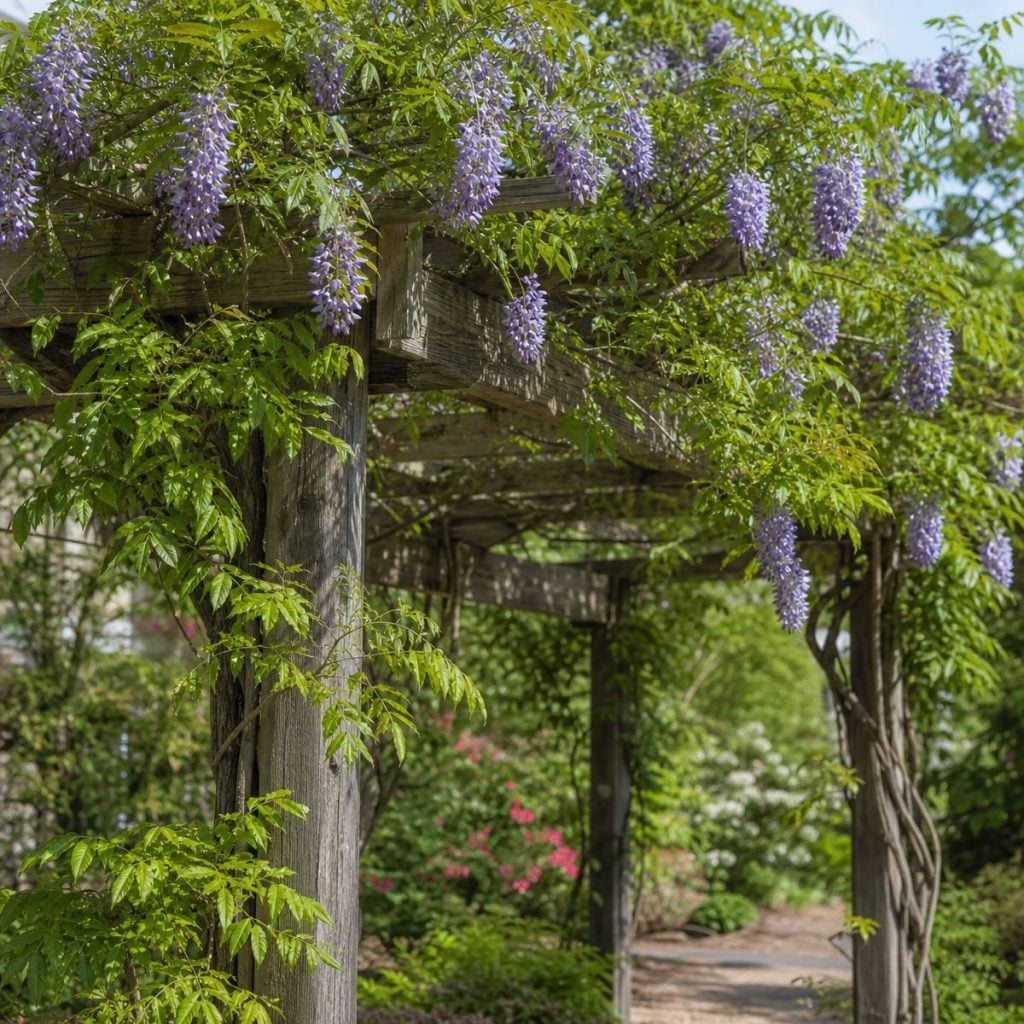
Some vines get very heavy. NC State Extension says trumpet vine “must be grown on sturdy structures because mature plants produce considerable weight.” Wisteria needs space and sturdy supports, and the stems of Chinese wisteria become twisted, trunk-like and massive over time. Climbing hydrangea can easily grow to 60 feet.
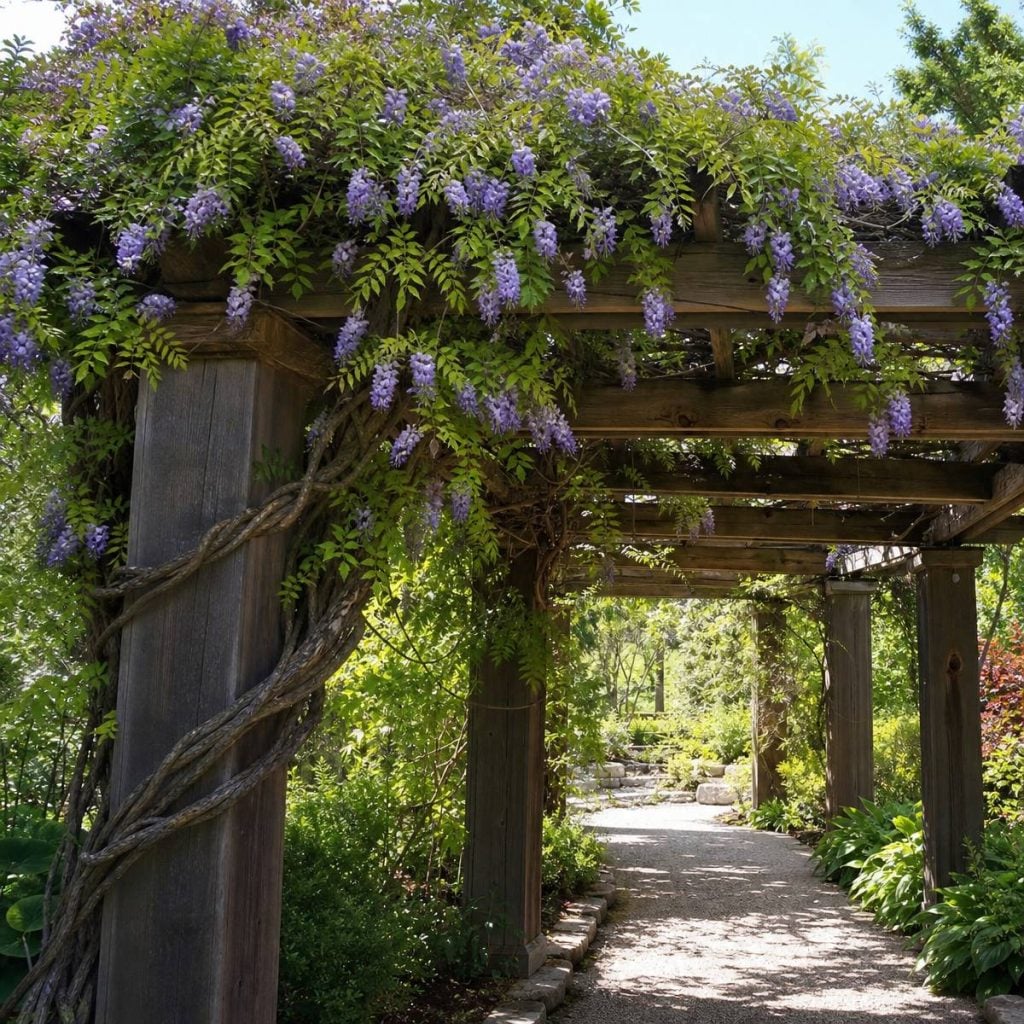
So make sure your pergola is strong enough for the vine you have in mind, with posts well anchored. If your pergola is a light kit, a vine that starts fresh each year is the easier match. Nasturtium and morning glory are annuals, and hops die back at the end of each growing season, so none of them build up the woody, trunk-like stems of an old wisteria.
How Does the Vine Climb?
Not every vine grabs on by itself. Vines fall into three groups:
- Clinging vines hold on with special organs: grapes and crossvine use tendrils, and some vines use adhesive rootlets.
- Twining vines, such as coral honeysuckle and star jasmine, wrap their stems around upright supports. They may need a little help finding their way.
- Sprawling vines, such as bougainvillea, have long stems but no way to attach. Without help they may grow into an ever-expanding mound.
For twining vines, weave new shoots sideways through the structure as they grow. Avoid clinging vines with adhesive rootlets, such as English ivy and Virginia creeper, because they grow aggressively up trees and walls and can cause damage. And a rule of thumb for any vine: never let it grow taller than your ladder.
Is It Invasive Where You Live?
Some of the most famous pergola vines are invasive. The UF/IFAS Assessment of Non-Native Plants lists Chinese wisteria as invasive in north, central and south Florida, rates Japanese wisteria as predicted to be invasive and not recommended, and lists Japanese honeysuckle as prohibited in Florida. In North Carolina, Japanese honeysuckle is considered highly invasive and Japanese wisteria invasive.
Rules differ from state to state, so check with your county Extension office before you buy. The good news: there are native vines that look just as good on a pergola, and you will find several of them below.
The Best Plants for Your Pergola
Jewel of Africa Nasturtium
The nasturtium vine comes in bushy and climbing forms, so read the label. The climbing types can grow up to 10 feet and quickly cover fences, trellises and banks, and ‘Jewel of Africa’ is a climber up to 8 feet with red, yellow, orange and cream flowers and white-spotted leaves.
Nasturtium is a warm-weather annual. It grows best in poor to average, well-drained soil in full sun, with some afternoon shade in hot summers. Go easy on fertilizer: it adds leaves but cuts down on flowers. Bonus: the leaves, flowers and seeds are edible, with a peppery bite.
Clematis ‘Henryi’
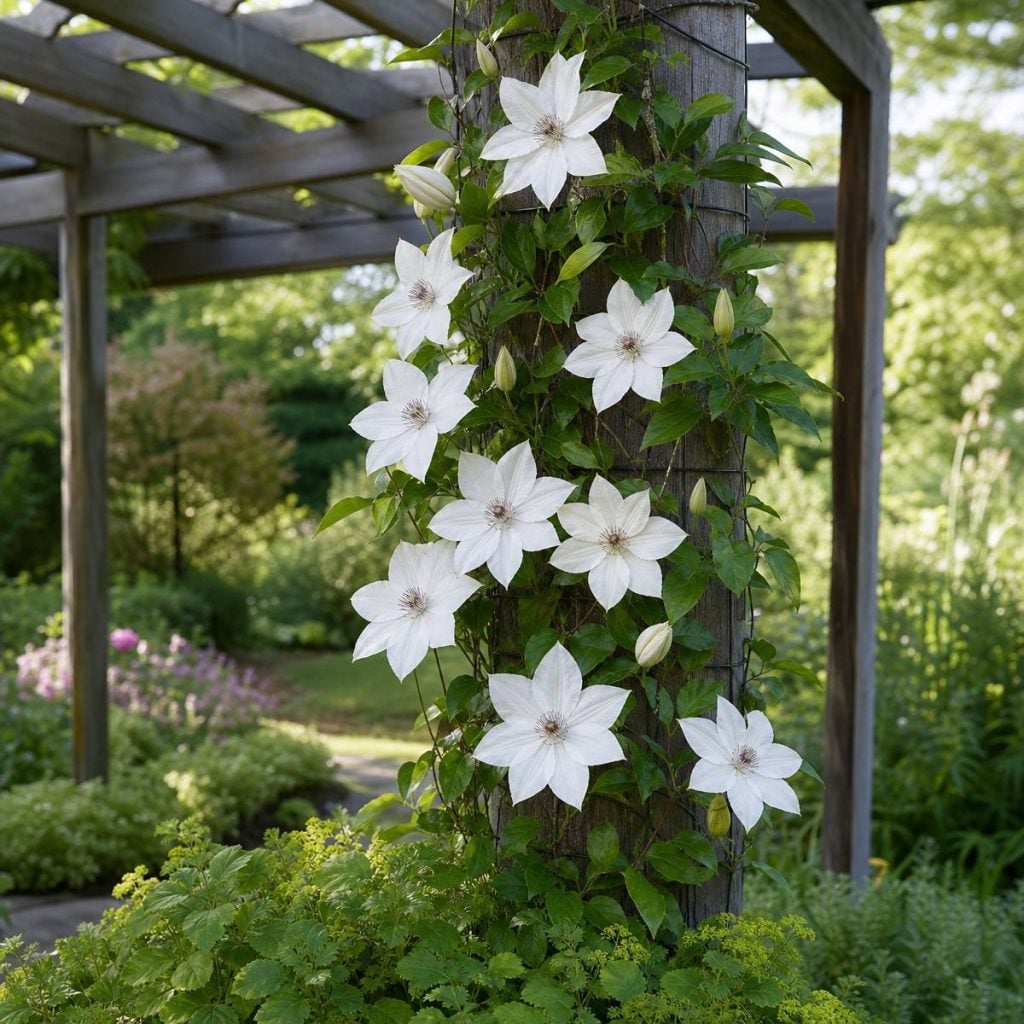
‘Henryi’ is a large-flowered clematis with big white flowers. The Royal Horticultural Society describes single white flowers 15 to 20 cm (about 6 to 8 inches) wide with brownish anthers in the center, from late spring to late summer, on a vine that reaches about 2.5 to 4 meters (8 to 13 feet).
That size makes it a good pick for one pergola post rather than the whole roof. Keep the roots and base cool and shaded, with other plants or a layer of pebbles. Clematis prefers full sun with afternoon shade where summers are hot, and large-flowered hybrids belong to pruning Type 2: prune lightly in late winter or early spring as the buds swell.
Honeysuckle: Choose Coral Honeysuckle
Here is where the variety really matters. Japanese honeysuckle (Lonicera japonica) is the invasive one (see above). Its native cousin, coral honeysuckle (Lonicera sempervirens), is the one to plant. It’s a Florida-Friendly alternative to Japanese honeysuckle, with bright red tubular flowers that attract hummingbirds and butterflies for months.
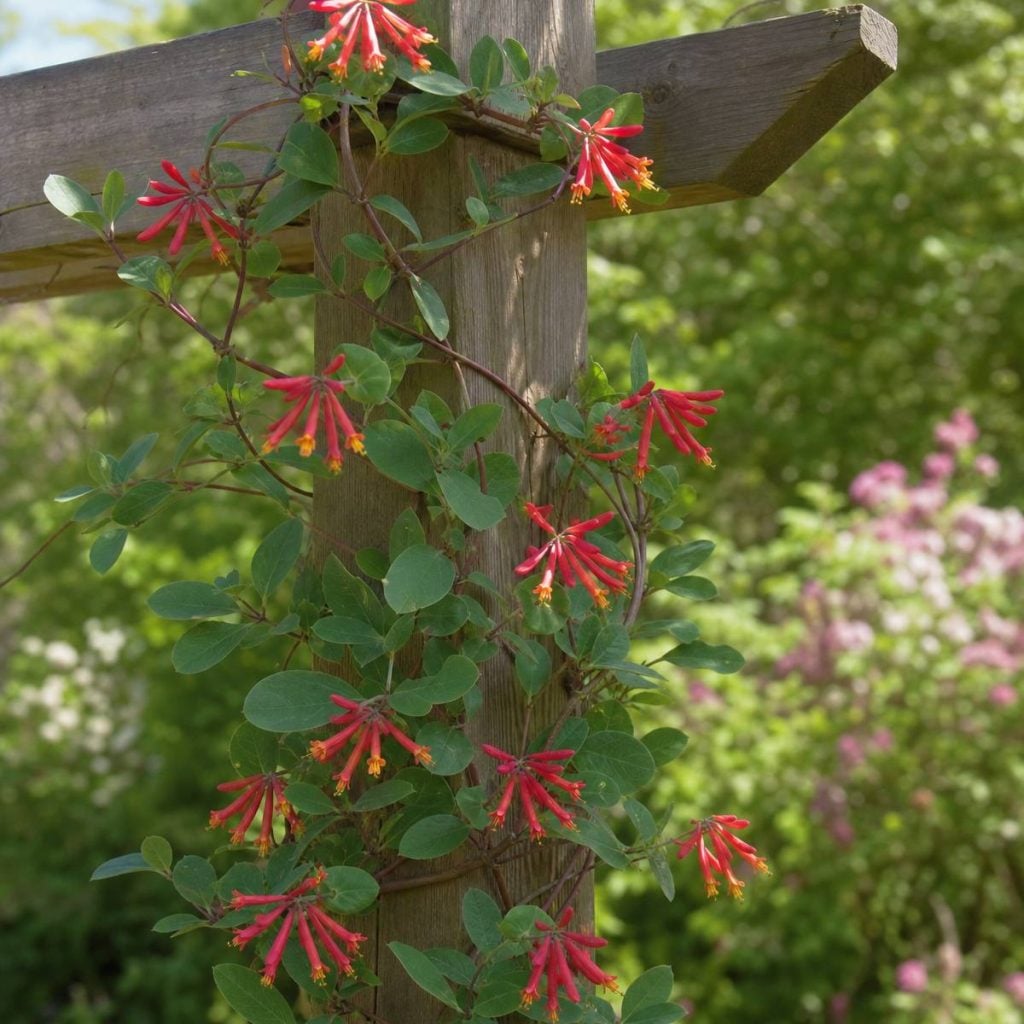
Coral honeysuckle is a twining vine. It reaches 10 to 20 feet, needs a support structure such as a trellis or arbor, and flowers best in full sun. Its blooms are not fragrant, but the hummingbirds don’t mind. It is generally low-maintenance once established and grows in USDA Zones 4 to 10.
Grape Vine
A grape-covered pergola gives you shade and fruit. In the Southeast, look at the native muscadine grape (Vitis rotundifolia). The pergola is among the structures it can be trained on, as long as there is enough space and light. Many muscadines are female, so choose a self-fertile (“perfect-flowered”) cultivar if you only have room for one vine.
One honest warning: an arch or pergola can make muscadines harder to maintain, and fruit production may decline, because you need easy access to the vine’s arms to prune them every year. If shade is the main goal, a pergola grape is fine. If you want a big harvest, a regular trellis is easier.
Wisteria: Pick an American Type Such as ‘Blue Moon’
Few vines look better hanging from a pergola than wisteria. But the commonly grown Asian species, Chinese and Japanese wisteria, become aggressive pests left to grow at will and can escape into natural areas. American wisteria (Wisteria frutescens) is not as aggressive a spreader and is less damaging to buildings. It is a non-invasive option, and so is evergreen wisteria (Millettia reticulata), which is not a true wisteria.
‘Blue Moon’ is one of these American types: Wisteria frutescens var. macrostachya ‘Blue Moon’, with lightly scented blue-mauve flowers in summer on a vine of 4 to 8 meters (about 13 to 26 feet).
Even the American species is a heavy vine. It is best grown on a sturdy surface to support its weight, in full sun, and may flower by the second or third year after planting, though it can take longer. Plan on regular pruning. Wisteria is also a problem for dogs, cats and horses, and the seeds of Japanese wisteria are poisonous.
Trumpet Vine (Campsis radicans)
The trumpet vine is native to the central and eastern United States and climbs by aerial rootlets. Its trumpet-shaped flowers come in orange, red and yellow forms, and they draw hummingbirds. It grows in full sun to partial shade but needs good sun for best flowering, and it blooms on new growth, so early spring pruning will not cost you flowers.
Go in with your eyes open. It must grow on a sturdy structure because mature plants get heavy, and it suckers heavily from underground runners and self-seeds, often forming colonies that choke out other plants. Planting it near concrete or a mowed area helps keep it in check. It is also called cow-itch vine, because some people get red, itchy skin after touching the leaves.
Bougainvillea
Bougainvillea is a tropical vining shrub. Its color comes from bracts, modified leaves that come in fuchsia, red, white, yellow and orange and appear through most of the year, especially in winter.
Because it is a sprawling vine, you will need to tie it to the pergola. It needs full sun, does better when the soil is left a little dry, and must be protected from frost and freeze. Too much nitrogen gives you leaves instead of color. Wear heavy gloves when you prune: many cultivars have sharp thorns.
Climbing Hydrangea
Climbing hydrangea (Hydrangea anomala subsp. petiolaris) is the pick for a pergola in a cooler climate. It suits USDA Zones 4 to 8, flowers in early summer, clings by aerial rootlets, and grows in sun or shade. The University of Connecticut Plant Database describes fragrant white flower clusters in early June and peeling cinnamon-colored bark.
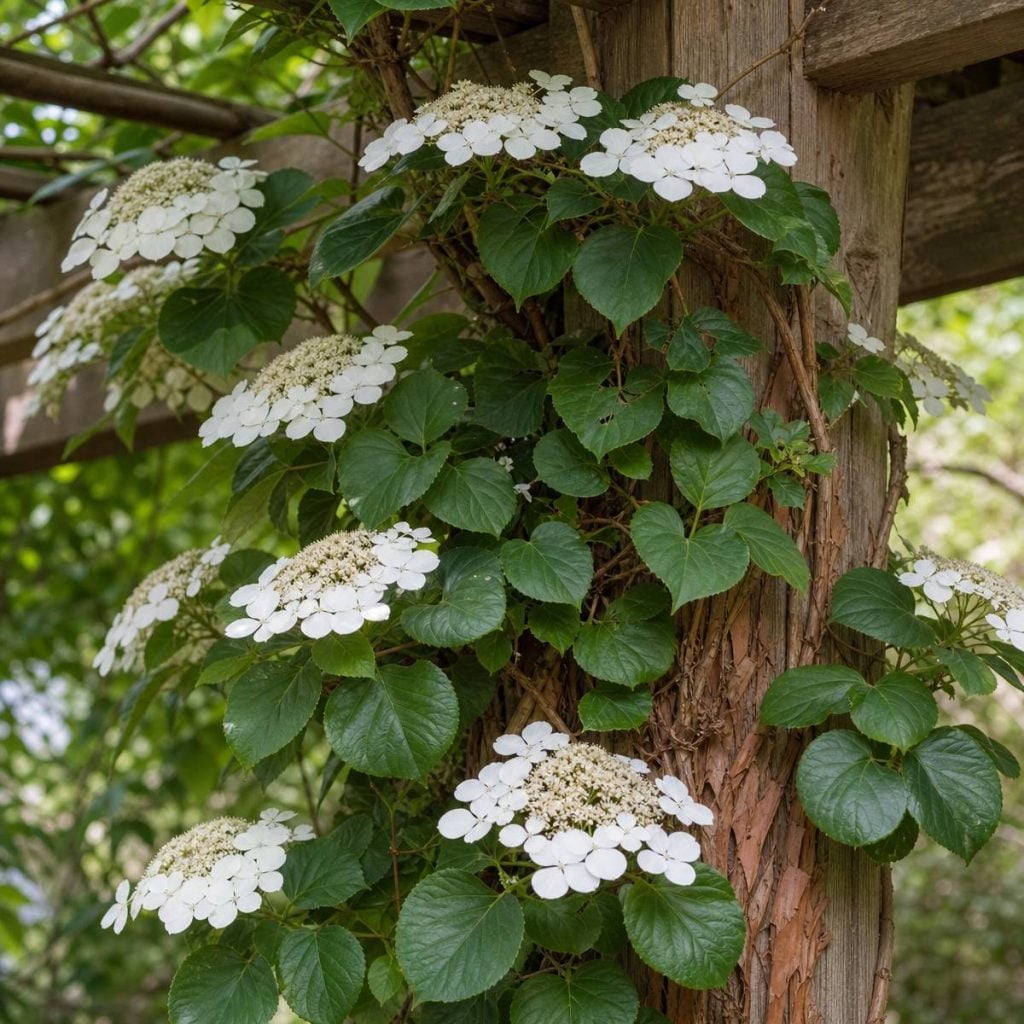
Be patient with it. It is somewhat slow to establish and slow to start flowering after transplanting, and it becomes large, so it needs ample support. Train young shoots onto wires or a trellis at first; after a season they form their own clinging roots.
Golden Hops
Golden hop (Humulus lupulus ‘Aureus’) is grown for its bright yellow leaves. It’s a strong-growing climber reaching 4 to 8 meters (about 13 to 26 feet), with deeply lobed yellow leaves and aromatic, cone-like flower clusters. A sunny spot gives the best leaf color, as long as the soil does not dry out.
Hops are herbaceous. The plant dies back at the end of the growing season and regrows from the roots, and common hop suits USDA Zones 5 to 8. Wear gloves: contact can cause dermatitis in some people, and golden hop is toxic to dogs if eaten.
Butterfly Pea
The butterfly pea, Clitoria ternatea, gets its name from its flower shape. It is not named for attracting butterflies, but because its bright blue flowers resemble them. It is a fast vine that can reach 15 feet, and the flowers, leaves, young shoots and tender pods are all edible.
It suits USDA Zones 10 to 12 and is usually grown as an annual in temperate areas. It prefers full sun and good drainage, can be a perennial in Central and South Florida, and should be treated as an annual farther north. It climbs weakly, so give it a trellis or wires to start.
Bleeding Heart Vine
For a vine with a bleeding heart look, try bleeding heart vine (Clerodendrum thomsoniae). University of Wisconsin Extension describes it as a twining evergreen vine from tropical West Africa, with balloon-like white calyxes and bright crimson flowers in clusters of 8 to 20. It can reach 10 to 15 feet in its native habitat, but it is a somewhat bushy climber, so give it a trellis or other support if you want it to climb. It also makes the vine list for Miami-Dade gardens, with a weak-stemmed habit and spectacular sprays of white bracts tipped with red flowers.
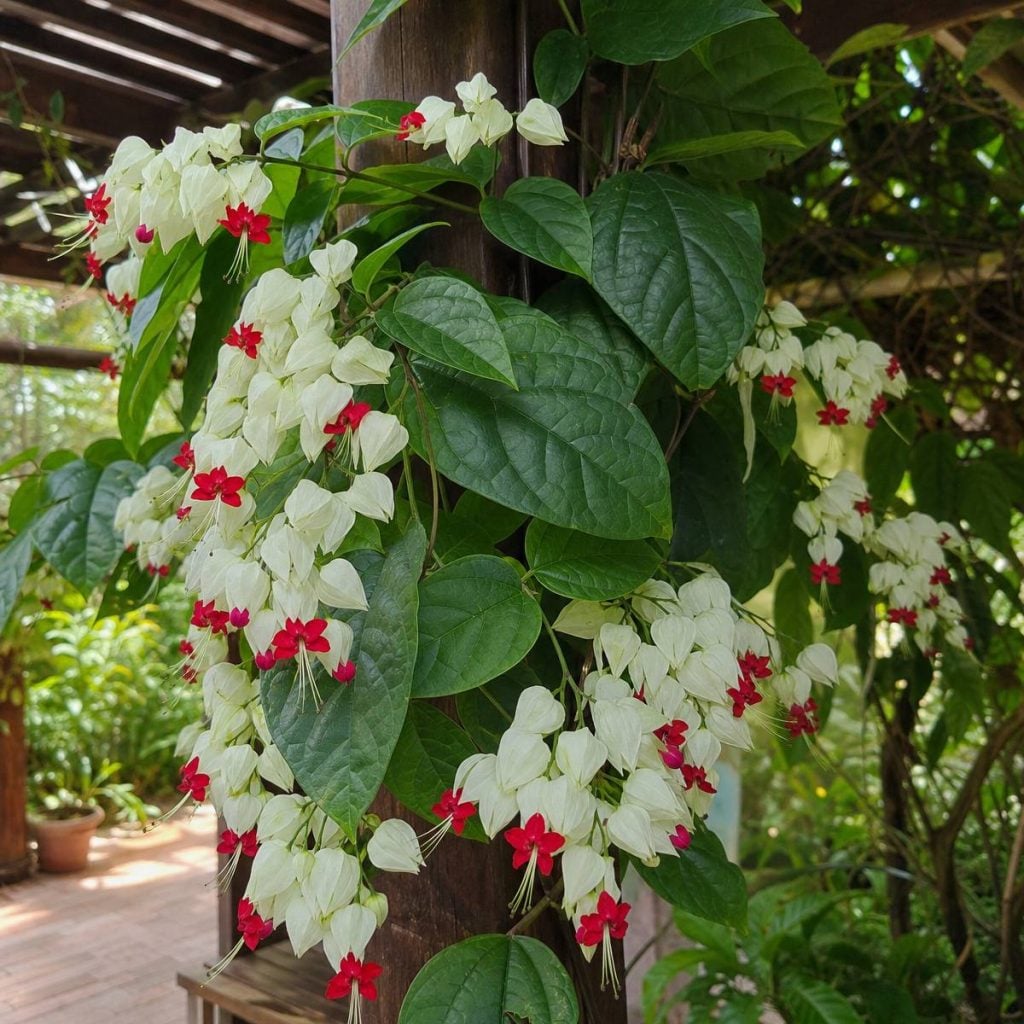
Sources differ on light. Some list it for full sun to partial shade and note that it flowers in shade, while others say it needs direct sun to bloom well. It is a tropical plant: it is root hardy to Zone 9a but needs protection from freezing, and potted plants should come inside when temperatures fall below 45°F. It blooms on new growth, so cut it back after flowering.
Don’t confuse it with the bleeding heart plant (Lamprocapnos spectabilis), the shade perennial with arching sprays of heart-shaped flowers. The two plants are not related, and the bleeding heart plant is not a vine, so it will not climb a pergola.
Perennial Sweet Pea
The perennial sweet pea (Lathyrus latifolius) is an old-fashioned climber. It grows up to 10 feet tall, blooms in summer, climbs by tendrils, and does well in full sun or light shade in evenly moist, well-drained soil. It suits USDA Zones 4 to 8 and has no serious pest problems.
Two cautions. It spreads by rhizomes and self-seeds and can become weedy, though it is easily controlled in a large pot. It is also poisonous and a problem for dogs, cats and horses, so keep the pea-like pods away from kids and pets.
Passion Flower
Our native passion flower, or maypop (Passiflora incarnata), is a great pergola vine. It is hardy in USDA Zones 7B to 11, with lavender or purple flowers 3 to 5 inches wide that last about a day each in summer and early fall. It is a host plant for gulf fritillary, variegated fritillary and zebra longwing butterflies.
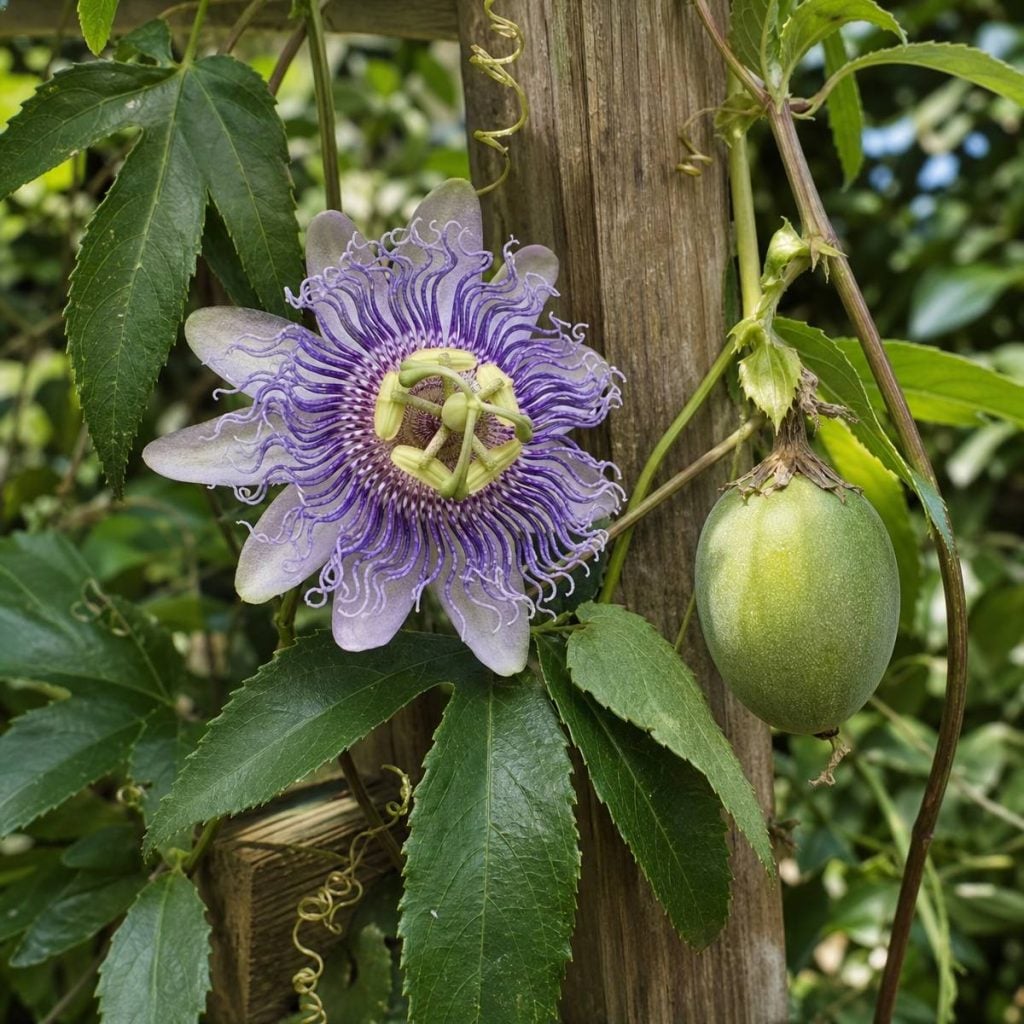
The pergola is one of its best uses, and it’s the hardiest of the passionflower vines. It also spreads by root suckers, and heavy pruning may be necessary to keep it in check. For more, read our detailed article on the exotic passionflower.
Lavender Trumpet Vine (Clytostoma callistegioides)
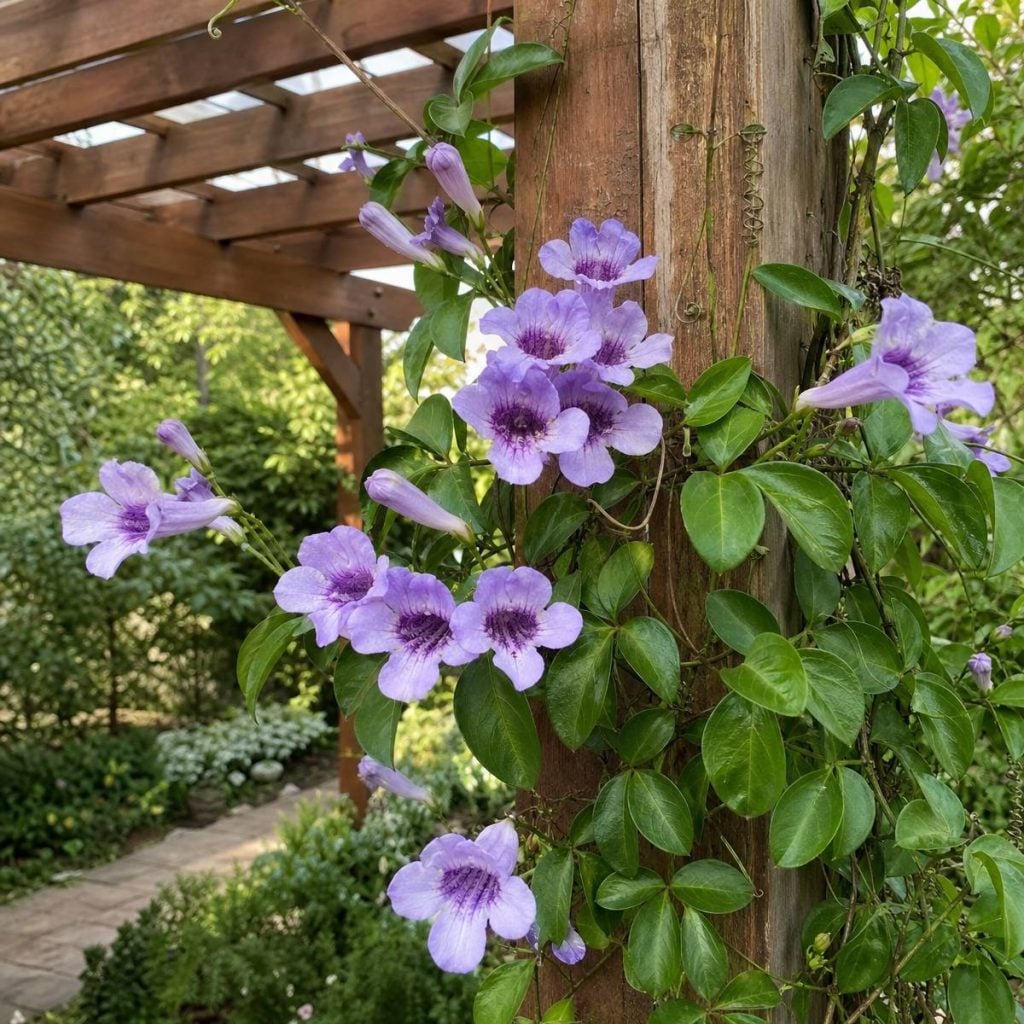
The lavender trumpet vine, also called violet trumpet vine, is a fast grower on the vine list for Miami-Dade gardens. It’s a robust evergreen, woody vine with glossy green leaves and 3-inch lavender to purple trumpet flowers, followed by large prickly seed pods. It grows in full sun to partial shade, attracts butterflies and hummingbirds, and needs lots of room, so it is best grown on a fence or pergola.
Zephirine Drouhin Rose
‘Zephirine Drouhin’ is a heirloom Bourbon climbing rose that is easy on the hands. It is almost prickle-free, has a strong, fruity fragrance, blooms from spring to fall and can grow up to 12 feet as a climber. Plant it near a patio or walkway, where you can enjoy the scent.
It tolerates shade and poor soil, but flourishes in warmer climates with full sun, steady moisture and rich soil. It is considered disease resistant, though it may still get black spot and powdery mildew. Like other climbing roses, don’t prune it for the first two to three years while the flowering canes develop.
Honorable Mention
A few more vines worth a look for a pergola:
- Carolina jessamine: a native evergreen vine with fragrant yellow flowers in late winter to early spring. It’s a lovely vine for pergolas that is fairly easy to keep in bounds, but all parts of the plant are poisonous, the sap can irritate skin, and it is not suitable for beekeepers.
- Crossvine: a native vine that climbs by tendrils and blooms in late winter to early spring. The early flowers are critical food for hummingbirds; pull up root suckers to keep it where you want it.
- Morning glory: a twining annual that can reach 6 to 10 feet in one season. It is considered invasive in some parts of the world.
- Mandevilla: one of the twining vines that work well in Florida gardens.
Which vine is climbing your pergola right now? Tell us in the comments!
Frequently Asked Questions
Is wisteria too heavy for a pergola?
It can be. Wisteria needs space and sturdy supports, and the stems of Chinese wisteria become twisted, trunk-like and massive over time. Even the less aggressive American wisteria is best grown on a sturdy surface to support its weight. Trumpet vine must also grow on sturdy structures because mature plants produce considerable weight.
What vines should I avoid on a pergola?
Avoid invasive vines. Chinese wisteria is listed as invasive in Florida, Japanese wisteria is predicted to be invasive and not recommended, and Japanese honeysuckle is prohibited in Florida and highly invasive. English ivy is no longer recommended either. Check with your county Extension office, since invasive lists differ by state.
What native vines grow well on a pergola?
Several native vines suit a pergola, including American wisteria, coral honeysuckle, Carolina jessamine and passion flower. Native does not mean low-care: American wisteria needs regular pruning and passion flower spreads by root suckers, and trumpet vine, also native, can form colonies that choke out other plants.
Can you grow grapes on a pergola?
Yes, but expect a trade-off. The pergola is one of the structures muscadine grapes can be trained on, with enough space and light. But an arch or pergola can make muscadines harder to maintain and fruit production may decline, because you need easy access to the vine’s arms for yearly pruning. Most muscadines are female, so pick a self-fertile cultivar if you have room for only one vine.
Which pergola vines do well in shade?
A few handle some shade. Climbing hydrangea grows in sun or shade, and bleeding heart vine can flower in shade, though it may need direct sun to bloom well. ‘Zephirine Drouhin’ rose tolerates shade but flourishes in full sun. Wisteria, coral honeysuckle, trumpet vine and bougainvillea all bloom best in full sun.