
Snake plants, also known as mother-in-law’s tongue, are favorite houseplants for good reason. They look sharp, they put up with a lot, and they suit beginners and seasoned plant people alike. UF/IFAS Extension calls the plant easy to grow and tolerant of a wide range of conditions.
Easy is not the same as automatic, though. Getting the basics right, especially light requirements and watering, keeps a snake plant looking its best for years. Here are 12 things worth knowing, including a couple most care guides skip.
1) Snake Plants Are Easy To Care For And Hard To Kill (Mostly)
Snake plants earn their tough reputation. NC State Extension describes the plant as durable, easily grown and difficult to kill, and UF/IFAS Extension says some varieties have been known to live 20 to 25 years.
They are not indestructible, though. Iowa State University Extension says the quickest, and sometimes the only, way to kill a sansevieria is to overwater it. We come back to that in number 9. NC State Extension also says to watch for mealybugs and spider mites.
Two cautions before you bring one home. First, pets. The ASPCA lists the snake plant as toxic to dogs and cats, names saponins as the toxic principle, and lists nausea, vomiting and diarrhea as the signs.
Iowa State University Extension says all sansevierias should be kept out of reach of children, dogs and cats. If you suspect your pet has eaten some, the ASPCA says to call ASPCA Poison Control or your local veterinarian.
Second, if you garden in Florida, keep it in a pot. In its north, central and south Florida assessment, UF/IFAS Extension rates this group of plants a high invasion risk, predicted to be invasive and not recommended by IFAS. A 2021 UF/IFAS article noted that the last assessment was issued in 2011.
A 2025 UF/IFAS article still says it is best to keep this plant in a pot indoors, because any part of the plant can regrow and no herbicides are currently labeled for controlling it.
2) Snake Plants Are Now Reclassified As Dracaena
Snake plants have a new scientific name. Recent DNA-based studies showed that the group once called Sansevieria sits inside the genus Dracaena, so botanists folded it in. UF/IFAS Extension puts it the same way: Sansevieria is now included in the genus Dracaena.
Snake plants are now officially Dracaena. The common snake plant, once Sansevieria trifasciata, is now Dracaena trifasciata, as NC State Extension lists it. Other snake plant species moved to Dracaena as well.
You will still see the old name in plenty of places, including some university and ASPCA pages. The name is what changed. The plant on your shelf is the same one.
3) Many Snake Plant Varieties And Cultivars Exist
Snake plants come in many shapes and sizes. Check out our article on 35 rare, unique varieties. The one most people know is Dracaena trifasciata, also called mother-in-law’s tongue.
NC State Extension lists a long run of cultivars. A few popular ones: the Laurentii variety is dark green with lighter zigzags and yellow edges. The Moonshine snake plant has silvery-gray foliage. ‘Black Gold’ is dark green with bright gold edging. And the Hahnii, also known as the Bird’s Nest snake plant, is a dwarf.
With so many choices, you can find a variety that fits your space and style.
4) Snake Plants Do Not Need Much Fertilizer
Snake plants do not ask much of you at feeding time. Iowa State University Extension says frequent fertilizing is not necessary, and that an all-purpose fertilizer at half or quarter strength in spring promotes healthy growth.
NC State Extension rates the growth rate as medium. For product ideas, see our guide to the best fertilizer for snake plants.
5) Snake Plants Flower, But Rarely Indoors
Snake plants do bloom. UF/IFAS Extension says mature plants can produce small, fragrant, greenish-white flowers in spring, followed by orange berries. It also says the flowers and fruit rarely appear on indoor plants, and NC State Extension agrees that a snake plant rarely blooms as a houseplant.
Iowa State University Extension says that with abundant light and good fertility, a sansevieria may produce flowers. Read more about snake plant flowers. If yours ever does bloom, enjoy it. It is a real treat.
6) Snake Plants Were Part Of The NASA “Air Purifying” Study
Yes, NASA tested snake plants. A 1989 NASA report lists mother-in-law’s tongue (Sansevieria laurentii) among a dozen common indoor plants chosen for screening. The chemicals studied were benzene, trichloroethylene and formaldehyde.
Your living room is not a lab chamber, though. Iowa State University Extension says the NASA study put houseplants in small sealed chambers, and that in reality these houseplants have little effect on air quality in the home or office.
Researchers who reviewed a dozen studies spanning 30 years in 2019 found that the air exchange in homes and offices dilutes these chemicals much faster than plants can remove them.
If cleaner air is your goal, the American Lung Association suggests cutting pollution sources and opening doors and windows for 10 to 15 minutes a day. Grow a snake plant because it is tough and good looking, not because you expect it to purify your air.
7) Snake Plants Do Not Mind Being A Little Crowded
Snake plants do not need frequent repotting. Iowa State University Extension says sansevieria does not mind being a bit crowded in its container, and that dividing the plant helps manage one that gets excessively pot-bound.
UF/IFAS Extension notes that wider-than-normal clay pots are often used for this tall, narrow plant so it does not topple over.
When you do repot, choose a pot with drainage holes that is only a little bigger than the current one. Iowa State University Extension recommends a well-drained potting soil, such as cactus mix or potting soil amended with perlite. Staying wet is what leads to root rot, which we cover in number 9.
8) It Is Easy To Grow New Snake Plants
Snake plants are simple to propagate. Iowa State University Extension describes two methods.
The first is leaf cuttings. Cut a leaf into sections 3 to 4 inches tall. The end closest to the base of the parent plant is the bottom.
Dip that end in rooting hormone, then insert it 1 to 2 inches deep into a moist rooting medium such as perlite. Iowa State says new shoots or plantlets should appear at the base in about two months.
The second is division. For a mature plant, separate the clumps or rosettes of leaves by cutting the thick underground rhizome, making sure each section has both roots and shoots.
There is one catch. Iowa State says variegated types with edged leaves, such as Laurentii, lose their coloration when grown from leaf cuttings, because that variegation comes from a chimera. Divide those instead to keep the pattern.
Be patient either way. If you share pups with friends, tell them to keep the plant in a pot. UF/IFAS Extension advises explaining how snake plants reproduce and keeping them in a controlled environment.
9) The Biggest Danger To Snake Plants Is Overwatering
Iowa State University Extension says that if plants stay wet, root rot develops, causing leaves to turn yellow and collapse, and eventually the plant dies. NC State Extension says careful watering is a must because overwatering can rot the roots.
So skip the calendar and watch the soil. Iowa State says to water only after the soil has completely dried out. NC State says to let it dry between waterings from spring to autumn and to water only every one to two months in winter.
UF/IFAS Extension says to cut watering back significantly from fall to late winter, and not to pour water into the center of the rosette.
Watch for leaves turning yellow or a plant that starts to droop and collapse. If you suspect root rot, unpot the plant, cut away mushy roots and repot in fresh, well-draining mix. Our guide to snake plant root rot walks through it.
10) Pruning Snake Plants Is Sometimes Needed
Snake plants need very little pruning. The main job is removing damaged or yellowing leaves so the plant looks its best.
Use clean, sharp scissors or pruning shears, and cut leaves close to the soil line for a neat look. Taking a whole leaf looks tidier than trimming part of one.
11) Upright And Bird’s Nest Types Of Snake Plants
Snake plants come in two main growth habits: upright and bird’s nest. Upright types have stiff, flat, sword-shaped leaves.
NC State Extension says the leaves of Dracaena trifasciata can be up to 4 feet long and 2 to 4 inches wide, and UF/IFAS Extension says indoor plants are often smaller, to about 2 feet tall.
Bird’s nest types like Hahnii stay much shorter. NC State Extension describes ‘Hahnii’ as a dwarf plant with 6 to 12 leaves forming a short, funnel-shaped rosette, and Iowa State University Extension says bird’s nest types typically have leaves less than 8 inches long.
Light is flexible for both. Iowa State University Extension says sansevieria tolerates low light levels very well.
12) Snake Plants Grow In High And Low Light Conditions
Snake plants are adaptable about light, which makes them versatile houseplants. Iowa State University Extension says sansevieria prefers bright, indirect light, meaning bright enough to cast a shadow but not in the sun’s direct rays. It also says plants tolerate low light very well, although leaf color and patterns can look muted.
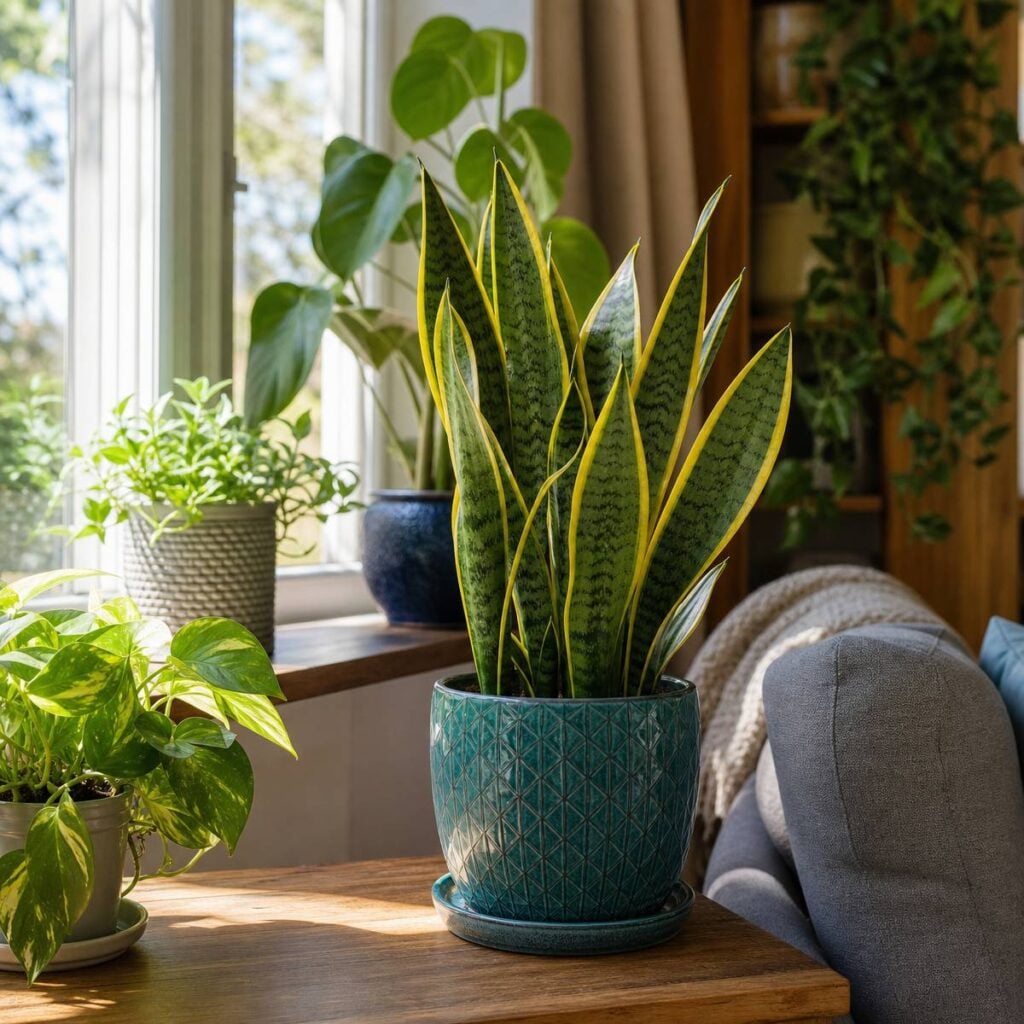
UF/IFAS Extension says snake plants prefer warm, sunny locations but tolerate some shade, and to protect them from hot afternoon sun.
NC State Extension suggests direct sun for only part of the day (2 to 6 hours) and says the plant tolerates very low light. In short, aim for a bright spot out of the harshest sun, and don’t worry if you can’t provide one. Our full guide to snake plant light requirements has more.
Average home temperatures suit them. Iowa State says they prefer it a little warmer, with 70 to 90 degrees F ideal, and NC State says they tolerate cool temperatures around 50 degrees. UF/IFAS Extension says indoor plants may be taken to shady outside locations in summer.
Which snake plant is on your shelf, and what surprised you most on this list? Tell us in the comments.
Frequently Asked Questions
Are snake plants toxic to cats and dogs?
Yes. The ASPCA lists the snake plant as toxic to dogs and cats, names saponins as the toxic principle, and lists nausea, vomiting and diarrhea as the signs. Iowa State University Extension says all sansevierias should be kept out of reach of children, dogs and cats. If you suspect your pet has eaten some, call your veterinarian or ASPCA Poison Control.
How often should I water a snake plant?
Only when the soil has dried out completely. Iowa State University Extension says to water after the soil has completely dried out, and NC State Extension says to let it dry between waterings from spring to autumn, then water only every one to two months in winter. Overwatering can lead to root rot.
Do snake plants really clean the air?
Not in a way you would notice at home. NASA’s 1989 study, which included snake plants, used small sealed chambers, and Iowa State University Extension says houseplants have little effect on air quality in a home or office. The American Lung Association suggests opening doors and windows for 10 to 15 minutes a day instead.
Is Sansevieria the same as Dracaena?
Yes, today it is. UF/IFAS Extension says sansevieria is now included in the genus Dracaena, based on molecular studies. NC State Extension lists the common snake plant as Dracaena trifasciata, previously Sansevieria trifasciata. You will still see the old name on some university and ASPCA pages.
Can I grow a variegated snake plant from a leaf cutting?
You can, but it will not stay variegated. Iowa State University Extension says cultivars with variegated leaf edges, such as Laurentii, lose their coloration when propagated from leaf cuttings. To keep the pattern, divide the plant by cutting the thick underground rhizome so each section has both roots and shoots.
.