
Do you plant tomatoes and hope for the best? Plenty of gardeners do. Tomatoes have a reputation as an easy crop, but a few habits separate a heavy harvest from a big, leafy plant with hardly any fruit.
Here are ten rules to follow, from choosing the plant to picking off hornworms. Each one is backed by university extension sources, and where those sources give different numbers, you’ll see the range.
1. Choose the Right Tomato for Your Space
Tomatoes come in two growth habits, and the choice shapes how you’ll care for them. Bush-type (determinate) plants stay compact and ripen their fruit over a short window, generally four to six weeks according to Iowa State. That makes them a good fit for canning or small spaces. UF/IFAS suggests a determinate variety if you’re limited on space, though it will produce a single crop.
Vining (indeterminate) plants keep growing, flowering and setting fruit until the first fall cold. Iowa State says their harvest often stretches over two to three months and yields are generally higher than determinate types. They also need a plan: Minnesota Extension says vining plants need support such as a tomato cage, stakes or a trellis, and Iowa State says to keep removing their suckers (see rule 7).
Bush types are a little more forgiving. Minnesota Extension says they don’t need pruning, staking or trellising, though UF/IFAS notes that most tomatoes benefit from staking or trellising to keep the fruit off the ground.
2. Harden Off Your Seedlings Before Planting
Don’t move indoor-grown seedlings straight into the garden. Maryland Extension says to begin hardening transplants one to two weeks before setting them out. Start in a shaded, protected spot on warm days and bring them in at night, then give them more sunlight each day. Keep them indoors on windy days or when temperatures are below 45 degrees F.
You can also water a little less often to slow growth, but don’t let the plants wilt.
3. Give Each Plant Room to Grow
Small seedlings look lonely, so it’s tempting to plant them close together. Resist. UF/IFAS lists 18 to 32 inches between supported plants in its Florida Vegetable Gardening Guide, Maryland Extension says 18 to 36 inches, and Minnesota Extension says to allow two to three feet in all directions between vining plants. Bush types can go closer together.
Crowding also cuts airflow. Minnesota Extension lists staking or trellising and spacing plants adequately apart as ways to increase airflow against early blight. Minnesota Extension says to stake or cage plants at the time of planting, and UF/IFAS says staking keeps the fruit off the ground.
4. Plant Tomatoes Where They Get Enough Sun
Tomatoes are sun lovers, and the numbers vary a bit by source. UF/IFAS’s Florida Vegetable Gardening Guide asks for at least six hours of direct sun for a vegetable garden, other UF/IFAS pages give four to six hours for tomatoes, and Maryland Extension says at least six hours, with eight to ten preferred. Aim for six or more, and give tomatoes the sunniest spot you have.
Learn more: Caring For Tomato Plants
5. Give Them Well-Drained Soil and Even Water
UF/IFAS says vegetables cannot tolerate standing water, so pick a well-drained site. A raised garden bed is one way to get there. Work in organic matter such as composted manure before planting. UF/IFAS Gardening Solutions gives an ideal soil pH of 6.2 to 6.5 for tomatoes and suggests a soil test through your local Extension office, the UF/IFAS Florida Vegetable Gardening Guide gives 5.8 to 6.3 for vegetable gardens on sandy soil, and Minnesota Extension calls a pH of 5.5 to 7 ideal.
Water deeply and evenly
UF/IFAS recommends about one to two inches of water per week, with a heavy soaking once a week preferred over several light sprinklings. Minnesota Extension calls one inch of rainfall or irrigation per week ideal. Try deep watering your tomatoes rather than a quick daily spritz.
Water at the base of each plant with drip irrigation, a soaker hose or careful hand watering, as Minnesota Extension advises. Keeping the leaves dry helps hold tomato blight in check. A layer of mulch helps too: UF/IFAS calls staking and mulching beneficial for tomatoes, and Iowa State says mulch conserves and maintains uniform soil moisture.
Watch for blossom end rot
Blossom end rot shows up as a dark, sunken, leathery patch on the bottom of the fruit. UF/IFAS calls it a localized calcium deficiency in the developing fruit, and says calcium is typically adequate in Florida soils, so other factors, including too little or too much soil moisture, are often the cause. Iowa State says it’s most often the result of erratic watering, and that adding calcium to the soil is generally ineffective. UF/IFAS adds that calcium sprays on the leaves don’t reduce it.
Your best defense is steady moisture from even watering and mulch. Iowa State also says to pick and discard affected fruit so the plant can put its resources into healthy fruit. Answered: Why Do Tomatoes Crack When Growing?
Wondering about Epsom salt for blossom end rot? See our guide to Epsom salt for tomatoes.
6. Feed Your Tomatoes, But Don’t Overdo the Nitrogen
Nutrients matter, but more is not better. Minnesota Extension says too much nitrogen fertilization leads to plants that are bushy, leafy and slow to bear fruit. UF/IFAS says blossom drop is usually due to too high or too low temperatures and/or excessive nitrogen fertilization, and Iowa State says excess nitrogen may contribute to blossom end rot.
For a
7. Prune Vining Tomatoes Regularly
Pruning helps plants direct more energy to flowering and fruiting, and it lets in more light and air, which reduces disease issues, according to Iowa State. The main job is removing suckers, the small stems that grow between the main stem and a leaf. For indeterminate tomatoes, Iowa State says to keep removing suckers as they form all along the main stem. UF/IFAS suggests removing the first few side branches as they appear and leaving two to three main stems.
Snap suckers off while they’re small, less than a few inches long. For determinate tomatoes, Iowa State says to remove suckers only up to the first cluster of flowers (Minnesota Extension, by contrast, says bush types don’t need pruning). Clean your hands or tools between plants, or every few plants, to avoid spreading disease. Our step-by-step guide shows how to prune tomatoes.
8. Spot and Treat Early Blight Promptly
Early blight is a fungal disease. Minnesota Extension says it starts as small dark spots on older foliage near the ground, and the round brown spots can grow up to half an inch across with target-like rings. Lower leaves become infected when they touch contaminated soil or when raindrops splash soil onto them.
Cultural steps come first. Mulch the soil under the plants, water at the base, keep airflow good, and prune the bottom leaves so spores can’t splash up. Remove leaves with spots, and wash and sanitize pruning tools after touching infected plants. Minnesota Extension says it’s okay to remove up to one-third of the leaves if you catch it early, but not more than that.
Fungicide is not always the answer. Minnesota Extension says most home gardeners don’t need to treat tomatoes with a fungicide, because tomato plants can tolerate a lot of early blight without producing fewer tomatoes. If you do spray, apply it according to the label.
Then rotate. The early blight pathogens overwinter in infected plant debris and soil, so don’t plant tomatoes back in the same spot. Minnesota Extension says to let two years pass in its early blight guide, and its tomato-growing guide says to choose a spot where tomatoes, potatoes, peppers, eggplants and tomatillos haven’t grown for the past three or four years.
9. Control Tomato Hornworms
Big green caterpillars with a horn on the rear can strip a plant. UF/IFAS says tomato hornworms can eventually cause complete defoliation if they are not removed, and that they have also been known to feed on green, developing fruit. Minnesota Extension suggests checking plants at least twice a week in summer. Learn more about green tomato worms.
Hand-picking is the first move. Minnesota Extension calls it the most effective means of managing them, and suggests dropping the caterpillars into soapy water. If you see white, rice-like cocoons on a hornworm, those are parasitic wasp cocoons. Minnesota Extension says to leave that hornworm in the garden so the adult wasps can emerge and go after more.
If hand-picking isn’t practical, Bt (Bacillus thuringiensis) is a biological option. UF/IFAS says caterpillars must eat it for it to work and that it can wash off in rain or irrigation, so repeat applications may be needed. Minnesota Extension says Bt is specific to caterpillars and does not affect other insects, including bees, and that it works best on very young caterpillars. Always follow the label. Natural enemies like lady beetles, green lacewings and paper wasps also help, so protect your other beneficial insects, and till the soil after harvest to destroy pupae.
10. Plant a Mix of Varieties So Fruit Ripens at Different Times
Planting a mix spreads out the harvest so you’re not buried in tomatoes all at once. Iowa State says early-season tomatoes need 65 or fewer days from transplanting to harvest, mid-season tomatoes 70 to 79 days, and late-season tomatoes more than 80 days.
Shape and size help you match the tomato to the job. Iowa State describes standard (slicing or globe) tomatoes, large beefsteaks that can top a pound, bite-sized salad tomatoes like cherry and grape types, and paste (Roma or plum) tomatoes with thick flesh that make good sauces and paste. ‘Cherokee Purple’ is one colorful indeterminate heirloom to try.
Good Care Yields Good Tomatoes
Tomatoes are fairly easy to grow when you get the basics right: enough sun, room to grow, even water, careful feeding, pruning for vines, and a close eye out for blight and hornworms. Keep these ten rules handy as you plan, plant and harvest your tomato patch.
Frequently Asked Questions
What are the most important tips for growing tomatoes?
Give them your sunniest spot (sources range from four to six hours up to at least six hours of direct sun), well-drained soil, and even watering of about one to two inches a week. Support vining types, don’t overdo nitrogen, and keep leaves dry to hold early blight down. Those habits cover most of the ground, and the ten rules above show how each one works.
How much sun do tomatoes need?
Aim for at least six hours of direct sun. UF/IFAS’s Florida Vegetable Gardening Guide asks for at least six hours for a vegetable garden, other UF/IFAS pages give four to six hours for tomatoes, and Maryland Extension says at least six with eight to ten preferred. Give tomatoes your sunniest spot.
Do tomato plants need pruning?
Vining (indeterminate) tomatoes do, and bush (determinate) types need little or none. Iowa State says to keep removing suckers along the main stem of indeterminate plants and only up to the first flower cluster on determinate ones, while Minnesota Extension says bush types don’t need pruning. Pinch suckers while they’re small. Here’s how to prune tomatoes.
How much and how often should I water tomatoes?
Plan on about one to two inches of water a week, given as a heavy soaking rather than several light sprinklings. UF/IFAS prefers one heavy soaking a week, and Minnesota Extension calls one inch of rainfall or irrigation per week ideal. Water at the base of the plant, not over the leaves, and mulch to keep moisture steady. See deep watering tomatoes.
What causes blossom end rot on tomatoes?
A calcium shortage in the developing fruit, most often tied to uneven watering. UF/IFAS says calcium is typically adequate in Florida soils, so too little or too much soil moisture is often the cause, and calcium sprays on the leaves don’t help. Keep moisture steady with even watering and mulch, and pick off affected fruit.
Let me ask you a question. When planting tomato plants, do you follow any “rules” or simply plant and hope for the best?
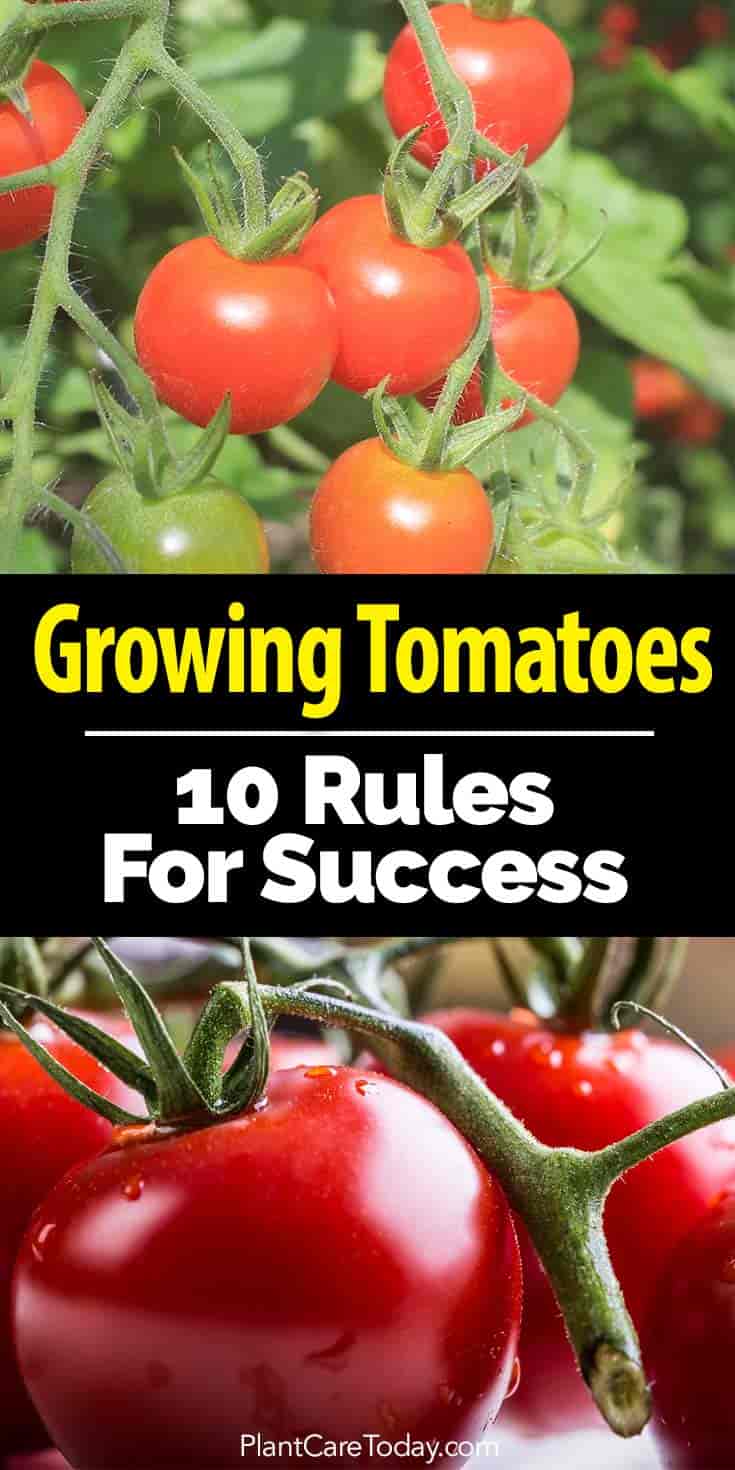
Garden tomatoes are just as tasty to insects and birds as they are to us, and low-hanging tomatoes can even become lunch for terrapins!
Although many people believe tomatoes are a foolproof crop, the fact is you do need to know a thing or two to grow tomatoes successfully.
In this article, we will share ten smart tips and techniques many successful gardeners follow when planting their tomatoes.
Not following these tips and techniques are the mistakes many gardeners make!
Hopefully, you’ll be on your way to growing the best tomatoes.
Make Sure To Select the Right Tomatoes for Your Growing Conditions
It’s important to be realistic about the space you have. If you have only limited space or are doing container gardening, you will want to select determinant tomatoes. These are tomatoes that only grow to a given size.
Patio tomatoes are a good example. This type of tomato has a thicker stalk that can support the weight of the plant and fruit without a tomato cage or trellis. Additionally, this type of plant never needs to be pruned because it only grows to a specific size.
If you have lots of space, you will want to select indeterminate tomato plants. These will keep them growing until they run out of space.
They need quite a bit of attention and care because you must stake them or place a cage around them to provide support. You must also prune tomatoes to encourage good growth and discourage fungus.
In terms of production, indeterminate plants produce more and have a longer producing season. Determinant plants are somewhat limited in the number of tomatoes they will produce and the length of time that they can produce.
Do You “Harden” Your Seedlings Before Planting Tomatoes In The Garden?
You cannot simply set your tomato seedlings outside in the garden and expect them to survive. They need to be introduced to the elements gradually to become used to and hardened to them. This acclimation process takes several days.
Begin when your tomato seeds are approximately a month old. Set them out in indirect light for a few hours on a mild day. They should not be exposed to rain, harsh sunlight, or excessive temperatures (either hot or cold).
Give your seedlings a little more time outdoors daily for a week to ten days. At the end of this time, they should be hardened and prepared for life outdoors.
Be Sure To Provide Enough Space For The Tomato Varieties You’re Growing
Planting tomatoes close together is very tempting when the plants are small.
Remember that from the time they are seedlings until they are mature, they will put on several feet of growth both upwards and from side to side.
If you plant these tomato cultivars too close together, they will not be able to attain their full potential. They will become stunted.
Each of your tomato plants should have its own tomato cage for support. These tomato cages should be placed 1- 1/2 to 2 feet apart. This placement will give your plants plenty of space to sprawl and grow while being firmly supported by the surrounding cage.
Ensure adequate support for each plant to prevent the leaves or fruit from touching the ground. This can cause blossom-end rot which can lead to the death of your tomato plant.
The Many Ways You Can “Cage” Tomatoes: Video
Do You Plant Your Tomatoes In Enough Sun?
All fruit-producing plants need at least seven hours of bright sunlight daily.
Plants depend upon the sun’s light for photosynthesis, which feeds the plant and helps it produce abundant amounts of fruit.
If your tomato plants do not get enough sun, they’ll be attractive and leafy; however, they will not produce a good tomato crop.
Learn More on: Caring For Tomato Plants
Does The Soil Provide Adequate Drainage For Your Tomatoes?
Because tomatoes are so prone to fungal infection, your tomato bed must be well drained.
Your potting soil should be light and airy, slightly acidic, and enriched with compost. A raised garden bed is ideal for tomatoes because water is unlikely to pool and cause rotting roots.
Water Tomatoes Correctly Will Improve The Yield!
Be sure to establish a regular watering schedule for your tomato plants. Consider deep watering your tomatoes. Provide a couple of inches of water directly to the soil once a week when the sun is out.
Avoid spraying the leaves because this can cause tomato blight and blossom end rot. You want to keep your tomato leaves and main stem dry and the well-drained soil beneath the plants moist.
A soaker hose is a good investment for your tomato patch.
Answered: Why Do Tomatoes Crack When Growing?
Do You Provide The Right Amount Of Fertilizer For Your Plants?
It is just as detrimental to allow nutrients to build up excessively in your soil as it is to deplete them excessively.
If you provide too much fertilizer, nitrogen may build up in the soil and cause your tomato plants to produce lots of lovely leaves but no tomatoes.
When you shop for fertilizer, purchase types specially made for tomato plants. Alternately, use only all-natural compost.
Do You Know: How To Read Fertilizer Numbers
Reasons Why You Should Prune Your Tomatoes Regularly
Indeterminate tomatoes need to be pruned occasionally because disease and fungus can run rampant when they are overcrowded.
The reason for this is that water tends to accumulate in crowded plants. You must prune regularly to provide good air circulation to keep your leaves and stems dry.
Additionally, when you do not prune your tomato plants, they use up many of the nutrients you provide to grow leaves instead of tomatoes. This is not what you want!
Be sure to prune off sucker stems larger stems to produce more and larger fruit.
Keep Eyes Peeled To Treat Early Blight Promptly and Properly
Early Blight is a fungal infection that strikes tomatoes especially hard. As mentioned, the fungus can be the result of overcrowding.
If you notice damaged (blighted) leaves on your tomato plants, you must prune them off. Be sure to sterilize your shears after pruning so that you do not spread blight from one plant to another.
Always keep your eyes peeled for early blight (browning of the leaves).
It appears on the lower leaves first and moves up the plant. If you are not diligent, you may not notice it. Watch carefully, prune as necessary, and use organic fungicides to discourage blight development.
If you have problems with early blight one year, do not plant tomatoes in that area the next year. The reason for this is that this fungus can survive in the soil through the winter.
Aside from this, it is always a good idea to rotate your crops so that your soil does not become entirely depleted of any given nutrient.
Be Sure To Control Tomato Worms
A tomato hornworm infestation can devastate your entire crop. Keep a close eye out for these caterpillar invaders.
When you see them, pick them off by hand and dispose of them properly and in a way that will prevent them from returning.
While spraying your tomato plants with insecticide to kill green tomato worms may be tempting, try to resist this temptation.
Remember that the tomatoes your plants produce will also be affected by that insecticide and so will you! Additionally, insecticide kills insects, including bees, butterflies, pest-devouring praying mantis, and other beneficial insects.
Plant A Wide Variety Of Tomatoes To Have Fruit Ripening At Different Times
It’s smart to plant several different varieties of tomatoes that ripen at different times. This way, you will not be deluged with a bumper mono-crop of tomatoes all at once.

Instead, you will have choices among several types of tomatoes throughout the growing season.
Different types and sizes of tomatoes are better suited to a variety of purposes.
For example, beefsteak tomatoes are better suited sliced on sandwiches, while cherry tomatoes are great for snacking.
Plum tomatoes are excellent for cooking and Cherokee Purple makes a colorful and flavorful addition chopped up in a salad.
Good Care Yields Good Tomatoes
As garden veggies go, tomatoes are fairly easy to care for; however, you must follow a few guidelines for best results. Refer to the ten handy tips presented here as you plan, plant, and harvest your tomato patch!