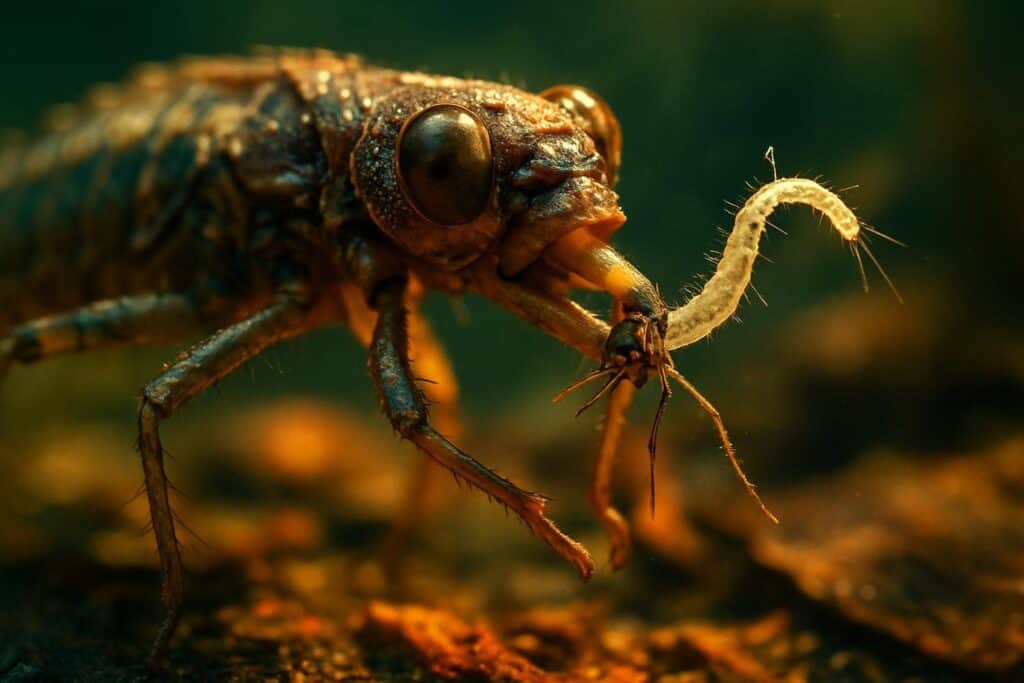
40 mosquito larvae eaten daily by a single larva — 31 studies, 47 species, one result: 45% of the larvae in its water are gone by sundown.
A dragonfly larva eliminates roughly 45% of the mosquito larvae sharing its water body every single day. That figure comes from a 2023 meta-analysis in the Journal of Animal Ecology by Priyadarshana and Slade, synthesizing 31 studies across 47 dragonfly and damselfly species. The hovering adult everyone photographs is not the primary threat to mosquitoes. The threat lives in the mud beneath the surface.
What makes the larval stage so effective isn’t appetite alone — it’s architecture. The larva carries a modified lower lip called a labium, folded tight under its head until the moment it fires. That mechanism turns a motionless ambush predator into something mosquito larvae have almost no time to register.
The Extendable Labium: How the Larva’s Jaw Actually Works
The labium folds back against the underside of the larva’s head between strikes. When prey drifts close enough, the labium launches outward to snare it — a mechanism fast enough that mosquito larvae in the same water have little behavioral response time. The larva itself stays still. It is a sit-and-wait predator, not a chaser, which makes the jaw extension its entire offensive strategy.
What the 2023 Meta-Analysis Actually Measured
Priyadarshana and Slade pulled data from 31 studies covering dragonfly and damselfly larvae preying on Aedes, Anopheles, and Culex mosquitoes from 14 countries. In experimental containers where mosquito larvae were the available prey, the mean daily consumption held at 40 larvae per larva. The 45% population reduction figure follows directly from that consumption rate relative to the starting larval densities in those containers. Both numbers are specific to controlled conditions — prey density, water volume, and the absence of competing food sources all influence results in open water.
What Dragonfly Predation Does and Doesn’t Do for Mosquito Control
Locally, in small ponds or containers, a resident larva can make a measurable difference in mosquito larval density. Mosquito control agencies, including the Collier Mosquito Control District, describe dragonflies as partners in a broader ecological network rather than stand-alone controllers. A single larva eating 40 mosquito larvae daily does not overcome the scale of continuously replenished mosquito populations across large wetland systems. Dragonflies share that food web with fish, aquatic insects, spiders, bats, and birds — and their presence tends to signal healthy water quality in the surrounding habitat, making them indicators as much as predators.
The larva that eventually becomes a jewel-winged adult may spend one to four years underwater first. By the time it emerges, it has already done considerable work. The wings come later. The hunting started long before.
Frequently Asked Questions
How many mosquito larvae does a dragonfly larva eat per day?
A 2023 meta-analysis found an average of 40 mosquito larvae per day, with a 95% confidence interval of 20 to 60.
What is the extendable jaw on a dragonfly larva?
It is a modified lower lip called a labium that folds under the head and shoots forward to grab prey.
Can dragonflies control mosquito populations on their own?
No. Mosquito control agencies note that dragonflies contribute to biological control but cannot substantially reduce large, continuously replenished mosquito populations alone.
Do the 40-larvae-per-day figures apply in natural ponds?
The figures come from controlled container experiments. Real-world consumption varies with prey density, species, temperature, and competition from other food sources.