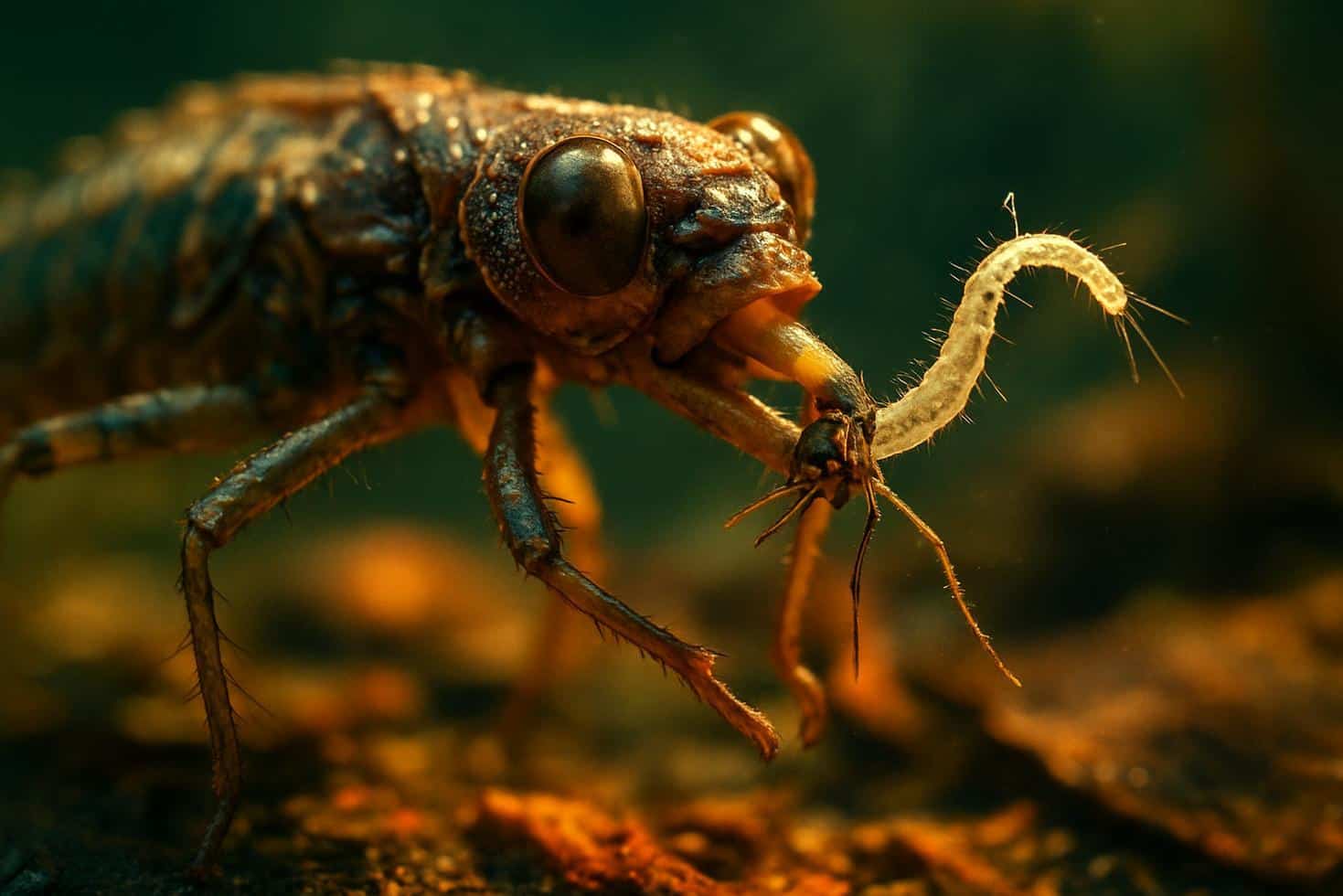
The dragonfly you see skimming over a pond isn’t the one doing the real damage to the mosquito population. That happens earlier, underwater, where the larva — called a naiad — spends most of its life as an ambush predator. It wields one of the strangest hunting tools in the insect world.
The Extendable Labium: How the Strike Actually Works
A dragonfly naiad’s lower lip, called the labium, folds back against the underside of its head between strikes. When prey drifts within range, the naiad doesn’t chase it. It stays still, fires the labium forward, and snares prey with two hooked claws at the tip before pulling it back to the mouth.
The strike isn’t muscle-powered like a punch; it’s hydraulic. Abdominal muscles raise the naiad’s internal body pressure. When a mechanical “click” at the base of the labium releases, that pressure drives the strike forward.
It moves fast enough that prey has very little time to react (Tanaka & Hisada, 1980, Journal of Experimental Biology). It’s the original mechanical study behind what people now describe as a “spring-loaded” strike.
More recent high-speed video studies clock the full extension-and-grab at well under a quarter of a second in some species.
What the 2023 Meta-Analysis Actually Found
The most-cited number on dragonfly/mosquito predation comes from a real 2023 meta-analysis by Priyadarshana and Slade, published in the Journal of Animal Ecology. They pulled data from 31 separate studies, totaling 485 effect sizes.
Those studies covered 47 species of dragonfly and damselfly naiads preying on nine species of mosquito larvae across three genera (Aedes, Anopheles, and Culex), from 14 countries.
The result: in experimental containers, a single naiad ate an average of 40 mosquito larvae per day (95% confidence interval: 20–60). That translated to roughly a 45% reduction in the mosquito larval population sharing that water per day (95% CI: 30–59%) (Priyadarshana & Slade, 2023).
Predation success didn’t vary much by mosquito species or by which larval stage was targeted.
That’s a real, solid number. But notice the setting: experimental containers, where mosquito larvae were often the only prey on offer. That matters for the next part.
Mosquito Larvae Aren’t the Only Thing on the Menu
Naiads aren’t mosquito specialists. University of Florida’s own entomology reference describes them as “voracious predators feeding on everything from small invertebrates such as mosquito larvae to smaller vertebrates such as fish and frogs” (UF/IFAS, EENY355).
Iowa State University Extension describes the same broad diet — “other insects, worms, tadpoles and even small fish” (Iowa State Extension). Mosquito larvae are a real, documented prey item, not a myth. But in an actual pond, a naiad eats whatever’s available and easiest to catch. It isn’t hunting mosquitoes specifically.
Can Dragonflies Actually Control Mosquito Populations?
Not on their own. Mosquito control agencies are direct about this. The Collier Mosquito Control District in Florida addressed this exact question and cited the same 2023 meta-analysis.
A naiad eating 40 mosquito larvae a day “might sound impressive, but what works in the lab doesn’t always hold up in the real world” against wetland mosquito densities that can reach an estimated 2 billion larvae per acre in their district.
The district also points to a real field trial in Maine, where a mosquito control program tried stocking dragonfly naiads directly into breeding sites. The result was “no noticeable difference in mosquito larvae between treated and untreated areas” (Collier Mosquito Control District, 2025).
Their conclusion, and a fair one: dragonflies are “excellent partners in an integrated mosquito management program,” not a stand-alone fix.
If you’re dealing with a real mosquito problem near standing water, that’s a genuinely useful distinction from mosquito-repelling plants. Most of those rely on repellent compounds that only work once extracted and concentrated, not from a plant just sitting in a pot.
Dragonfly larvae predation is a real, measured, peer-reviewed effect. But like the plants, it’s one piece of managing mosquitoes around your yard, not a substitute for dumping standing water and using a registered repellent when you actually need one.
How Long Do Dragonfly Larvae Live Underwater?
It varies more than a single number suggests. Iowa State University Extension puts it at “several months…up to as long as three years.” UF/IFAS notes Florida’s naiads typically live in water “for up to two years.”
Species in colder climates can take longer still. Either way, the larval stage is where a dragonfly spends nearly all of its life. The flying, mate-finding adult you actually notice is a comparatively brief final act after months or years of underwater hunting.
Frequently Asked Questions
How many mosquito larvae does a dragonfly larva eat per day?
A 2023 meta-analysis of 31 studies found an average of 40 mosquito larvae per day (95% CI: 20–60), in experimental containers where mosquito larvae were the available prey.
What is the extendable “jaw” on a dragonfly larva?
It’s not technically a jaw — it’s a modified lower lip called the labium. It folds under the head between strikes and fires forward on hydraulic pressure to grab prey.
Can dragonflies control mosquito populations on their own?
No. Mosquito control agencies, including Florida’s Collier Mosquito Control District, describe dragonflies as valuable partners in mosquito management, not a stand-alone solution — real-world mosquito densities far outpace what naiads can eat.
Do dragonfly naiads eat only mosquito larvae?
No. University extension sources describe a broad diet that includes other aquatic insects, worms, tadpoles, and even small fish. Mosquito larvae are a real, documented prey item, not their sole food source.
Frequently Asked Questions
How long do dragonfly larvae live underwater?
It varies. Iowa State University Extension says naiads live in the water for several months or up to as long as three years, while UF/IFAS says they live in water for up to two years. Those figures come from different places and species, so there isn’t one number that fits every dragonfly larva.
How does a dragonfly larva catch its prey?
A naiad folds its lower lip, the labium, back under its head between strikes. When prey is in range, the labium shoots forward and snares the prey with two hooked claws. A 1980 study by Tanaka and Hisada found the strike is hydraulic: raised body pressure drives it once a click mechanism releases.
What did the 2023 meta-analysis find about dragonfly larvae and mosquitoes?
The meta-analysis pooled 31 studies and 47 species of dragonfly and damselfly naiads preying on nine species of mosquito larvae, from 14 countries. In experimental containers, one naiad ate an average of 40 mosquito larvae per day (95% CI: 20–60), about a 45% reduction per day (95% CI: 30–59%).
Does stocking dragonfly larvae reduce mosquitoes in a real yard or wetland?
Not in the field trial the Collier Mosquito Control District describes. A Maine program stocked dragonfly naiads into breeding sites and found no noticeable difference in mosquito larvae between treated and untreated areas. The district calls dragonflies excellent partners in integrated mosquito management, not the main act.
Do dragonfly larvae eat only mosquito larvae?
No. UF/IFAS describes naiads as voracious predators feeding on everything from small invertebrates such as mosquito larvae to smaller vertebrates such as fish and frogs. Iowa State University Extension lists other insects, worms, tadpoles and even small fish. Mosquito larvae are a documented prey item, but not the only one.