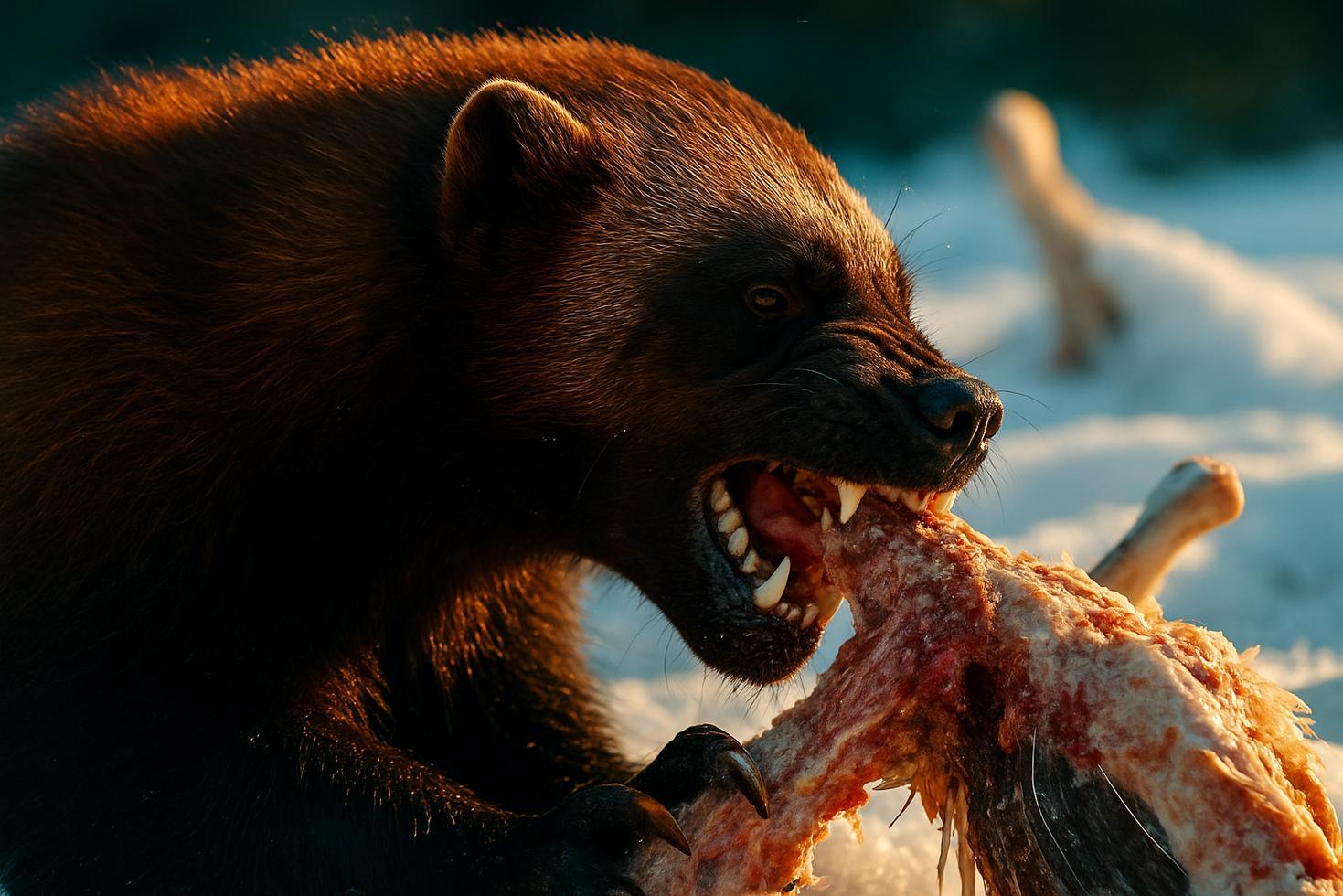
One upper molar rotated 90 degrees. A jaw force of 940.8 N — more than a cheetah. Winter’s frozen carcasses don’t stand a chance.
A wolverine carries a rear upper molar rotated 90 degrees from its normal orientation, pointing inward rather than lying flat, converting what would be a grinding surface into a bone-splitting wedge. That single anatomical feature, paired with a mandibular condyle compressive force of 940.8 N, gives an animal of roughly 30 pounds access to frozen carcasses that no comparably sized predator can breach.
That number deserves a second look. A cheetah generates 784.4 N at the jaw joint. A honey badger — itself famous for outsized toughness — produces 710.8 N. Both animals outweigh the wolverine. The wolverine outperforms them anyway.
How the Rotated Molar Actually Works as a Bone-Cracker
Most carnivore molars lie horizontal, optimized for shearing or grinding. The wolverine’s rotated upper molar reorients that surface so it contacts bone at an angle that concentrates force into a narrow point. a wedge splitting frozen tissue rather than a flat surface pressing against it.
The result is access to marrow locked inside bones that have frozen solid. Marrow is calorie-dense and largely inaccessible to scavengers without this kind of mechanical advantage. In subarctic winter, that difference is the meal versus no meal at all.
Wolverine Jaw Force Compared to Larger Carnivores
The 940.8 N figure comes from mandibular condyle compressive force measurements — the load the jaw joint itself must bear during biting. Comparing across species at that joint normalizes for differences in skull geometry.
At that metric, the wolverine outperforms the cheetah by roughly 156 N and the honey badger by 230 N. A Malagasy civet scores 714.4 N. jaw-joint load exceeding all four comparably studied species is what the data actually shows for the wolverine.
This is a size-to-force ratio that makes more sense when the rotated molar is in the picture. The tooth geometry channels mechanical stress efficiently, which means the joint bears more load because the bite is doing more concentrated work.
Why This Anatomy Matters in Subarctic Scavenging
Wolverines operate across Arctic and subarctic landscapes where carcasses freeze hard within hours of an animal dying. Most scavengers either wait for a thaw or abandon the resource entirely.
The wolverine’s dentition doesn’t require a thaw. Its broad feet aid movement over deep snow, and its wide-ranging solitary foraging behavior means it covers ground in search of exactly these frozen resources. The jaw is the tool that makes the carcass worth finding.
No other mustelid of comparable size carries this combination of rotated molar geometry and joint-load capacity.
Pat has spent four decades watching animals do things that shouldn’t work on paper. The wolverine’s jaw is the clearest case: a single rotated tooth reshaping what’s possible at 30 pounds. The math shouldn’t work. The molar makes it work.
Frequently Asked Questions
How much force does a wolverine’s jaw produce?
Mandibular condyle compressive force in wolverines measures 940.8 N, exceeding both the cheetah (784.4 N) and honey badger (710.8 N).
What is special about the wolverine’s molar?
The rear upper molar is rotated 90 degrees, pointing inward rather than lying flat, which concentrates bite force into a wedge-like point useful for splitting frozen bone.
Can wolverines really crush frozen bone?
Yes. Their dentition, including the rotated molar, is adapted specifically to tear frozen meat and crush bone to access marrow in subarctic winter conditions.
Are wolverines apex predators?
Wolverines function as powerful carnivores and scavengers in Arctic and subarctic food webs, but “apex predator” is context-dependent and not a universal scientific classification for the species.