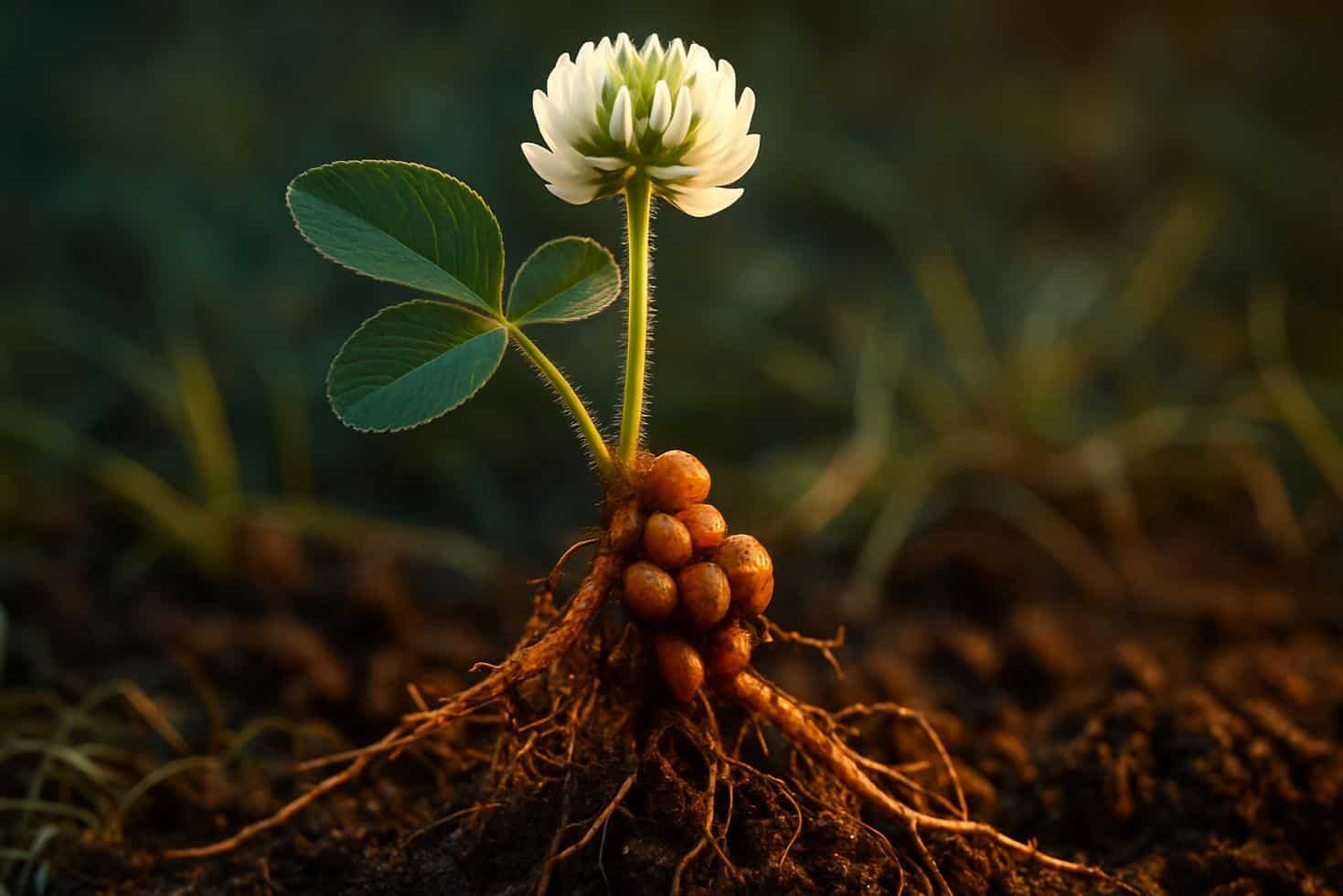
White clover fixes 50–150 kg of nitrogen per hectare yearly through root bacteria — feeding surrounding grass at no cost — until 1950s herbicides made it collateral damage of a different product entirely.
White clover (Trifolium repens) was a deliberate ingredient in North American lawn seed mixes through the early 20th century — not an accident, not a weed. The shift came in the 1950s and 1960s when selective broadleaf herbicides like 2,4-D arrived on the consumer market. Clover wasn’t removed because it stopped working. It was removed because the chemistry couldn’t tell it apart from a dandelion.
What the seed catalogs understood, and what the herbicide era quietly buried, is that clover runs a nitrogen-fixing operation in the soil below the lawn. Specialized rhizobia bacteria colonize tiny nodules on clover’s roots, where they convert atmospheric nitrogen gas into ammonia and organic forms the soil can use. Mixed grass-clover swards can fix 50–150 kg of nitrogen per hectare per year, depending on clover density, soil conditions, and management.
How White Clover’s Root Bacteria Actually Fix Nitrogen
The process is microbially mediated, not something the plant does on its own. Rhizobia bacteria require the enzyme nitrogenase, ATP, and reducing power to crack the strong triple bond in atmospheric N₂. The fixed nitrogen enters the plant first, then moves into the surrounding soil through root exudates, nodule turnover, leaf drop, and grass clippings returned after mowing. The pathway from air to soil is indirect and gradual — not instant — but over a growing season, the cumulative nitrogen contribution is substantial enough to measurably reduce external fertilizer requirements in mixed swards.
Why the 1950s Herbicide Transition Mattered for Lawn Clover
Selective herbicides targeting broadleaf plants were a genuine agricultural advance. But “broadleaf” is a botanical category, not an ecological value judgment. White clover — a legume, not a grass — qualified as a broadleaf target. Lawn seed companies responded by removing clover from mixes so that homeowners could spray without patchy die-off. The plant wasn’t failing the lawn. It was inconvenient to the product being sold alongside it.
The result was a quiet functional shift: lawns moved from a partially self-fertilizing system to one entirely dependent on synthetic nitrogen inputs to stay green.
What Came After Clover’s Removal
Lawns didn’t improve without clover. They became structurally simpler and nutritionally dependent. The nitrogen that rhizobia once supplied for free had to be replaced with manufactured fertilizer — produced using fossil fuels through the Haber-Bosch process. The clover wasn’t a weed that got cleaned up. It was infrastructure that got accidentally decommissioned.
Forty years of watching lawns cycle through green and brown has a way of clarifying what actually works. The clover was working. The bottle just didn’t know that.
Frequently Asked Questions
What bacteria fix nitrogen in white clover roots?
Rhizobia bacteria colonize nodules on white clover’s roots and use the enzyme nitrogenase to convert atmospheric nitrogen gas into plant-available forms.
How much nitrogen can white clover fix per year?
Mixed grass-clover swards fix approximately 50–150 kg of nitrogen per hectare per year, depending on clover density, soil conditions, and management.
Why did lawn seed companies stop including white clover?
Selective broadleaf herbicides introduced in the 1950s–1960s killed clover alongside weeds, so companies removed it from mixes to make those products compatible with a standard lawn.
Does clover fertilize nearby grass immediately?
No. Fixed nitrogen enters the plant first, then reaches soil gradually through root decay, exudates, and returned clippings — the benefit accumulates over a growing season, not overnight.