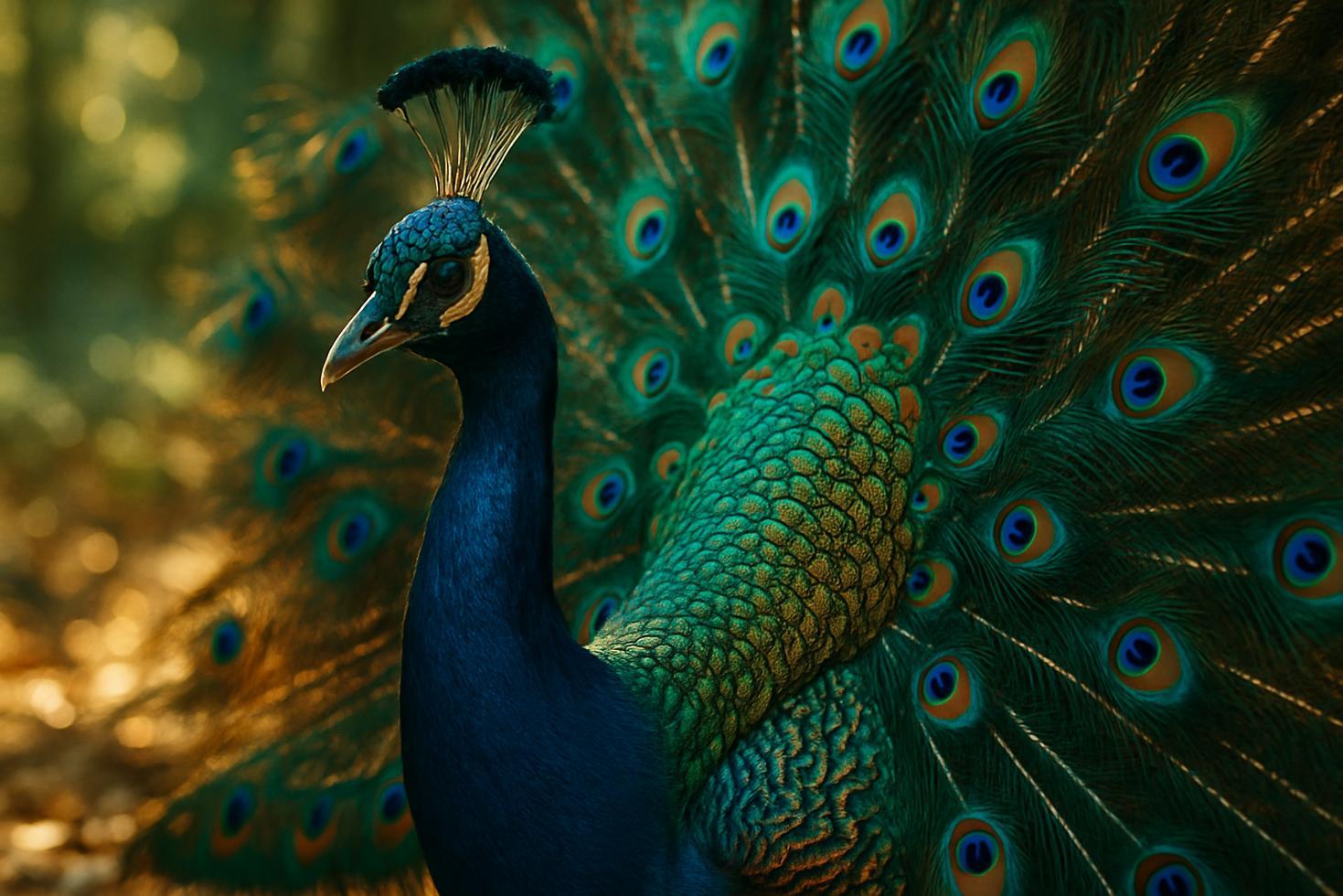
A peacock’s tail contains zero blue pigment. Rows of melanin rods spaced 140 nanometers apart bounce back pure color — shift that gap by 10 nanometers and the whole feather turns green.
A peacock’s brilliant blues and greens are produced entirely by nanoscale geometry, not by any blue or green pigment molecule. Inside each feather barbule sits a two-dimensional lattice of melanin rods and air channels locked in a keratin matrix — and the spacing between those rods determines which wavelength of light bounces back to the eye.
That lattice spacing runs around 140 nanometers for blue barbules. That is roughly one five-thousandth the width of a human hair. The structure is so small it interacts directly with individual wavelengths of visible light, reflecting some and swallowing the rest through optical interference.
Quick Facts
– Peacock feather color comes from optical interference in a nanostructured lattice, not pigment
– Blue barbules: ~140 nm lattice spacing; green: ~150 nm; yellow: ~165 nm
– Each barbule stack runs 5–12 repeating layers deep and about 2 µm thick
– Melanin rods are ~120 nm in diameter; air channels between them ~75 nm
– Blue reflectance peaks near 420–450 nm; green peaks near 540 nm
How the Melanosome Lattice Controls Peacock Feather Color
The melanosomes — melanin rodlets, each about 120 nm in diameter and roughly 1 µm long — arrange into a rectangular lattice with air channels approximately 75 nm wide running between them. This photonic crystal-like structure creates a partial bandgap: certain wavelengths reflect constructively while others cancel out.
Lattice periodicity, not pigment chemistry, sets the hue. Blue barbules carry about 9–12 repeating periods in the stack. Yellow barbules carry only about 6. Brown barbules have roughly 4 periods and a less regular lattice, producing weak, mixed reflectance rather than a saturated hue.
Why Lattice Regularity Matters as Much as Spacing
The difference between a vivid blue and a muddy brown is not just spacing size — it is the consistency of that spacing across layers. Fewer repeating periods and irregular lattice geometry produce a broad, weak reflectance signal.
Damage the ordered architecture and the color collapses, not because any pigment fades, but because the interference pattern physically falls apart. The melanin itself is still present. It just no longer sorts light.
Frequently Asked Questions
Does a peacock feather have any pigment at all?
Yes — melanin is present, but it contributes dark background absorption rather than the blue or green color itself. The vivid hues are produced entirely by optical interference from the nanostructure.
What exactly causes the color to shift from blue to green?
A change in lattice constant from about 140 nm to about 150 nm shifts the constructive interference peak from the blue range (around 420–450 nm) to the green range (around 540 nm).
Why does the color change depending on viewing angle?
The interference conditions change as the angle of incoming light shifts, so different wavelengths meet the constructive-interference threshold — a property called iridescence.
How thick is the entire photonic stack inside one barbule?
The full stack of 5–12 melanosome layers measures approximately 2 micrometers thick — narrower than most bacteria.