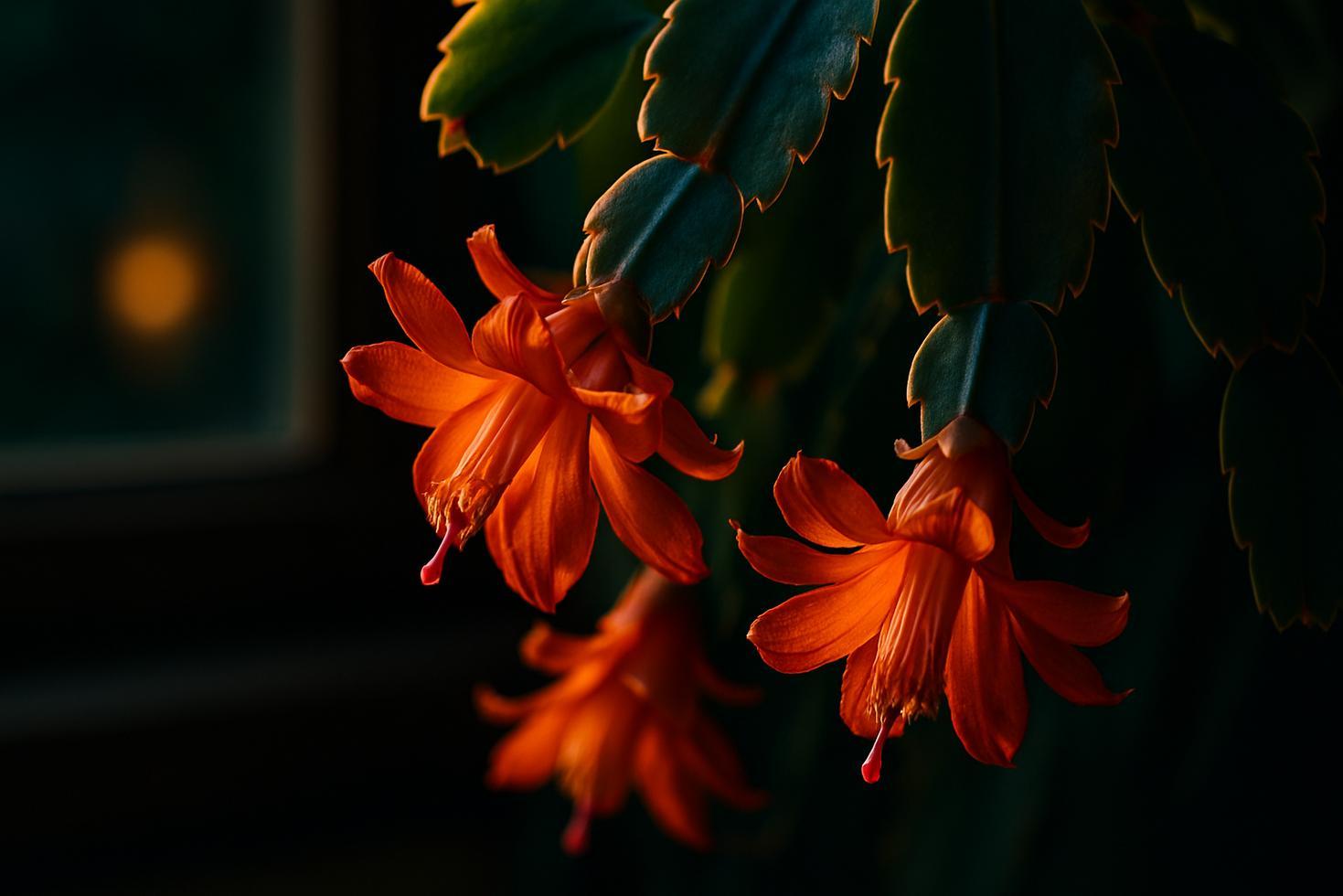
12–14 hours of unbroken darkness, held for 4–6 weeks — one lamp clicking on at midnight erases the countdown entirely. Darkness isn’t the absence of light. It’s the signal.
Schlumbergera — the Christmas cactus — flowers in response to uninterrupted darkness, not light. That single fact flips the usual logic of plant care upside down. A plant sitting in a bright, well-tended living room can go season after season without producing a single bud, and the reason has nothing to do with soil or water.
It came from the shaded canopy floors of Brazilian cloud forests. There, temperature barely shifts across seasons — so the plant evolved to read something else: the slow, reliable lengthening of night. That forest rhythm is still wired into every Schlumbergera growing on a modern windowsill.
What the Darkness Threshold for Schlumbergera Flowering Actually Is
Sources give a range of 12 to 14 hours of continuous darkness each night, sustained across 4 to 6 weeks, before bud formation begins. The word “continuous” is doing the real work in that sentence. Uninterrupted night as the hormonal trigger means the signal runs on duration, and any break resets the process — not pauses it.
The physiological mechanism is photoperiodism. Long nights prompt internal hormonal changes, including florigen production, which travels from the stems to growth points and initiates flower buds. The clock does not carry memory of previous nights. Each night’s dark period must be complete on its own.
How Artificial Light Disrupts the Schlumbergera Flowering Signal
A streetlight bleeding through a curtain. A phone screen. A hallway bulb clicked on for thirty seconds at midnight. Any of it is enough to collapse the signal entirely. Artificial light breaks the night-length measurement that the plant’s photoperiodic program requires, and the hormonal countdown resets to zero.
This is why indoor plants so frequently fail to bloom despite appearing healthy. They are receiving fragmented nights rather than the long, whole darkness the plant evolved to detect.
Cool night temperatures also matter — sources give an ideal range of 12 to 18 degrees Celsius. Radiators, heat vents, and cold drafts can all interfere with bud set even when light conditions are correct.
Frequently Asked Questions
Does a Christmas cactus need exactly 14 hours of darkness?
Sources give a range of 12 to 14 hours of continuous darkness nightly. The consistent requirement across all sources is that the dark period be uninterrupted over 4 to 6 weeks.
What happens if a light turns on briefly during the night?
The hormonal flowering signal resets completely. The dark-period countdown starts again from zero, not from where it left off.
What temperature does a Christmas cactus need to bloom?
Sources give an ideal night temperature of 12 to 18 degrees Celsius during the pre-flowering rest period.
Why won’t a healthy-looking Christmas cactus bloom indoors?
The most common cause is fragmented nights from indoor artificial lighting. The plant never accumulates the continuous darkness its photoperiodic program requires.