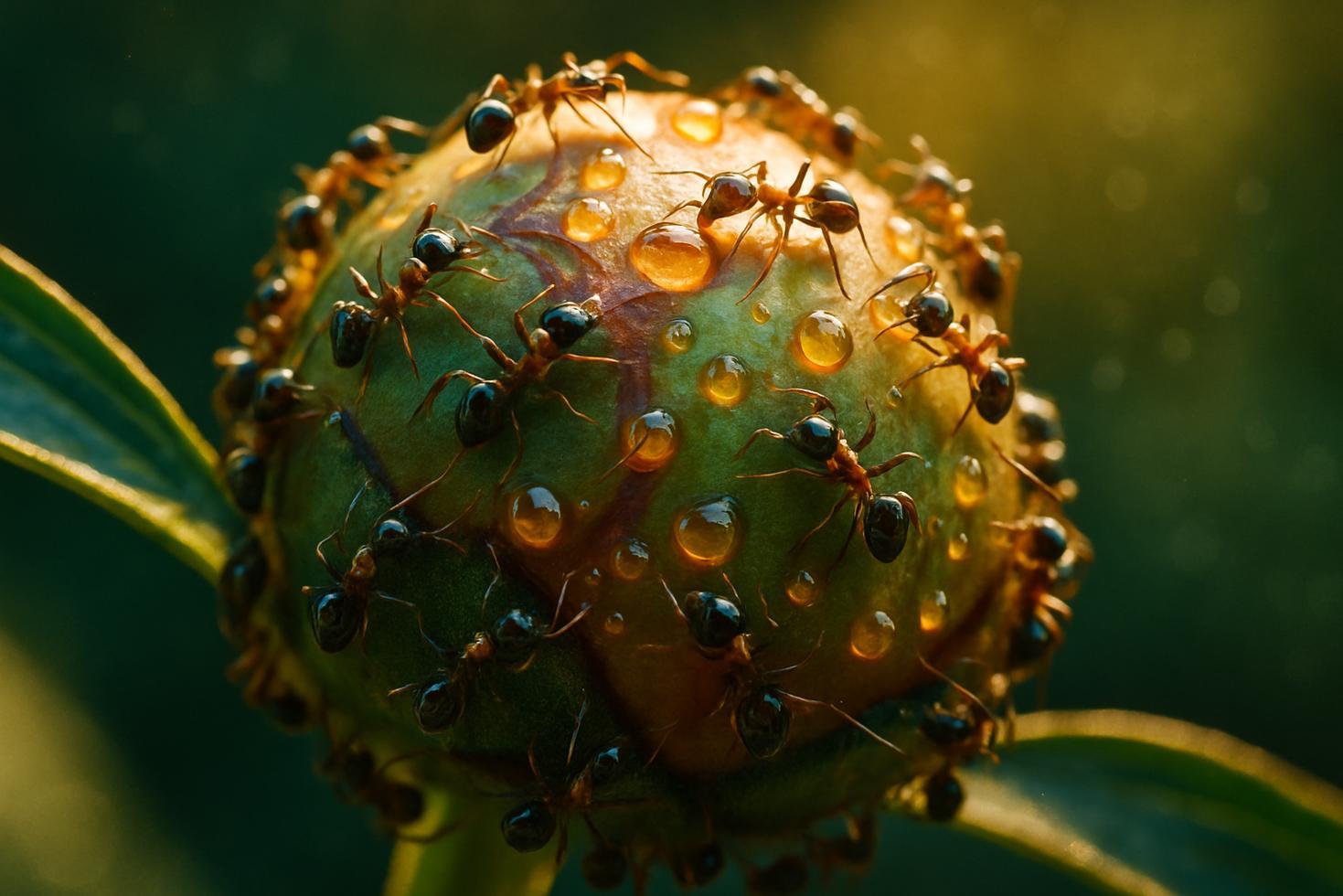
Peony sepal glands secrete nectar that is 95% sugar — ants that swarm the bud are feeding, and while feeding, they clear the area of other insects. The bud doesn’t bloom by accident.
Peony buds produce nectar through glands on their sepals, and that nectar draws ants that incidentally defend the bud from other insects while they feed. The sight of a bud black with ants looks like an infestation. It is closer to a transaction.
The nectar itself is remarkable. Missouri Botanical Garden staff describe it as approximately 95% sugar — sucrose, glucose, and fructose — plus amino acids and lipids. Scout ants find it, lay a chemical trail, and recruit nestmates back to the source.
Quick Answer:
– Peony sepals carry extrafloral nectaries that secrete sugar-rich nectar to attract ants
– The nectar is approximately 95% sugar, per Missouri Botanical Garden staff
– Ants feeding on the nectar drive off other insects trying to reach the bud
– Ants are not required for peony buds to open — peonies bloom normally without them
– Extrafloral nectaries appear across nearly 4,000 plant species, not only peonies
What Peony Extrafloral Nectaries Actually Do
The glands sit on the outside of the bud, pressed into the sepal tissue. They are not floral nectaries meant for pollinators. They operate before the flower opens, when the bud is most vulnerable to insects that would bore into it or feed on developing tissue.
Missouri Extension notes that scout ants leave a pheromone trail that pulls nestmates in. Once a group is feeding, they behave territorially. ants attacking bud-feeding insects nearby is documented in general terms by Illinois Extension and the Burghardt Lab, though the specific roster of insects displaced varies by situation.
The Mutualism Mechanism — and Its Limits
This relationship is a mutualism: the plant supplies energy, the ants respond with behavior that happens to protect the plant. It is worth being precise here. The nectar is not engineered with intent. A biological process produced glands that secrete sugar; ants evolved to exploit sugar sources and defend them. The outcome benefits both, but no party is making a deal.
the ant’s territorial feeding behavior is what closes the loop. Illinois Extension confirms ants actively remove other insects from the bud surface. The Burghardt Lab describes ants setting up patrols after locating extrafloral nectaries.
One note on a persistent myth: ants do not help peony buds open. Illinois Extension and Bug of the Week both confirm peonies bloom normally without ant activity. The ants are there for the nectar, not the flower.
How Widespread This Gland System Is
Peonies are not unusual for having extrafloral nectaries. The gland type appears across nearly 4,000 plant species, on leaves, petioles, midribs, and buds. The peony’s version sits specifically on sepals and floral bracts.
Bug of the Week notes an alternate hypothesis worth knowing: in some plants, extrafloral nectar may function partly as a metabolic byproduct or may redirect ants away from floral nectar rather than toward bud defense. For peonies, that hypothesis has not been demonstrated. the dominant supported explanation remains mutualistic defense recruitment via sugar secretion.
The ants will leave when the nectar stops. The flower will open either way. What the bud manufactured was an energy source — and what it got in return was a temporary perimeter, written in sugar.
Frequently Asked Questions
Do ants help peony buds open?
No. Illinois Extension and Bug of the Week both confirm peonies bloom normally without ants present.
What is in peony bud nectar?
Missouri Botanical Garden staff describe it as approximately 95% sugar, including sucrose, glucose, and fructose, plus amino acids and lipids.
Are extrafloral nectaries unique to peonies?
No. The gland type appears on nearly 4,000 plant species across many plant parts.
Do ants harm peony plants?
Illinois Extension states ants do no harm to peony plants and may remove insects that would otherwise feed on the bud.