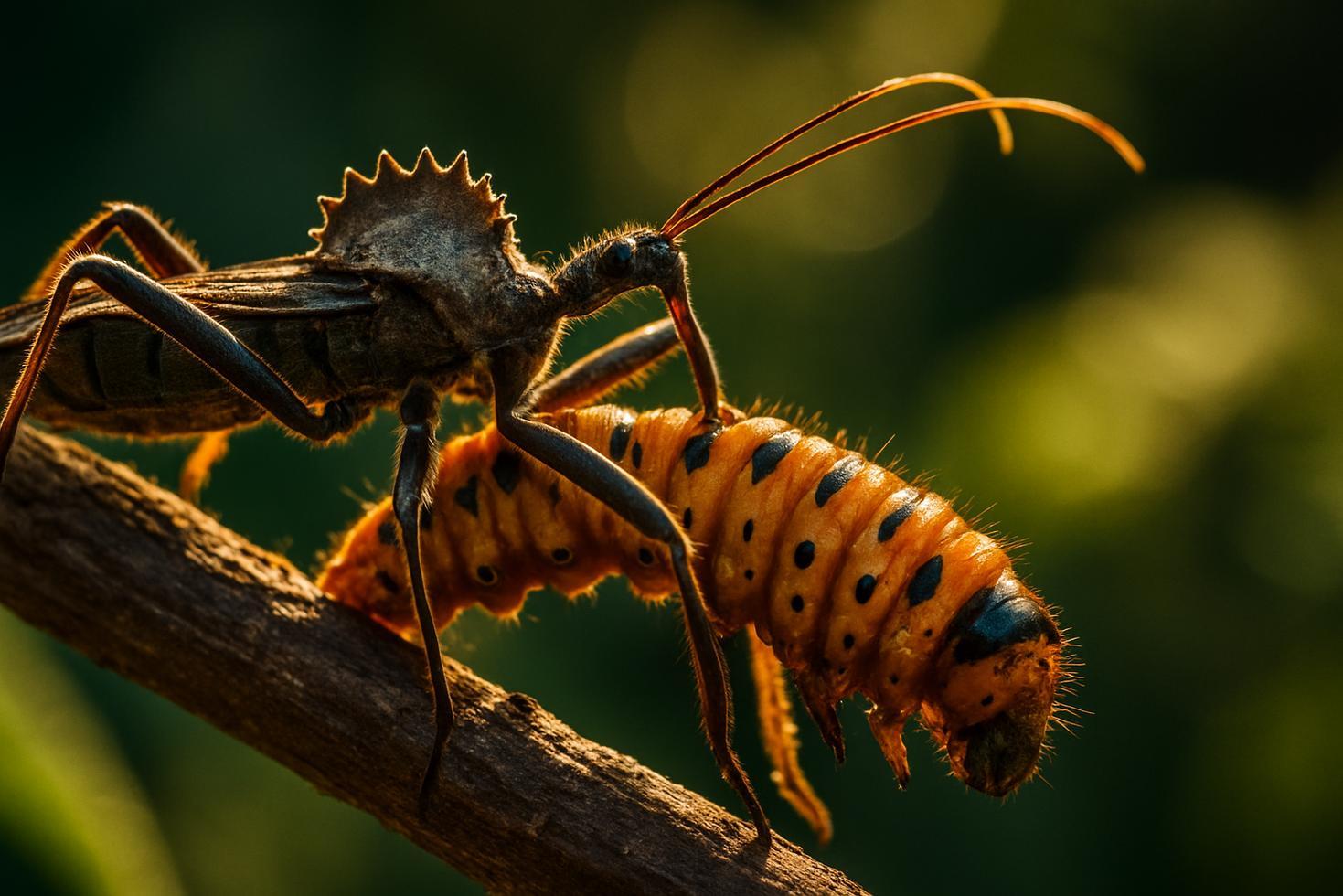
The largest assassin bug in North America — up to 1.5 inches — stabs prey with a folding beak, floods it with digestive enzymes, and drinks the liquefied result. That semicircular gear on its back exists on no other North American assassin bug.
The wheel bug (Arilus cristatus) kills without chewing, tearing, or venom in the vertebrate sense. It folds a piercing rostrum beneath its head when not in use, then deploys it to stab prey and inject enzyme-laden saliva that digests tissue externally. What gets consumed is already liquid.
That mechanism — stabbing, enzymatic flooding, suction — happens while the prey is still held in the wheel bug’s raptorial front legs. Those legs lock. Nothing moves until the meal is finished.
How the Wheel Bug’s Rostrum and Raptorial Forelegs Work Together
The rostrum is a hardened, segmented tube — not a stinger, not mandibles. When the wheel bug contacts prey, raptorial legs grip before the rostrum strikes. The sequence matters: immobilization comes first, penetration second. Saliva injected through the rostrum contains enzymes that break down soft tissue from the inside. The bug then draws the liquefied contents back through the same channel.
This is extraoral digestion — digestion that happens outside the body. The prey’s exoskeleton often remains largely intact while the interior is consumed.
What Insects the Wheel Bug Actually Hunts
The wheel bug is a generalist. Documented prey spans caterpillars, aphids, leafhoppers, stink bugs, beetle larvae, and other soft-bodied arthropods. It can subdue prey larger than many other predatory bugs can manage, partly because the foreleg grip is mechanically strong relative to its size.
Because it does not specialize, wheel bugs occasionally take beneficial insects alongside pest species. That trade-off is worth understanding. A single individual moves slowly and deliberately through vegetation across a season, working through whatever prey it encounters rather than targeting one pest species.
The Gear-Shaped Crest and What It Signals About Habitat
The semicircular, cogwheel-shaped pronotum on the wheel bug’s thorax is a reliable field identification mark. No other assassin bug in North America carries it. Scientists have not established a definitive function for the crest, and the debate remains open.
Finding a wheel bug in a garden does indicate that the habitat supports prey populations and physical refuges for a slow-moving predator. That inference stops short of proving a fully functioning or pesticide-free ecosystem — one predator’s presence is a data point, not a complete ecological audit.
One caution Raw_Research confirms: wheel bugs bite defensively when handled, and the bite is reported as notably painful.
The wheel bug does not look hurried, and it isn’t. It moves through a garden the way a mechanism works — steadily, without wasted motion. That gear on its back is unexplained. The hunger driving it is not.
Frequently Asked Questions
Is the wheel bug dangerous to humans?
Wheel bugs will bite defensively if handled, and the bite is reported as significantly painful. They do not seek out humans.
What does a wheel bug eat in a garden?
Documented prey includes caterpillars, aphids, stink bugs, leafhoppers, and beetle larvae. It is a generalist, not a specialist predator.
Is the wheel bug really the largest assassin bug in North America?
Adults reach 1.0 to 1.5 inches, placing it among the largest North American assassin bugs.
What is the gear-shaped structure on a wheel bug’s back?
It is a semicircular pronotum unique among North American assassin bugs. Its biological function has not been definitively established.