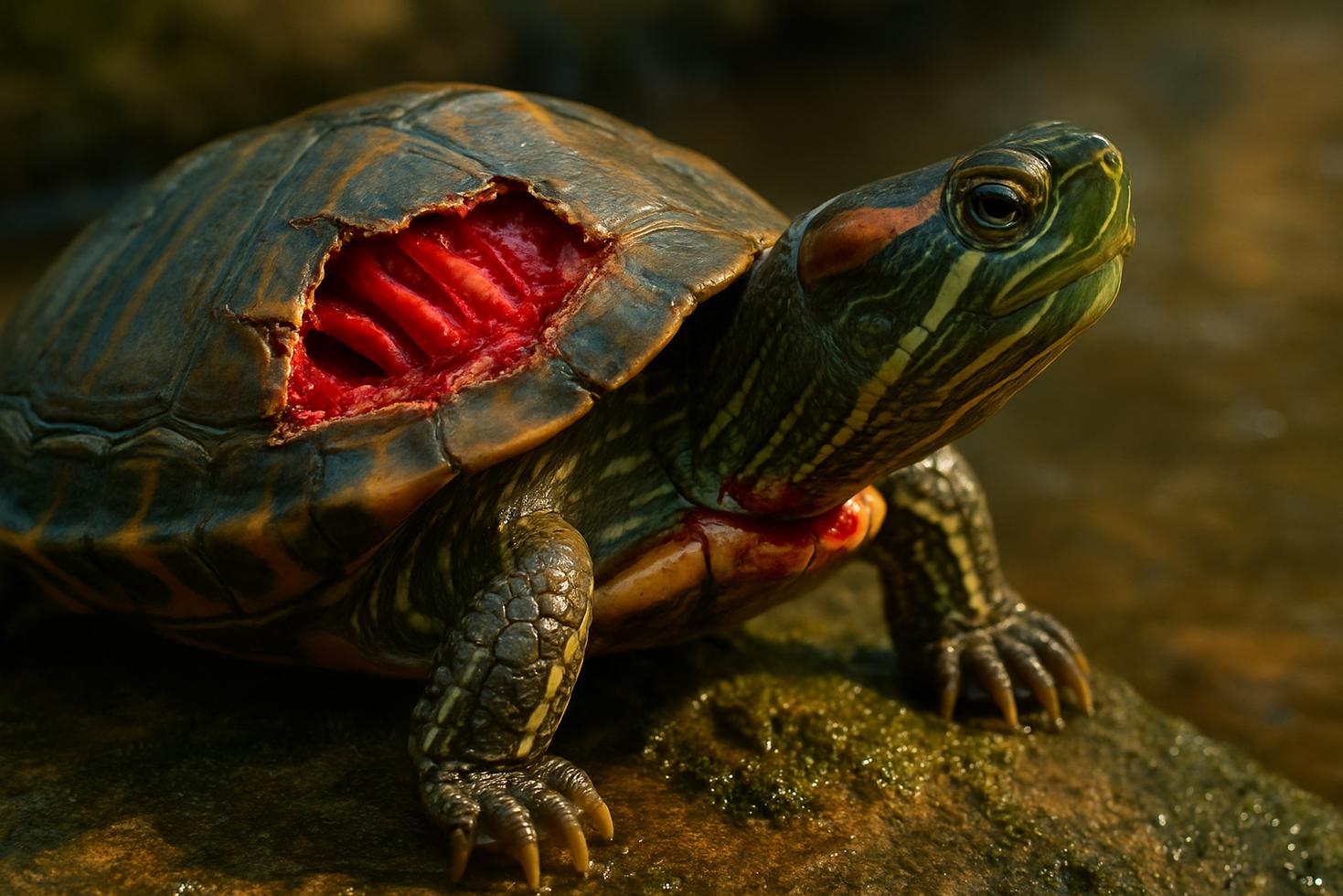
A turtle’s shell holds roughly 60 living bones fused to its spine — blood vessels and nerve endings run through the bony structure, making a crack hurt the same way a broken bone does.
A turtle’s shell is not a portable home or removable armor — it is the animal’s own skeleton, restructured. Roughly 60 bones, derived from the spine and ribs, have fused together over evolutionary time into a single rigid structure. That fact alone reframes every turtle ever seen crossing a road.
The dome visible from the outside is the ribcage itself, widened and flattened until it locked flat against the spine. The whole assembly is then covered by keratinous scutes — the same protein that forms human fingernails — sitting on top of living, vascularized bone beneath.
How Turtle Shell Bones and Nerves Actually Work
The bony layer of the shell contains blood vessels that allow it to grow and heal, just as any other bone does. Nerve supply runs through that same structure, giving the turtle the ability to sense pressure and touch on the shell surface. Nerve supply through vascularized shell bone is what makes this possible — not a surface-level sensitivity, but a signal originating in living skeletal tissue.
Sources note that turtles can perceive touch applied to the shell. The sensation is not uniform across every point, and the research does not establish that the shell is densely packed with nerves throughout, but sensitivity to physical contact is documented.
Why a Cracked Shell Is Closer to a Broken Bone Than a Dented Shield
When a shell cracks, it splits living bone. It opens blood vessels. The injury bleeds, and it causes pain — sources compare the experience directly to a broken-bone injury in terms of biological mechanism. Wildlife rehabilitators stabilizing a damaged shell are performing something functionally similar to orthopedic work, not cosmetic repair.
The shell can heal over time, the same way bone does elsewhere in the body. Stabilization of cracked shell during mending follows the same logic as casting a fracture — hold the structure still while vascularized tissue rebuilds.
Quick Facts About Turtle Shell Biology
- Roughly 60 bones make up the shell, fused from the spine and ribs.
- The shell contains blood vessels, allowing it to grow and self-repair.
- Nerve supply means turtles can sense pressure and touch on the shell.
- A cracked shell bleeds and causes pain comparable to a broken bone.
- The shell cannot be removed — no version of the turtle exists without it.
Frequently Asked Questions
Can a turtle feel if you touch its shell?
Yes. The shell contains nerve supply and blood vessels, and turtles can perceive pressure and touch applied to it.
Does a cracked turtle shell hurt the animal?
It does. A crack splits living bone and opens blood vessels, causing bleeding and pain similar in mechanism to a bone fracture.
Can a turtle’s shell heal after being damaged?
Yes. Because the shell is vascularized living bone, it can mend over time, though injuries typically require stabilization during recovery.
Is a turtle’s shell part of its skeleton?
It is the skeleton — roughly 60 bones from the spine and ribs, fused into one structure the animal cannot shed or survive without.