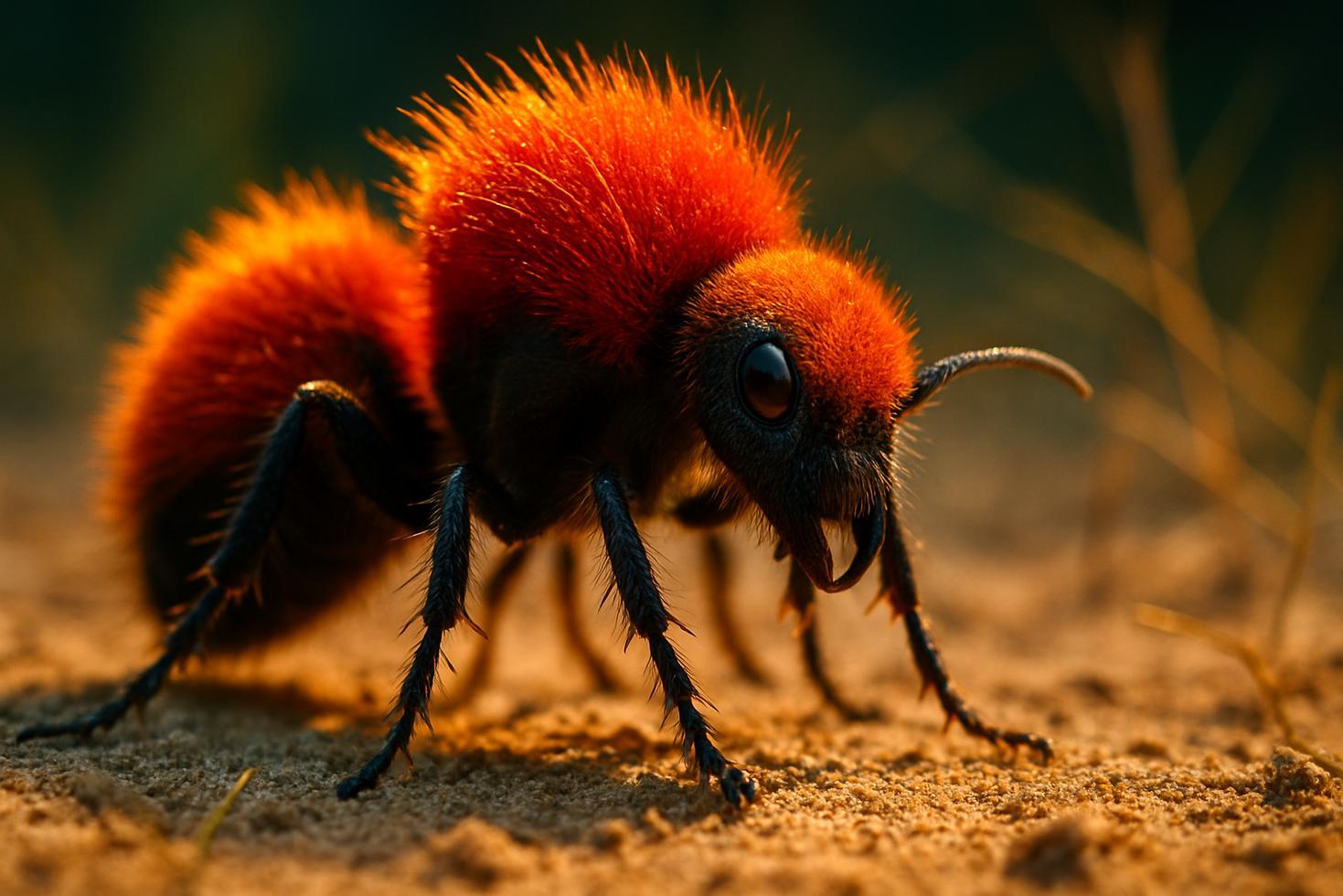
A female velvet ant carries no colony, no workers, and no backup — just a cuticle tough enough to survive a bird’s full bite and a parasitoid life cycle that ends only one way for the host.
The velvet ant is not an ant. She is a wingless female wasp in the family Mutillidae, and nearly everything about her appearance is functional rather than decorative. That electric red-orange fuzz catches the eye for a reason.
The dense setae covering her body serve as aposematic warning coloration — a biological broadcast that predators learn to associate with a severely painful sting. Birds and lizards do bite down. The cuticle simply does not give way. She walks off. The predator recalibrates.
How the Velvet Ant’s Cuticle and Sting Work as a Defense System
The coloration and the sting are two layers of the same strategy. Aposematism advertises a cost before the predator commits. The cuticle absorbs the attack if the warning is ignored.
Unusually tough cuticle surviving full-force bite attempts is the mechanism researchers point to when explaining why velvet ants survive encounters that would kill most other insects. The sting reinforces the lesson for any predator that gets that far.
The sting is real and severe. The Schmidt Sting Pain Index scores it at a 3 out of 4, placing it among the most painful insect stings documented.
The Velvet Ant’s Parasitoid Life Cycle Inside Ground Burrows
Defense is only half the biology. The female spends her time crossing open, sun-baked ground alone, locating the buried burrows of solitary ground-nesting bees and wasps.
Once inside, she lays an egg on or near the host larva already sealed within. Her offspring consumes that host larva completely, taking every resource the host had stored. The host does not survive the larva’s development — this is a parasitoid relationship, not simple parasitism.
This pattern is consistent across many Mutillidae species, though exact host choice varies by species. The outcome for the individual host is always the same.
Closing
The velvet ant is one of those animals whose whole biology reads as a set of interlocking solutions. Warning signal. Indestructible shell. Reproductive strategy that bypasses nest-building entirely by borrowing someone else’s work.
She needs no colony. She is the whole system.
Frequently Asked Questions
Is a velvet ant dangerous to humans?
Female velvet ants can deliver an extremely painful sting, rated 3 out of 4 on the Schmidt Sting Pain Index, but they are not aggressive and sting defensively.
Why can’t birds crush a velvet ant?
Velvet ants have exceptionally tough cuticles documented to resist crushing even under a predator’s full bite force, making them unusually difficult to kill mechanically.
What does a velvet ant parasitize?
Females target ground-nesting solitary bees and wasps, laying eggs on larvae already sealed in burrows; the velvet ant larva then consumes the host entirely.
Why do male and female velvet ants look so different?
Males are winged and females are wingless, and the two sexes often look so unlike each other that they can appear to belong to different species.