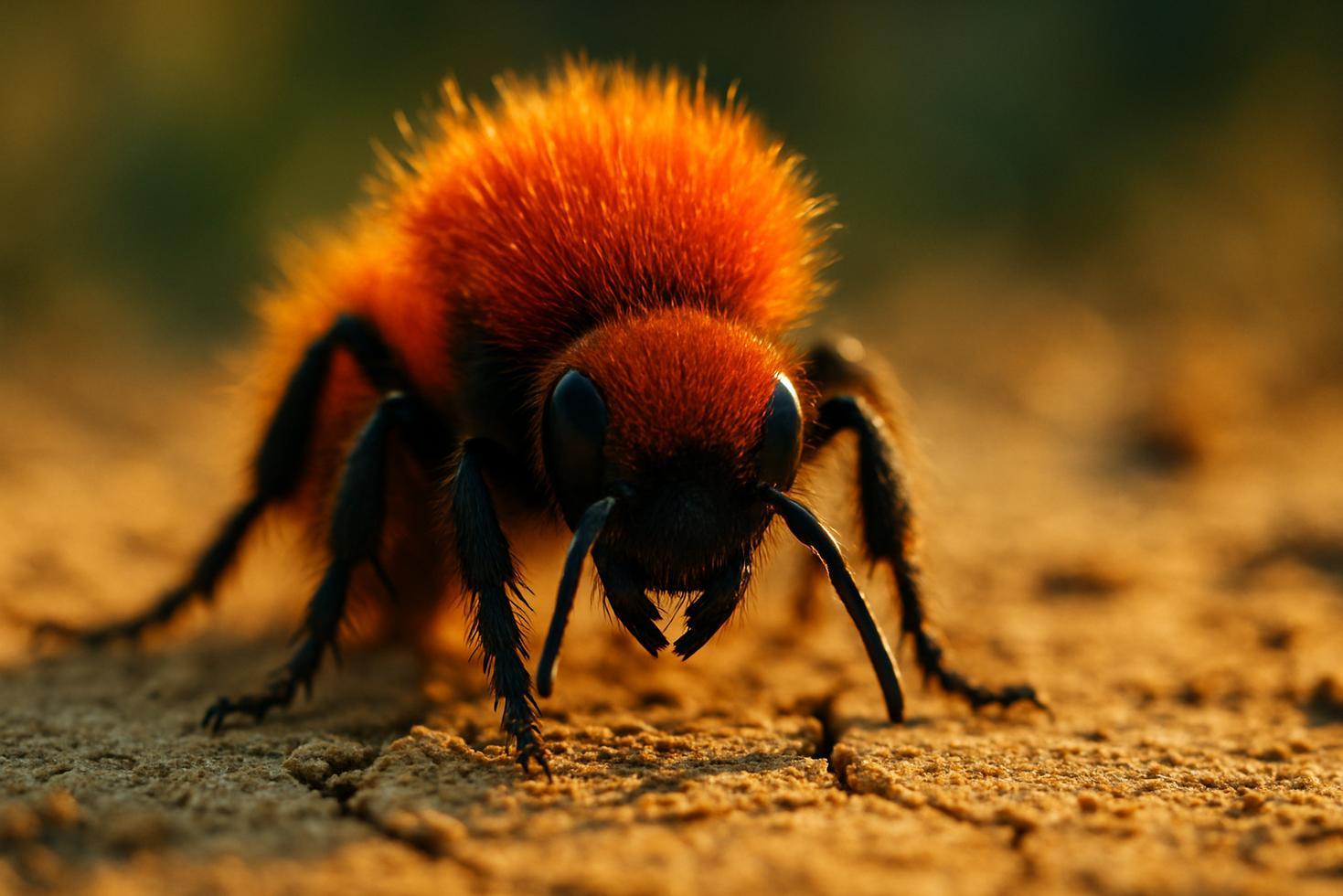
A Schmidt pain index 3 out of 4. A sting lasting up to 30 minutes. And she is not even an ant — she is a wasp wearing one of the hardest exoskeletons in the insect world.
The red fuzzy creature crossing the driveway is a female velvet ant — a wingless parasitoid wasp in the family Mutillidae, not an ant at all. That distinction matters, because everything about her body and behavior makes more sense once the wasp identity clicks into place. She is solitary, she stings, and she spends her days searching for underground nests to invade.
The “velvet” comes from dense, bright fuzz that functions as aposematic coloring — a warning signal aimed at predators. The fuzz is not softness. Underneath it sits an exoskeleton that researchers describe as one of the hardest in the insect world.
Why the Velvet Ant’s Exoskeleton Is Unusually Hard
Most wasps have lightly built bodies. The velvet ant does not. Her exoskeleton is dense and interlocking enough that it compresses under pressure rather than cracking. that compression resistance under nest-attack conditions is what lets her push through tunnels defended by stinging residents.
The armor also retains moisture, a practical advantage for an insect walking exposed ground in dry, sandy habitats. The hardness is structural, not incidental.
How Velvet Ants Parasitize Ground-Nesting Bees and Wasps
The female’s mission is finding a sealed host cell. She locates a ground-nesting bee or wasp nest, enters it, and lays one egg on or near the host larva. Her larva hatches and consumes the host, keeping it alive as long as the feeding continues. The host’s stored provisions may also serve as food.
This makes her a parasitoid rather than a predator — the host sustains the larva through consumption, not a quick kill. The hard exoskeleton is what buys her time inside a nest that is actively trying to repel her.
The “Cow Killer” Nickname and What the Pain Index Actually Measures
The common name “cow killer” comes from sting severity. Multiple sources confirm no cow deaths have actually been reported. The name reflects the Schmidt pain index rating of 3 out of 4 — described as explosive, long-lasting pain that persists up to 30 minutes. The sting is purely defensive. Females do not use it to hunt. Males cannot sting at all.
The bright red and black coloration reinforces the warning the sting delivers. Predators that learn the pattern avoid future encounters.
The velvet ant’s entire design — armor, color, sting — points toward a single outcome: surviving long enough to complete the parasitoid cycle. That red crawler is not wandering. She is working.
One of the insect world’s most effective infiltrators just happens to look like a fuzzy ant.
Frequently Asked Questions
Is a velvet ant actually an ant?
No. Velvet ants are wingless female wasps in the family Mutillidae; the antlike appearance comes from the absence of wings and dense body fuzz.
How painful is a velvet ant sting?
The Schmidt pain index rates Dasymutilla occidentalis at 3 out of 4, with pain reported to last up to 30 minutes.
Can a velvet ant kill a cow?
No. Multiple entomological sources confirm no cow deaths have been attributed to velvet ant stings; the “cow killer” nickname reflects sting intensity, not lethality.
How many species of velvet ants exist?
Roughly 8,000 species have been identified worldwide, with more than 400 species recorded in the North American Southwest alone.