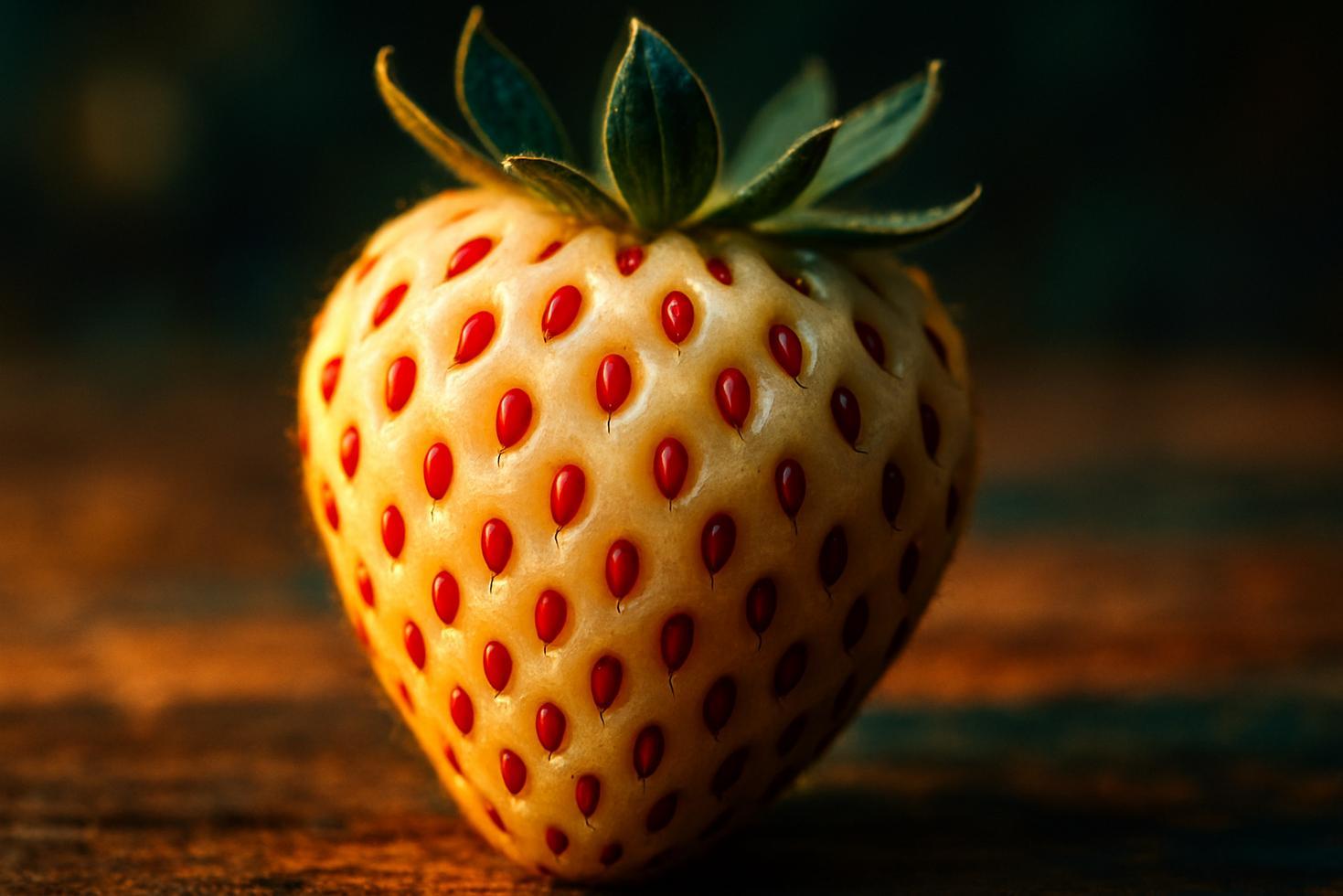
Selective breeding drained red pigment from pineberry flesh — yet the achenes still blaze full red against pale skin every 4–5 week season. One fruit, two separate color programs running at once.
Pineberries are cultivated strawberries (Fragaria × ananassa) with reduced anthocyanin pigmentation in the flesh but fully pigmented red achenes on the surface. That gap — pale body, vivid seeds — makes them look almost invented. They aren’t. They are a product of selective breeding across strawberry lineages, with no genetic modification involved.
The achenes and the flesh simply run independent pigment programs. Selective pressure reduced anthocyanin expression in the fruit body without touching the achenes’ own pigment pathway. The result is a strawberry that looks bleached from the outside but is structurally identical to a standard garden berry inside.
How Pineberry’s Dual Pigmentation Actually Works
Anthocyanins are the compounds responsible for red and purple coloration in strawberry flesh. In pineberries, selective breeding produced cultivars expressing reduced anthocyanin in the receptacle tissue — the fleshy part people eat. The achenes, each a separate botanical structure, retained their own pigment expression independently.
This is not a mutation. It is the result of crossing strawberry lineages over generations until breeders isolated plants that consistently produced pale flesh while otherwise behaving like normal strawberries.
Pineberry’s Origin: Netherlands Breeding, Not Wild Collection
Modern commercial pineberries trace to breeding work carried out in the Netherlands, developed from source material connected to Fragaria chiloensis (the Chilean strawberry) and Fragaria virginiana (the Virginia strawberry) — the same two species whose hybridization produced the modern garden strawberry. Dutch horticulturists spent roughly six years in research and development before small-scale commercial crops became viable. Pineberries first appeared in UK markets around 2010, with U.S. commercial sales beginning in 2012.
The fruit is not a rescued wild species. It is a deliberately bred cultivar shaped by about a decade of targeted horticultural selection.
Pineberry Size, Season, and Flavor
Pineberries grow between half an inch and just under an inch in diameter — smaller than most commercial strawberries. Their growing season runs only 4–5 weeks. Multiple sources describe the flavor as pineapple-like or sweet and tropical, which aligns with how aromatic compounds — not pigment — carry most of what people recognize as fruit flavor.
A berry that looks like winter but carries summer chemistry.
Pineberries show how selective breeding can separate traits that seem inseparable. Color and flavor, structure and pigment — they don’t have to travel together. Sometimes breeding just quietly reassigns which tissues keep which instructions.
The flesh gave up its red. The seeds never got the memo.
Frequently Asked Questions
Are pineberries genetically modified?
No. Pineberries are produced through selective cross-breeding of strawberry lineages, not genetic engineering.
Why do pineberries have red seeds on white skin?
The achenes (seed-like surface structures) retain their own independent pigment pathway, while selective breeding reduced anthocyanin expression only in the fleshy receptacle tissue.
What does a pineberry taste like?
Multiple sources describe the flavor as pineapple-like or sweet and tropical, distinct from standard strawberry flavor.
When did pineberries become commercially available?
Pineberries appeared in UK markets around 2010, following roughly six years of Dutch horticultural development, and reached U.S. commercial sales in 2012.