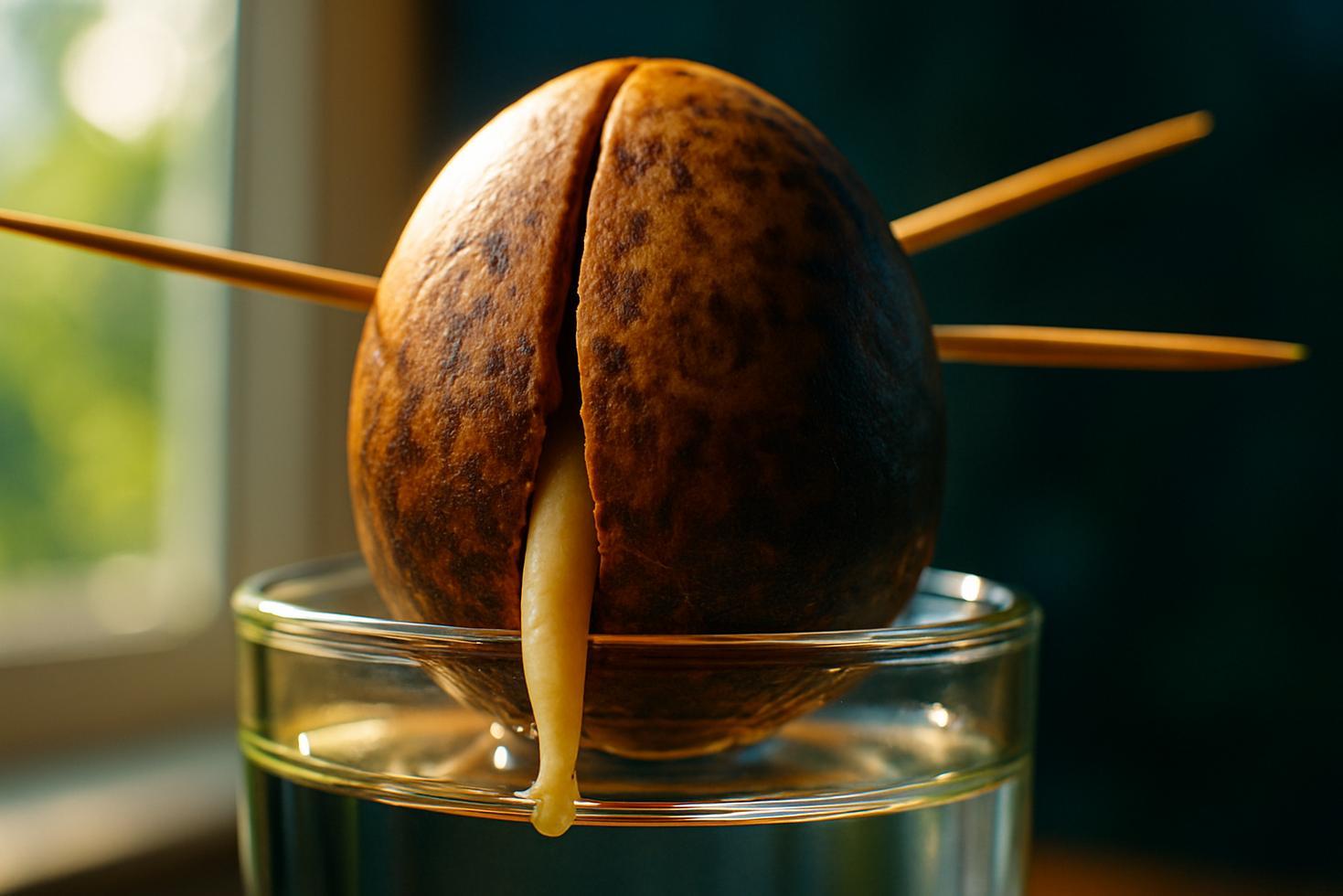
A living embryo has been waiting inside that pit — water triggers imbibition, enzymes fire, stored reserves mobilize, and a root cracks through the flat end in as little as 2–6 weeks. The whole sequence plays out in a glass on a windowsill.
An avocado pit contains a living embryo that remains dormant until water contact triggers a biological process called imbibition. That single signal — moisture reaching the seed tissues — starts a cascade that ends with a root pushing through the shell. What makes this unusual is where it happens: in open water, in a glass, completely visible.
Most seeds do this underground. The avocado does it in plain sight. The root emerges first from the flat end, anchoring downward. Weeks later, the shoot climbs from the top. Two directions, one unfolding sequence.
The embryo was never dead. It was waiting.
How Imbibition Breaks Avocado Seed Dormancy
Dormancy in an avocado seed is not damage or inactivity — it is a stable holding state. When water soaks into the seed coat, imbibition begins rehydrating the internal tissues. Enzymes switch on. Stored fats and starches convert into usable energy.
Enzyme activation mobilizing stored seed reserves is the engine behind everything visible afterward. Pressure builds inside the pit as tissues expand. The outer shell cracks — not from external force, but from growth pushing outward.
That crack at the flat end is the radicle breaking through. It is the first structure the embryo sends out, because anchoring comes before reaching for light.
What the Flat-End Crack and Root Sequence Actually Show
The broad, flat end of the pit is where the radicle exits. The pointed top is where the shoot eventually emerges — but not until the root system is already developing. This sequence is not random.
Root before shoot is standard germination logic: establishing a water supply before aerial growth begins. In soil, this happens invisibly. Suspended in water by toothpicks with roughly the bottom half submerged, the avocado makes the entire timeline observable.
Roots typically appear somewhere between 2 and 6 weeks. Cooler temperatures or inconsistent moisture can push emergence past 8 weeks. The shoot follows considerably later — sometimes months after the first root appears.
Closing
Watching an avocado pit germinate is watching seed biology without the soil in the way. The imbibition trigger, the dormancy break, the radicle-first emergence — all of it is standard plant mechanics, just unusually exposed.
The pit was always alive. Water just handed it the signal to move.
Frequently Asked Questions
How long does it take an avocado pit to sprout roots?
Roots typically emerge from the flat end in 2–6 weeks, though some pits take 8 weeks or more depending on temperature and moisture consistency.
Why does the avocado pit crack at the flat end?
The radicle, or taproot, exits from the broad flat end as internal tissues expand during germination — the crack is the root pushing through from inside.
What triggers an avocado seed to start growing?
Water contact initiates imbibition, which rehydrates seed tissues, activates enzymes, and mobilizes stored fats and starches to fuel growth.
Does temperature affect how fast an avocado pit germinates?
Yes. Warmer conditions — around 70–80°F — speed germination; cooler or inconsistent temperatures slow the process significantly.