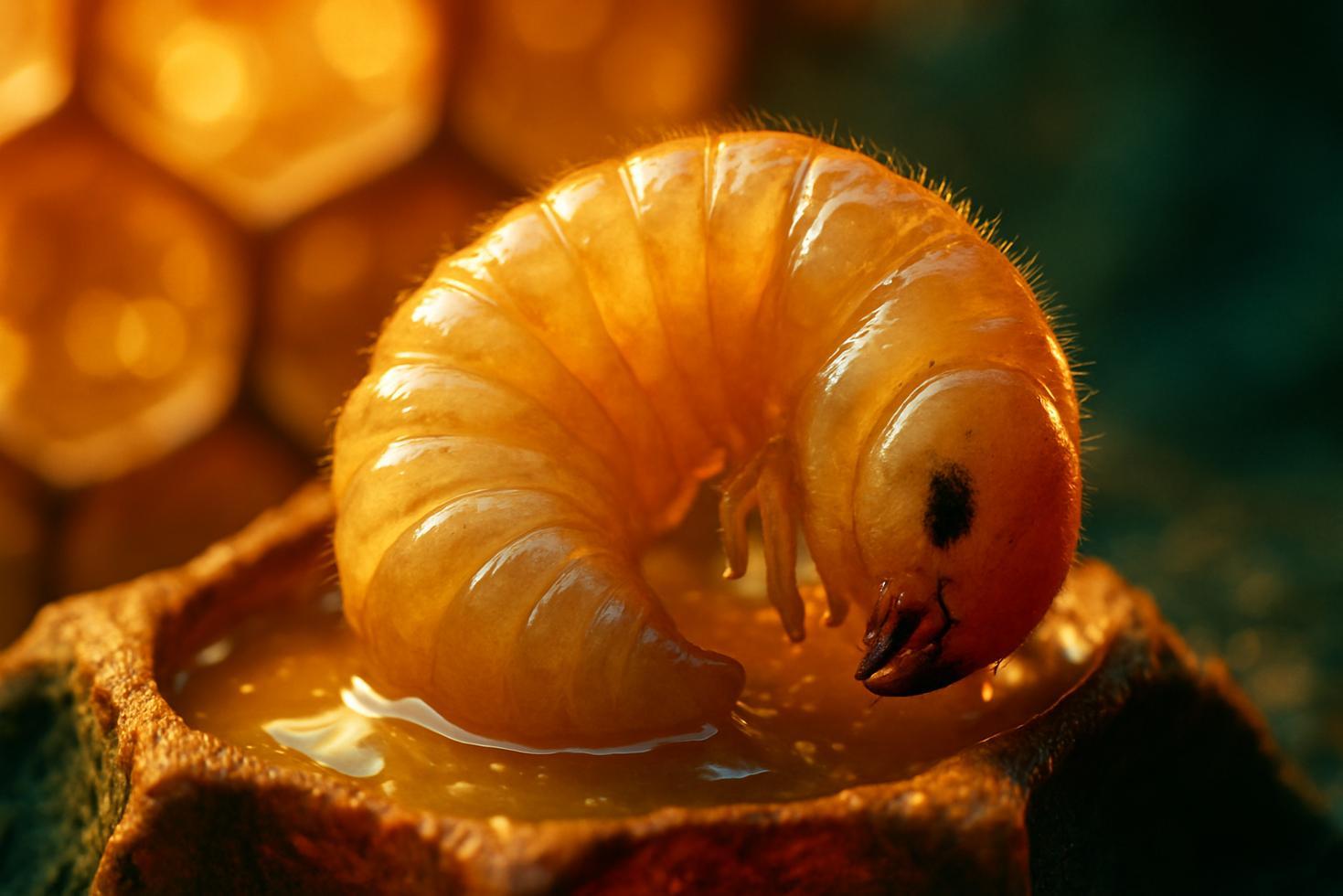
Queen and worker bees share identical DNA — royal jelly fed past day 3 builds 150–180 ovarian tubes per ovary. Diet delivers the verdict.
A queen bee and a worker bee develop from the same fertilized egg, with identical genetics. What separates them is a sustained nutritional difference that begins around the third larval instar and permanently rewires hormone signaling, organ development, and lifespan.
For roughly the first three days after hatching, both queen- and worker-destined larvae receive royal jelly. Then the diets split. Queen larvae keep receiving large amounts of royal jelly throughout development. Worker larvae are shifted to a nutritionally inferior mix of pollen, nectar, or bee bread. That single fork in the feeding road changes everything downstream.
How Royal Jelly Changes Larval Hormone Signaling
The shift in diet triggers a cascade, not a single switch. Queen larvae show faster weight gain by the third larval instar. Their corpora allata — glands that produce juvenile hormone — enlarge by the end of that same instar. Higher juvenile hormone levels then open the developmental pathways that build reproductive organs.
Sustained juvenile hormone elevation drives ovary differentiation in the queen. Workers, denied the continued royal jelly diet, never receive that hormonal signal at the required intensity or duration. The result is not gradual — it is a divergence that closes permanently as development continues.
Queen vs. Worker Bee: Differences in Fertility, Anatomy, and Lifespan
The downstream differences are striking in scale. Queens develop approximately 150–180 ovarian tubes per ovary. Workers develop almost none. A queen in peak season lays up to 2,000 eggs per day.
Worker bees, their reproductive development suppressed, live roughly 45 days in summer. Queens, shaped by that early nutritional window, live 3–5 years. Development timelines also diverge: queens emerge in about 16 days from egg to adult, while workers take about 21 days — the difference concentrated in a longer pupal stage for workers (roughly 12 days versus the queen’s 7).
Frequently Asked Questions
Does royal jelly genetically change the queen bee?
No. Queens and workers share the same genome. Royal jelly and the sustained feeding regime alter gene expression and hormone signaling during a critical larval window, not the underlying DNA sequence.
How many days of royal jelly does a queen bee receive?
Queen-destined larvae receive royal jelly throughout their larval development. Workers receive it for approximately the first two to three days, then are switched to pollen, nectar, or bee bread.
How long does a worker bee live compared to a queen?
Worker bees in summer live roughly 45 days to 6 weeks. Queens live approximately 3–5 years.
Can a worker bee become a queen later in life?
Only during a specific developmental window. If the colony needs a new queen and young larvae are available, workers can begin raising a new queen by switching a larva back to an exclusive royal jelly diet — but this only works within the critical early larval stage.