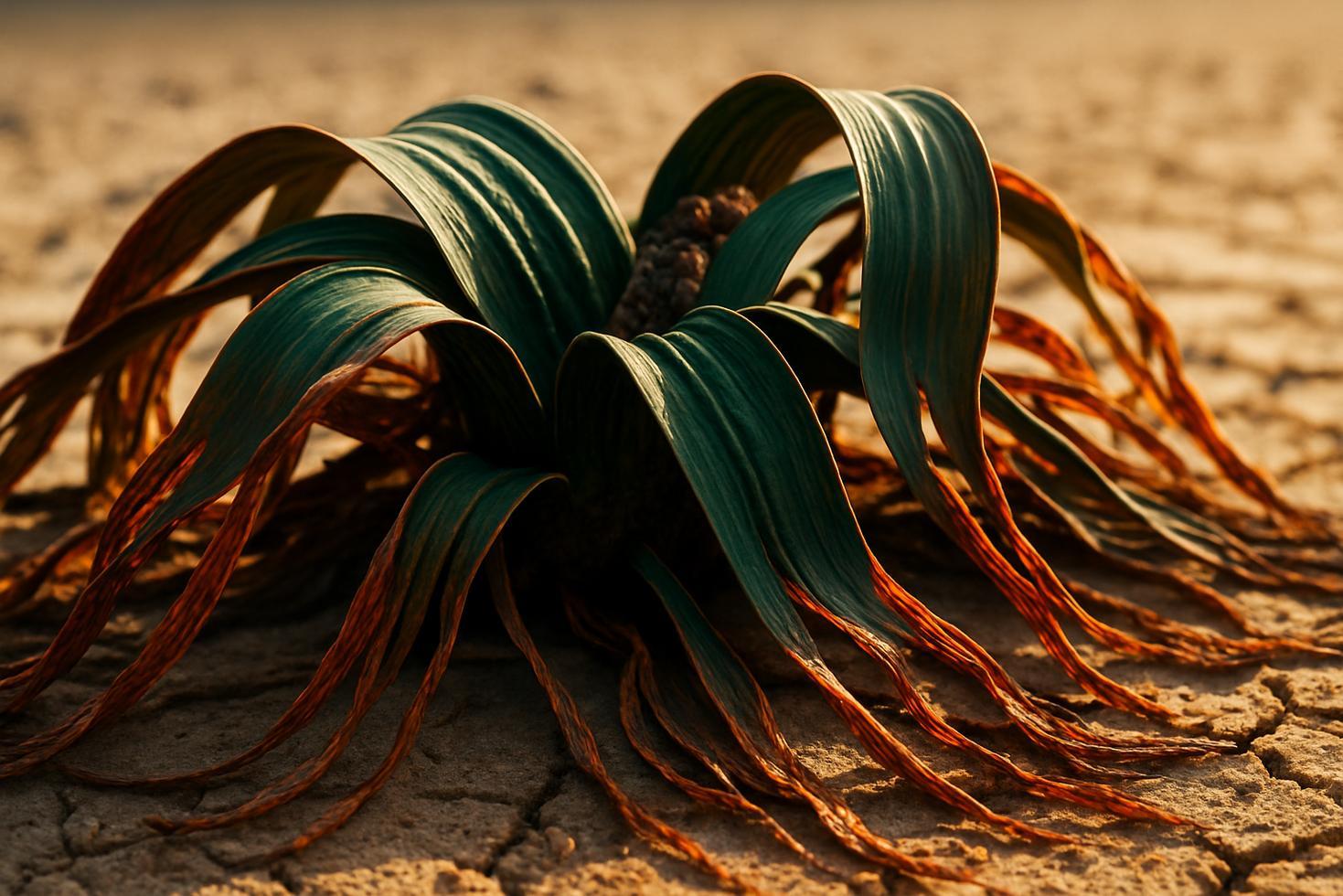
Two leaves. One plant. A basal meristem that never stops — for 1,500 years or more. The same original pair, still growing.
Welwitschia mirabilis produces exactly two permanent foliage leaves at the start of its life and never grows another pair. That alone is remarkable. What follows is stranger still: those two leaves keep growing from their bases, continuously, for centuries — making Welwitschia the longest-lived leaf condition known among plants.
The shoot apical meristem — the growth tip that would normally generate new leaves — dies shortly after germination. Growth shifts entirely to basal meristematic tissue at the leaf bases. Wind and sand abrade the leaves lengthwise into ribbon-like strips over time, so an ancient plant looks like a chaotic tangle of foliage. Count the bases, though. There are always two.
Quick facts:
– Welwitschia retains only two permanent foliage leaves for its entire life
– The shoot apex dies after germination; new leaves are never produced
– Leaves grow roughly 8–15 cm per year from a basal meristem
– After a single rainfall event exceeding 11 mm in mid-summer, growth rate quadruples
– Carbon-14 dating confirms some individuals exceed 1,500 years old
How Welwitschia’s Basal Meristem Produces Continuous Leaf Growth
Most plants grow leaves from an apical meristem at the stem tip. Welwitschia’s apical meristem shuts down early in life. Instead, a basal meristem at the outer crown keeps pushing each leaf outward from its base — indefinitely.
A long-term growth study recorded a baseline rate of 0.37 mm per day, with 22-fold variation within individual plants across seasons. Growth tracks air humidity and peaks during summer months. Fog, despite the Namib’s famous coastal mist, does not appear to drive leaf growth or germination.
The largest documented leaf measured 6.2 m in total length, with 3.7 m of living tissue remaining. Britannica notes leaves are typically kept to around 3 m by ongoing abrasion.
Why Welwitschia Plants Look Like Many Leaves When They Are Only Two
The two leaves lie along the ground for centuries. Wind-driven sand scores them lengthwise, splitting them into dozens of ribbon-like segments. Nothing is shed. The original tissue simply accumulates, frays, and spreads.
An old Welwitschia can look like a sprawling mass of dozens of separate leaves. The illusion is convincing enough that the two-leaf structure was a genuine botanical puzzle when European naturalists first encountered the plant in the 1850s. Age can be estimated by counting concentric rings on the woody crown — similar in principle to tree rings — placing some verified individuals past 1,500 years.
Closing
Welwitschia sits in a category almost by itself: a plant that committed to two leaves at germination and simply refused to stop growing them. What looks chaotic is structurally one of the simplest leaf arrangements in the plant kingdom — held together by one of the most unusual growth mechanisms known to botany.
Two leaves. Fifteen centuries. Still growing.
Frequently Asked Questions
How many leaves does Welwitschia grow in its lifetime?
Two permanent foliage leaves — the only pair it ever produces, retained and continuously growing from their bases throughout the plant’s life.
How fast do Welwitschia leaves grow?
Studies record roughly 8–15 cm per year under baseline conditions, with growth quadrupling after mid-summer rainfall events greater than 11 mm.
How old can a Welwitschia plant get?
Carbon-14 dating confirms individuals older than 1,500 years; some reports suggest certain plants may exceed 2,000 years, though that upper figure is less consistently verified.
Why does Welwitschia look like it has many leaves?
Wind and sand shred the two persistent leaves lengthwise into ribbon-like strips over centuries, creating the appearance of a dense, multi-leaved plant.