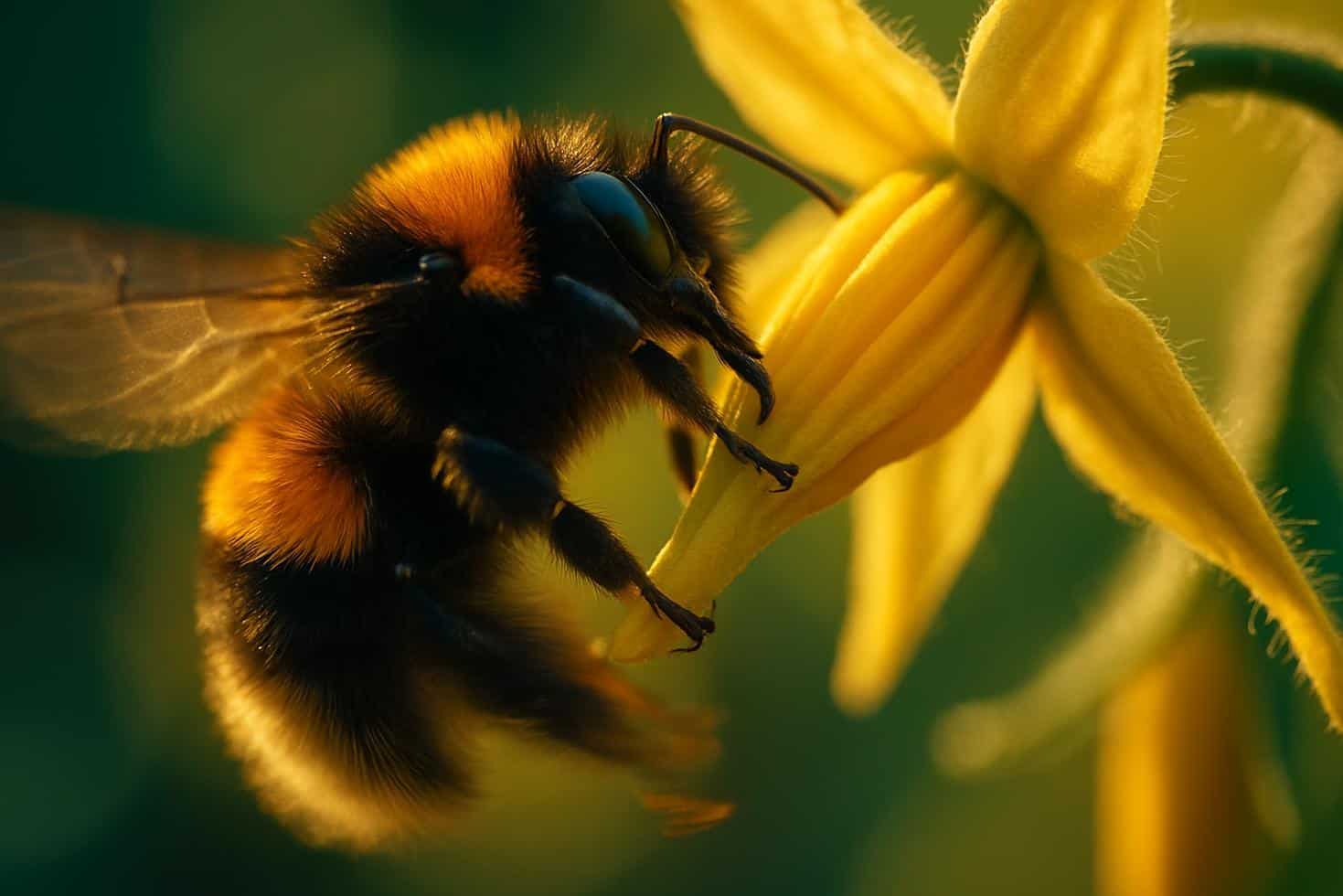
Tomato anthers lock pollen inside sealed pores — bumblebee thoracic muscles vibrating at up to 400 Hz shake it free. Honeybees visit the same flowers and leave with nothing.
Tomato flowers are physically built to withhold pollen until something shakes it loose. The anthers form a hollow cone with tiny pores at the tip, and pollen will not exit those pores without sufficient vibration. Wind handles the job outdoors. Inside a greenhouse, the situation gets more interesting.
A bumblebee solves this by gripping the anther cone with its mandibles and tarsal claws, then firing its thoracic flight muscles while keeping its wings folded. Those muscles generate vibrations in the range of roughly 100–500 Hz — Montana State University Extension cites up to 400 Hz. The cone resonates, and pollen shakes out through the apical pores.
Why the Tomato Anther Cone Requires Vibration to Release Pollen
The anther cone’s architecture is the whole story. Pollen grains sit inside sealed locules and exit only through apical pores when vibration accelerates them outward. Discrete element modeling confirms that pollen ejection increases approximately linearly with vibration duration, not with frequency alone. A brief, weak buzz leaves most pollen inside. A sustained vibration empties the cone far more completely.
Recent bioacoustic research adds another layer. Sonication can separate interlocked trichomes in the anther cone’s sheath, effectively unzipping the mesh and allowing the cone lobes to open. Mechanical contact between the bee and the anther is required — airborne sound waves alone do not achieve this.
Why Bumblebees Succeed Where Honeybees Cannot
Bumblebees disconnect their wings from their flight muscles mid-visit and vibrate the thorax independently. Honeybees lack this ability. Most honey bee species cannot perform floral sonication at all, which is why practical greenhouse experience and published reviews consistently report negligible tomato pollination benefit from honeybees compared to bumblebees. Commercial greenhouse operations routinely introduce managed bumblebee colonies specifically for this reason.
How Greenhouse Growers Replace Buzz Pollination Mechanically
Outdoor tomatoes get adequate pollen release from wind and incidental movement. Greenhouses eliminate wind, so growers substitute mechanical vibration. The University of Alaska Fairbanks Extension recommends touching a vibrating probe to the flower cluster branch for about one second per cluster, repeated at least every other day during bloom. Montana State University Extension recommends an electric toothbrush applied gently to the back of each flower for one full second. Electric toothbrushes operate at higher frequency and intensity than bumblebees but still release pollen effectively because they deliver sufficient anther movement.
Forty years of watching pollination biology has a way of making simple-looking flowers reveal surprising engineering. The tomato anther cone is a small structure with a specific mechanical requirement. Bumblebees meet it. Most other insects do not. That narrow compatibility, maintained across millions of years of co-evolution, is what makes the visible yellow pollen cloud feel like something worth stopping to watch.
The lock and the key arrived together.
Frequently Asked Questions
Can tomato plants pollinate themselves without bees?
Yes. Tomatoes are self-fertile, but physical movement — wind, shaking, or insect vibration — is still required to transfer pollen from anther to stigma.
What frequency do bumblebees use for buzz pollination of tomatoes?
Bumblebee thoracic muscles generate roughly 100–500 Hz during sonication; Montana State University Extension cites up to 400 Hz.
Why don’t honeybees pollinate tomatoes effectively?
Most honeybee species cannot perform floral sonication, so they cannot vibrate the anther cone enough to release pollen from the poricidal pores.
What can a home grower use instead of a bumblebee in a greenhouse?
An electric toothbrush applied to the back of each flower for about one second releases pollen effectively, according to Montana State University Extension.