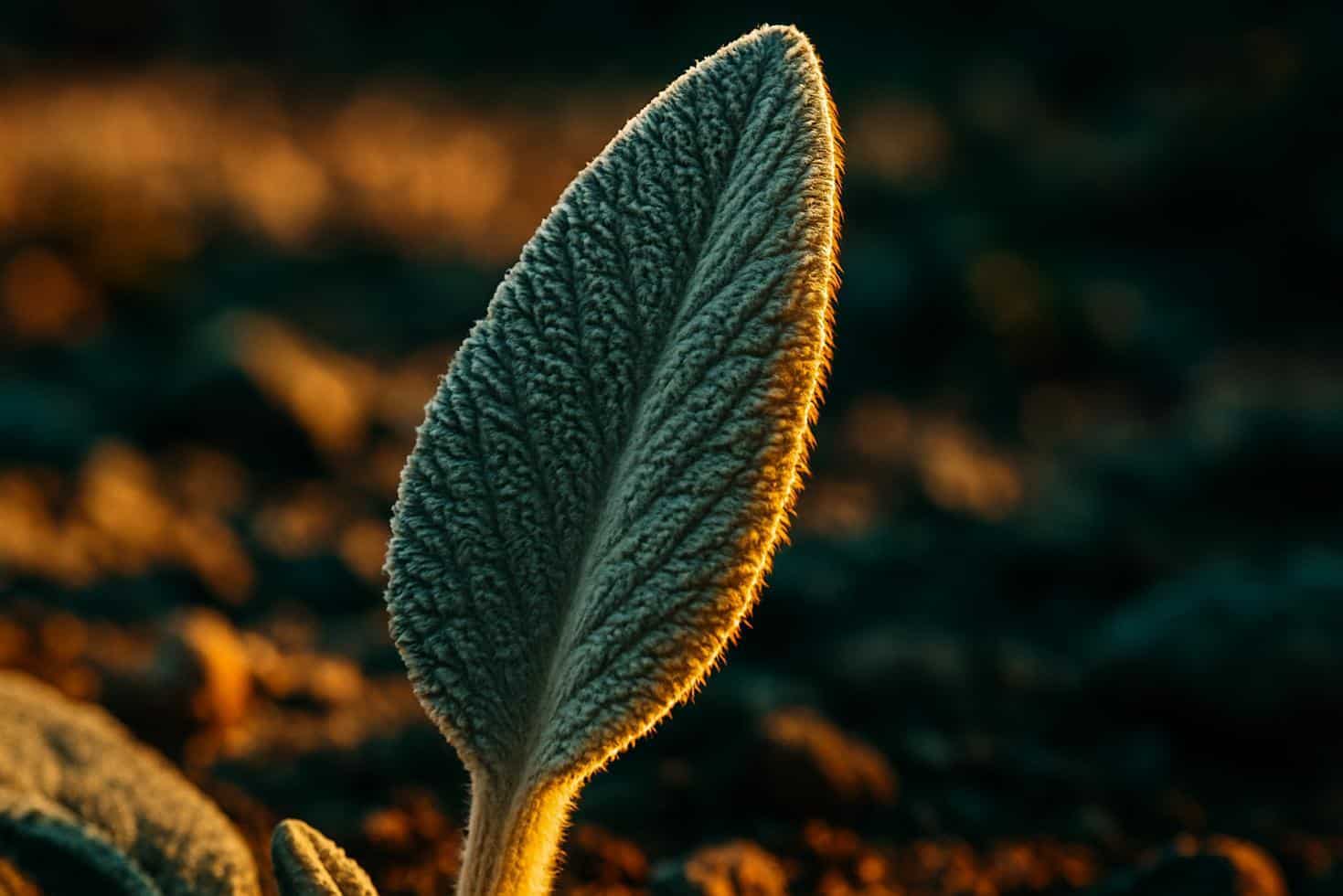
Thousands of trichomes blanket every lamb’s ear leaf — reflecting light, trapping still air, and cutting water loss in soil where most plants collapse.
The dense white fuzz covering Stachys byzantina is a trichome layer — a structural adaptation that modifies light, temperature, and moisture at the leaf surface. That softness underfoot in a dry garden border is actually a working drought system, built from microscopic hair-like outgrowths of the epidermis.
Each trichome scatters incoming sunlight in multiple directions. No single point on the leaf absorbs a concentrated dose of heat. Between the hairs and the leaf surface, a thin sleeve of still air forms — and still air neither conducts heat nor pulls moisture the way moving air does.
How Trichomes Reflect Light and Reduce Leaf Temperature
The silvery color of lamb’s ear comes directly from this trichome density. Dense hairs reflect a portion of incoming solar radiation back before it reaches living tissue. light scattered across multiple trichome angles means the leaf surface runs cooler than a smooth leaf would under identical sun exposure. No single spot gets cooked.
This is the same structural principle found in other drought-adapted plants, where velvety or hairy surfaces shift the energy budget at the epidermis rather than relying solely on internal chemistry.
How the Still-Air Pocket Slows Water Loss
Moving air is the enemy of a dry-climate plant. It strips humidity from the boundary layer around the leaf and accelerates transpiration. Trichomes interrupt that airflow. They trap a thin, relatively humid sleeve of air against the surface.
That microenvironment means the leaf’s vapor pressure deficit drops, slowing the rate at which water escapes through stomata. The plant holds onto moisture longer — not by storing more, but by losing less. It is a passive mechanism requiring no energy expenditure from the plant.
Why Lamb’s Ear Survives Where Other Plants Don’t
Poor, dry soil is exactly the environment trichomes are suited for. A plant with fewer resources to spend on active water management benefits enormously from a passive surface structure that reduces demand. Stachys byzantina thrives in conditions that stress or kill smooth-leaved plants not because it stores more water, but because its surface architecture conserves what it has.
The trichome layer also creates a physical barrier against some insects, adding a secondary function to the same structure doing the thermal and moisture work.
The softest leaf in the garden turns out to be running one of the more elegant surface systems in the plant world. Structure doing the work that chemistry would cost too much to maintain.
That fuzz isn’t softness. It’s efficiency.
Frequently Asked Questions
What are the hairs on lamb’s ear called?
They are trichomes — hair-like outgrowths from the leaf epidermis that give the plant its characteristic silver, velvety texture.
Do lamb’s ear leaf hairs actually help the plant survive drought?
Yes. Trichomes reflect light, reduce surface temperature, and trap still air that slows water loss through the leaf — all passive mechanisms that aid drought tolerance.
Why does lamb’s ear feel so soft?
The density and fine structure of the trichomes create a tactile softness. The texture is structural, produced by the physical arrangement of the hairs, not by any coating or chemical.
Is the velvety texture of lamb’s ear unique?
No. Multiple plant species produce velvety or hairy leaf surfaces through trichomes or specialized epidermal cells, all serving similar functions in light management and water conservation.