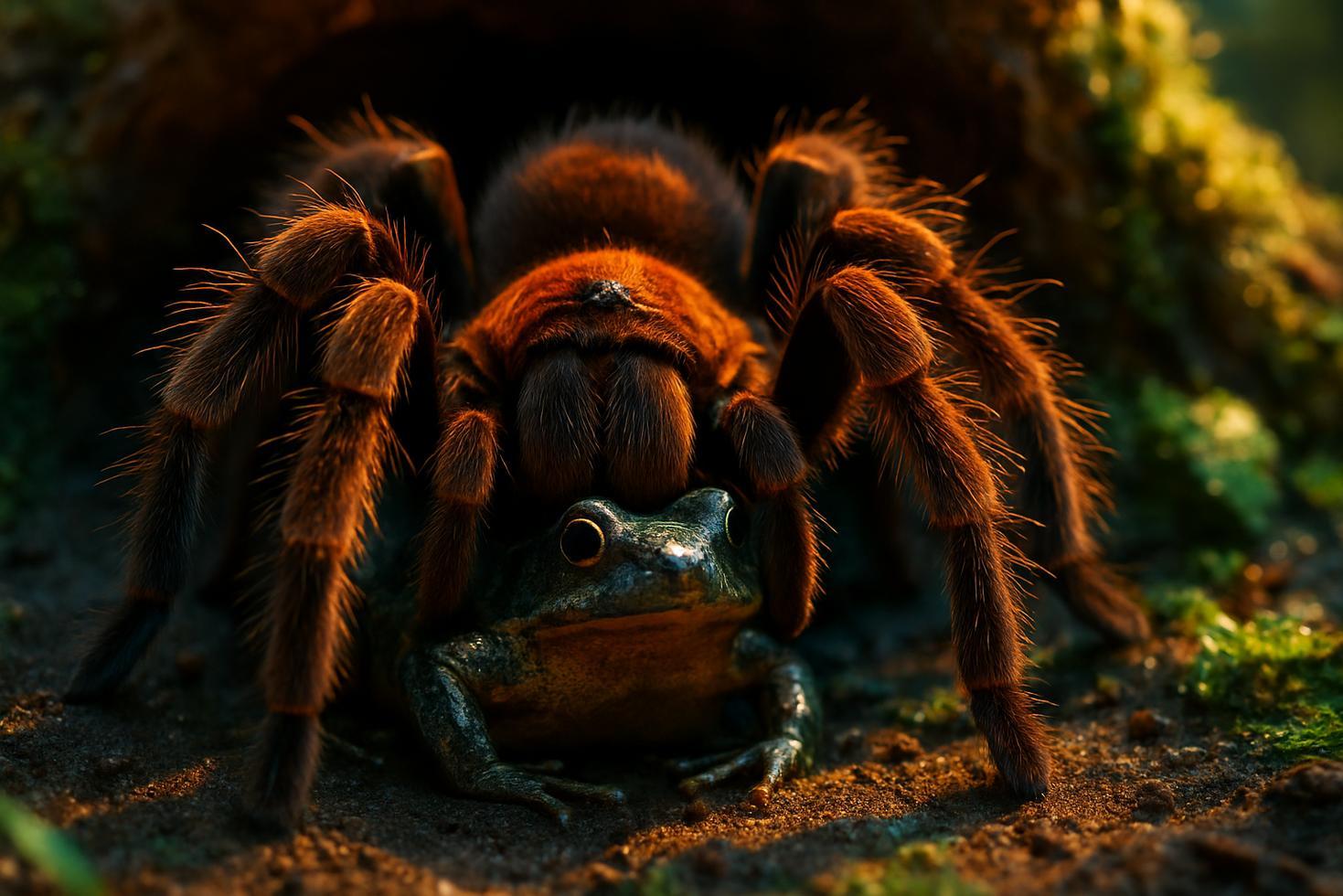
A burrowing tarantula in Peru shares its den with a tiny frog — the frog consumes ants threatening spider eggs, while the spider’s presence drives away snakes, geckos, and mantids entirely.
In southeastern Peru, the burrowing tarantula Xenesthis immanis tolerates the small microhylid frog Chiasmocleis ventrimaculata inside and around its burrow — not as prey, but as a cohabitant with measurable benefits for both animals. It’s one of those arrangements that sounds implausible until the mechanism clicks into place. A spider that could easily eat a frog, and a frog that has every reason to flee a spider, and yet neither does.
The association has been documented across multiple observations, with records going back to a 1989 field study and continuing through reviews in 2016.
Quick facts:
– Species involved: Xenesthis immanis (tarantula) and Chiasmocleis ventrimaculata (frog), southeastern Peru
– The frog eats ants and small invertebrates that can threaten spider eggs near the burrow
– The tarantula’s presence correlates with the absence of snakes, geckos, and mantids from occupied cavities
– The frog likely produces skin chemicals that signal the spider to treat it as non-prey
– Similar tarantula-frog associations have been observed in Sri Lanka as well
How Frog Skin Chemistry Shapes the Tarantula’s Response
The frog doesn’t survive this arrangement through speed or camouflage. Researchers believe Chiasmocleis ventrimaculata produces skin secretions that the tarantula detects as a non-prey chemical signal. frog skin chemistry altering predator strike behavior is the proposed mechanism — the spider registers the frog as something other than food and does not attack. This isn’t described as a learned behavior. It appears to operate through chemical recognition at the moment of contact or proximity.
What Each Animal Actually Gains From Sharing a Burrow
The frog’s benefit is substantial. Snakes, geckos, and mantids — all capable of eating a small frog — were absent from tarantula-occupied cavities in Sri Lankan tree-hole observations. The tarantula’s presence effectively clears the space of the frog’s predators without any coordinated effort.
The tarantula’s benefit comes from the frog’s diet. Ants are a documented threat to spider eggs, and Chiasmocleis ventrimaculata forages on exactly the kind of small invertebrates that accumulate around a burrow and its prey remains. A 1989 observation documented frogs feeding on invertebrates attracted to those remains. Later reviews in 2016 confirmed the ant-eating role in this context.
Neither animal does anything for the other in any intentional sense. The benefits are real and reciprocal, but they emerge from instinct and chemistry, not cooperation in any cognitive sense.
Closing
This association between Xenesthis immanis and Chiasmocleis ventrimaculata sits in a category biology calls mutualism — two species whose proximity improves survival outcomes for both, with no planning required from either side. The records span decades and multiple continents, with similar pairings documented in Sri Lanka.
The frog found the one neighbor whose presence made everything else leave it alone.
Frequently Asked Questions
What tarantula and frog species are involved in this mutualism?
The best-documented case involves Xenesthis immanis, a burrowing tarantula, and Chiasmocleis ventrimaculata, a microhylid frog, in southeastern Peru.
Why doesn’t the tarantula eat the frog?
Researchers believe the frog produces skin secretions that the tarantula detects as a non-prey chemical signal, causing it to tolerate rather than attack the frog.
How does the frog benefit from living near a tarantula?
Snakes, geckos, and mantids — predators of small frogs — were absent from cavities occupied by tarantulas in documented field observations.
How does the tarantula benefit from the frog’s presence?
The frog eats ants and small invertebrates near the burrow that can threaten the spider’s eggs, a role confirmed in observations from 1989 onward and reviewed in 2016.