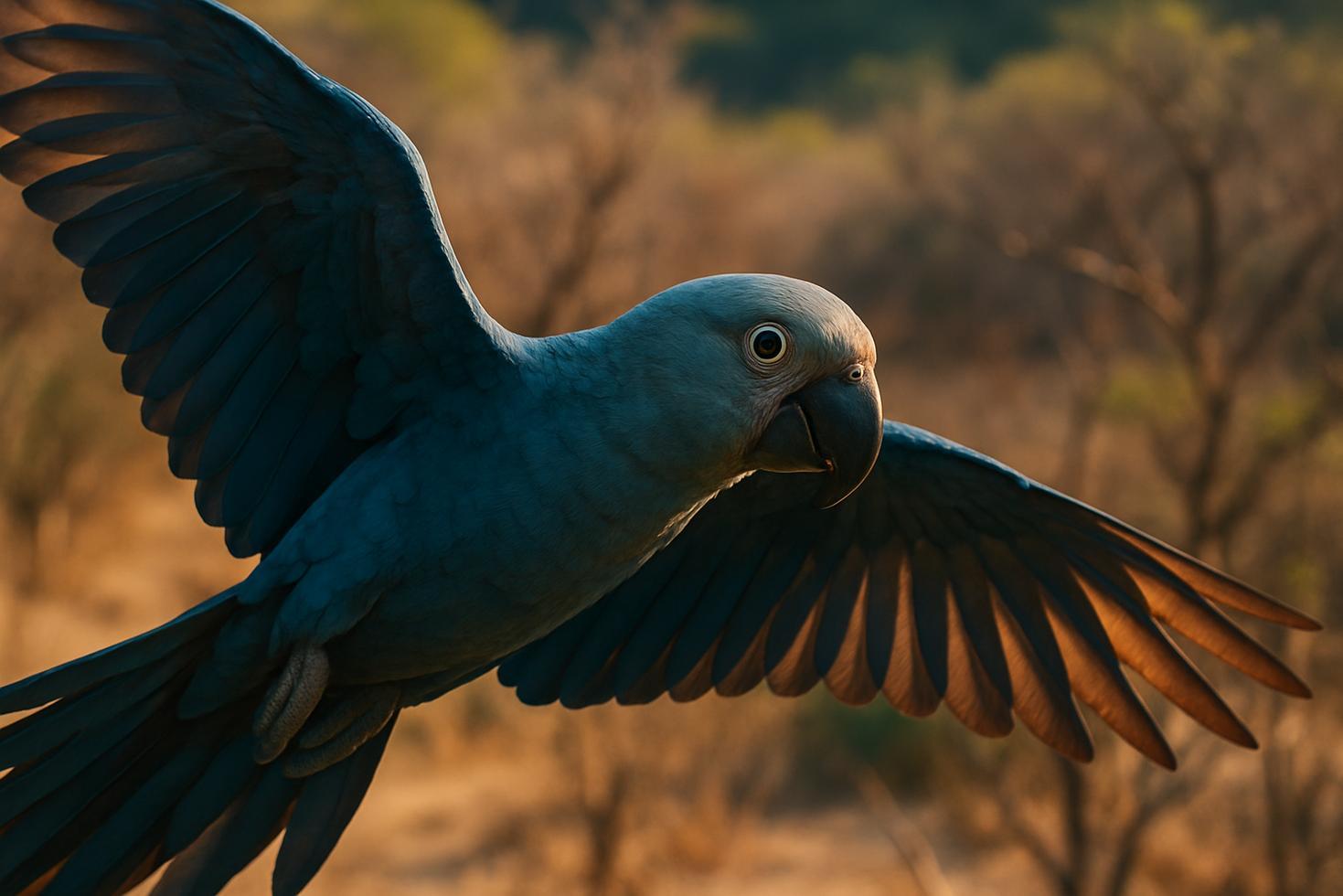
79 captive birds in 2012 grew to 158 by 2018 — all descended from just two individuals. In June 2022, eight of them touched caatinga soil for the first time.
The Spix’s macaw disappeared from the wild in 1990 and was formally declared extinct in the wild by the early 2000s. What followed was one of conservation biology’s most intricate puzzles: not just breeding a species back from the edge, but teaching captive-born birds to function as wild animals in a landscape that had to be rebuilt around them.
The captive population grew from 79 individuals in 2012 to 158 by 2018. Roughly 200 birds have since been bred, all tracing back to just two founding animals.
What Behavioral Training Spix’s Macaws Required Before Release
Captive-bred birds had never encountered a predator, a native food plant, or another macaw moving through open sky. The reintroduction program addressed each gap deliberately.
Birds were co-housed with blue-winged macaws (Primolius maracana) to absorb flock behavior through proximity rather than human instruction. Predator recognition and flight training were built into the pre-release program alongside a deliberate reduction in human contact. Supplementary feeding was planned for approximately one year after release to buffer the transition.
Radio transmitters tracked released birds for at least three months, giving researchers a real-time read on survival.
How Brazil’s Caatinga Habitat Was Restored for the Reintroduction
The birds weren’t released into an untouched wilderness. The caatinga in Bahia’s Juazeiro and Curaçá municipalities required parallel restoration work before any release was viable.
Brazil designated two protected areas — the Blue Macaw Environmental Protection Area and the Blue Macaw Wildlife Refuge — totaling approximately 120,000 hectares across that region. Anti-poaching enforcement accompanied habitat work, addressing one of the pressures that had contributed to the original collapse.
By 2023, the wild population in the Curaçá area was reported at 55 birds, with at least three wild-born chicks documented within two years of the 2022 releases.
Frequently Asked Questions
When did Spix’s macaw go extinct in the wild?
The last confirmed wild individual was seen in 1990, and the species was declared extinct in the wild by the early 2000s.
How many Spix’s macaws were released in 2022?
Eight birds were released in June 2022, followed by 12 more in December 2022, for a total of 20 birds that year.
What species helped train Spix’s macaws for the wild?
Blue-winged macaws (Primolius maracana) were co-housed with Spix’s macaws during the adaptation period to teach flock behavior.
Have wild-born Spix’s macaws been documented since the releases?
Yes. At least three wild-born chicks were reported in Brazil within approximately two years of the first 2022 release.