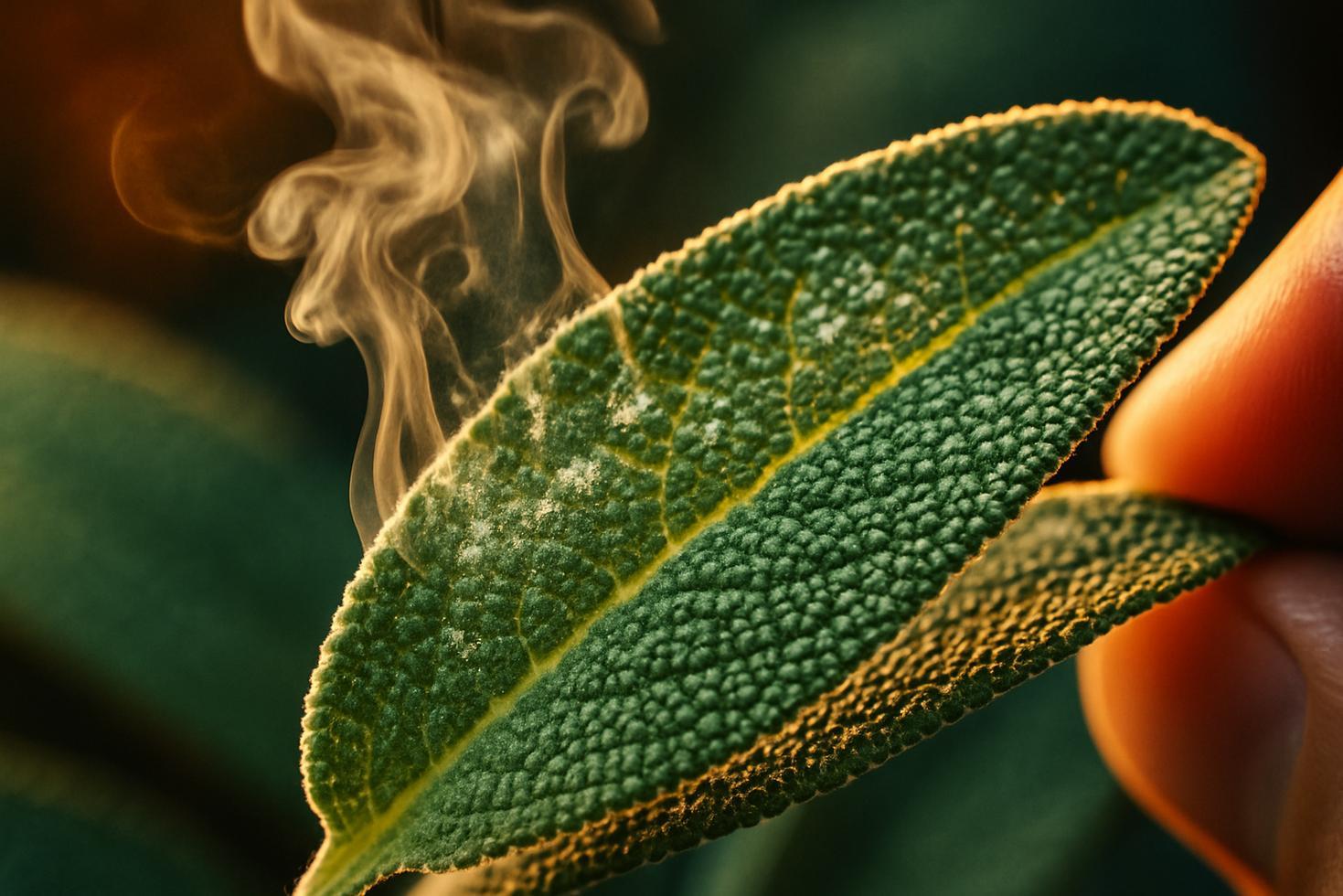
Sage oil runs 54.3% alpha-thujone and 18.8% camphor — sealed inside glands until the leaf breaks. Paired with patchouli oil, that release delivered 270 minutes of complete mosquito protection in a peer-reviewed trial. The leaf doesn’t broadcast. It waits.
Sage leaves store their insect-repelling compounds — primarily alpha-thujone and camphor — inside surface glands that only release those volatiles when the leaf is physically damaged. That release doesn’t create a barrier. It creates a chemosensory disruption that interferes with a mosquito’s ability to locate a host at all. The mechanism is olfactory, not physical, and the distinction matters enormously for understanding why the plant works the way it does.
How Sage Leaf Glands Lock and Release Volatile Compounds
Sage leaves carry their essential oils inside glandular trichomes — microscopic structures distributed across the leaf surface. Those glands hold the oil under physical containment. Volatile emission stays low until something ruptures the gland wall.
Physical damage — bruising, crushing, tearing — breaks that containment. Alpha-thujone and camphor then enter the air as free volatiles. Volatile emission depends entirely on gland rupture. No damage, no meaningful release.
What Alpha-Thujone and Camphor Do to Mosquito Chemoreception
Mosquitoes find hosts through olfaction. They detect carbon dioxide, skin odors, and temperature gradients through chemosensory receptors that generate host-seeking behavior. Alpha-thujone and camphor, once airborne, interfere with that receptor system.
The disruption isn’t a physical block. Volatiles scramble the olfactory signal itself, leaving the mosquito unable to resolve host location even when the host is present. The mosquito’s navigation system receives input it cannot decode.
What the Peer-Reviewed Protection-Time Data Actually Shows
The strongest verified data comes from a study measuring median complete-protection time against two mosquito species. Sage oil combined with patchouli oil delivered 270 minutes of protection against Aedes dirus. A 1:1 sage-and-basil combination reached 150 minutes against Aedes aegypti.
These are species-specific results from controlled conditions. Neither figure generalizes automatically across all mosquito species or application methods. The data shows the mechanism is real and measurable — it also shows that pairing matters.
Closing
Sage carried this chemistry long before anyone studied it. The glands evolved as a defense, not a convenience, and they only open when the plant is already under stress. That timing — release triggered by damage — is what makes the chemistry available at all.
The mosquito doesn’t find an obstacle. It finds noise where a signal should be.
Frequently Asked Questions
Does rubbing a sage leaf on skin repel mosquitoes?
Crushing sage releases alpha-thujone and camphor from leaf glands, and those volatiles disrupt mosquito olfaction. The effect depends on volatile concentration in the air, not direct skin contact.
How long does sage repel mosquitoes?
In a peer-reviewed trial, sage combined with patchouli oil produced 270 minutes of complete protection against Aedes dirus. Results vary by species and formulation.
What compounds in sage actually repel mosquitoes?
Sage essential oil is approximately 54.3% alpha-thujone and 18.8% camphor. Both compounds have documented repellent or biting-deterrent activity against mosquitoes.
Does sage work better fresh or dried?
The essential oils are stored in leaf glands that emit volatiles when ruptured. Drying can reduce volatile oil content, though a direct fresh-versus-dried comparison is not confirmed by peer-reviewed sources.