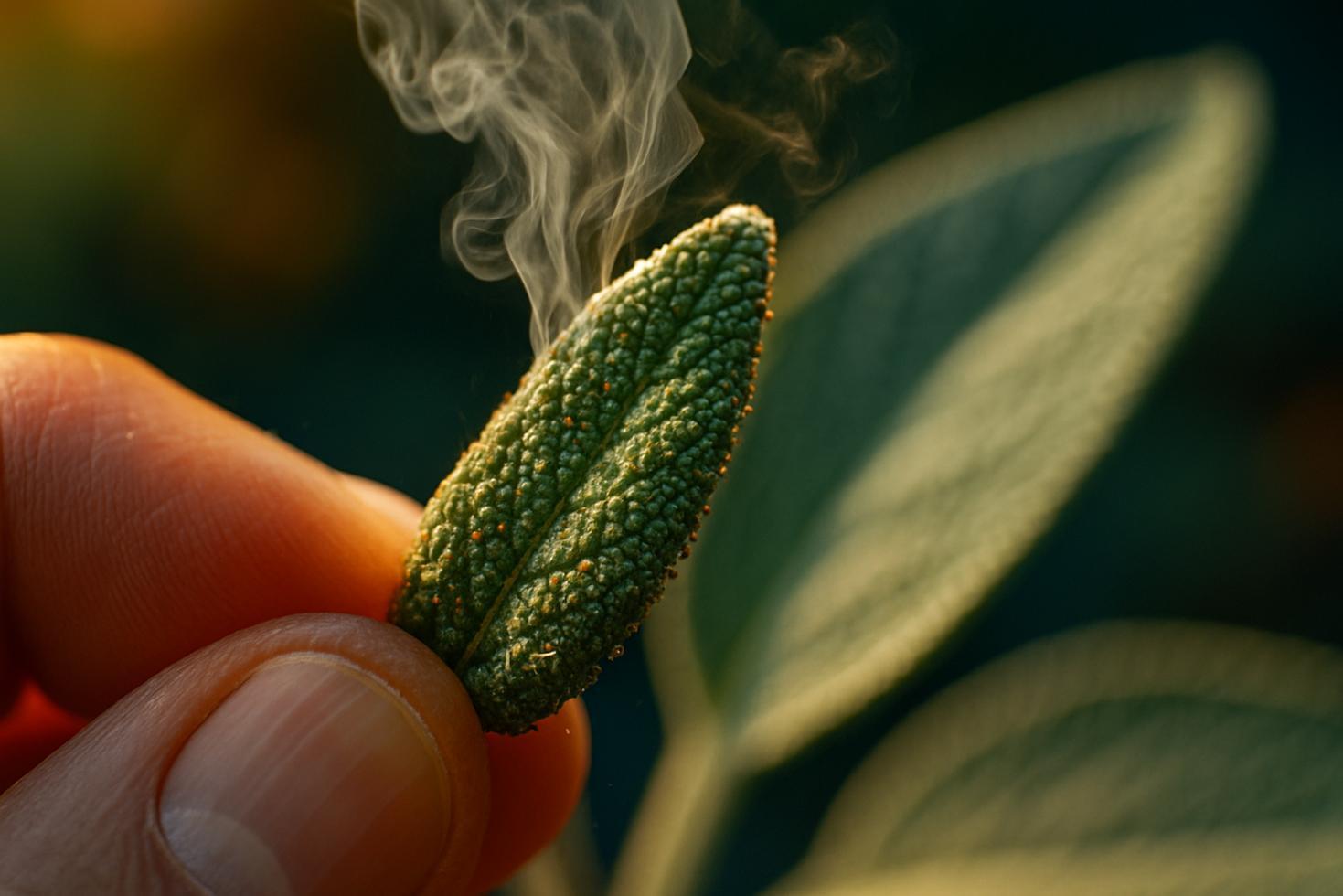
Sage oil is 54.3% alpha-thujone — stored under pressure in microscopic surface chambers. Crushing the leaf breaks those chambers open and floods the air with a compound that disrupts how mosquitoes read chemical cues. The invitation disappears.
Sage leaves deter mosquito biting by releasing terpene volatiles — primarily alpha-thujone — from glandular structures on the leaf surface when the tissue is mechanically damaged. That mechanism is more interesting than it first sounds. The plant isn’t doing anything active. It built the storage system; physics does the rest.
Peer-reviewed analysis of sage essential oil found alpha-thujone at 54.3% of total composition, with camphor at 18.8%. Those aren’t trace amounts. Together they account for nearly three-quarters of what floods the air when a leaf is crushed.
How Sage Stores and Releases Its Terpene Compounds
Aromatic herbs like sage concentrate their volatile oils inside glandular trichomes — raised structures visible on the leaf surface. These act as pressurized reservoirs. Physical damage, brushing, or crushing ruptures them and releases the contents into the surrounding air.
The exact amount released and the degree of protection from bruised fresh leaves specifically depends on oil concentration, the mosquito species involved, and how the damaged material is applied or used. Glandular rupture as the release trigger is the verified mechanism, but bruised leaves alone are not a guaranteed skin barrier.
What Alpha-Thujone and Camphor Do to Mosquito Navigation
Mosquitoes locate hosts by reading airborne chemical signals — carbon dioxide gradients, skin volatiles, and other olfactory cues. Essential-oil repellency works largely through insect chemoreception and olfactory avoidance.
Monoterpenes like those in sage can interact with multiple insect nervous-system targets. Documented targets include GABA receptors, nicotinic acetylcholine receptors, TRP channels, and acetylcholinesterase. Alpha-thujone’s high concentration drives repellency — researchers attributed the activity primarily to it, noting the minimal contribution of 1,8-cineole in sage’s specific composition.
Sage oil combined with patchouli achieved a median complete-protection time of 270 minutes against Aedes dirus in one study.
Sage Oil’s Broader Mosquito Bioactivity
Beyond biting deterrence, Salvia species show larvicidal activity. S. elegans oil produced an LC50 of 46.4 ppm against Aedes albopictus larvae at 24 hours. S. splendens Blue Ribbon reached LC50 of 59.2 ppm under the same conditions.
These are essential-oil findings, not fresh-leaf findings. Larvicidal potency at 46.4 ppm represents a concentration only achievable through extraction, not casual handling. Still, the underlying chemistry operates whether the oil is extracted or volatilizing naturally off a crushed leaf.
The compounds are real. The activity is verified. The scale of effect changes with concentration and delivery method.
Sage built nothing with mosquitoes in mind. It built pressurized oil chambers for its own reasons, and those chambers happen to broadcast a signal that erases it from a mosquito’s chemical map. That’s the whole story, told in terpenes.
Frequently Asked Questions
Does crushing sage leaves actually repel mosquitoes?
Crushing releases volatile terpenes from glandular structures, and sage oil has verified biting-deterrent activity — but protection from bruised fresh leaves depends on oil concentration, application method, and mosquito species.
What is alpha-thujone and why does it matter in sage?
Alpha-thujone is the dominant compound in sage essential oil at 54.3% of total composition. Researchers attribute sage’s repellent activity primarily to it because of that high concentration.
How long does sage oil repellency last?
In one study, a sage-and-patchouli oil combination provided a median complete-protection time of 270 minutes against Aedes dirus.
Does sage oil kill mosquitoes or just repel them?
The strongest verified evidence is for biting deterrence and olfactory disruption. Separately, Salvia species oils show larvicidal activity against Aedes albopictus at concentrations around 46–59 ppm.