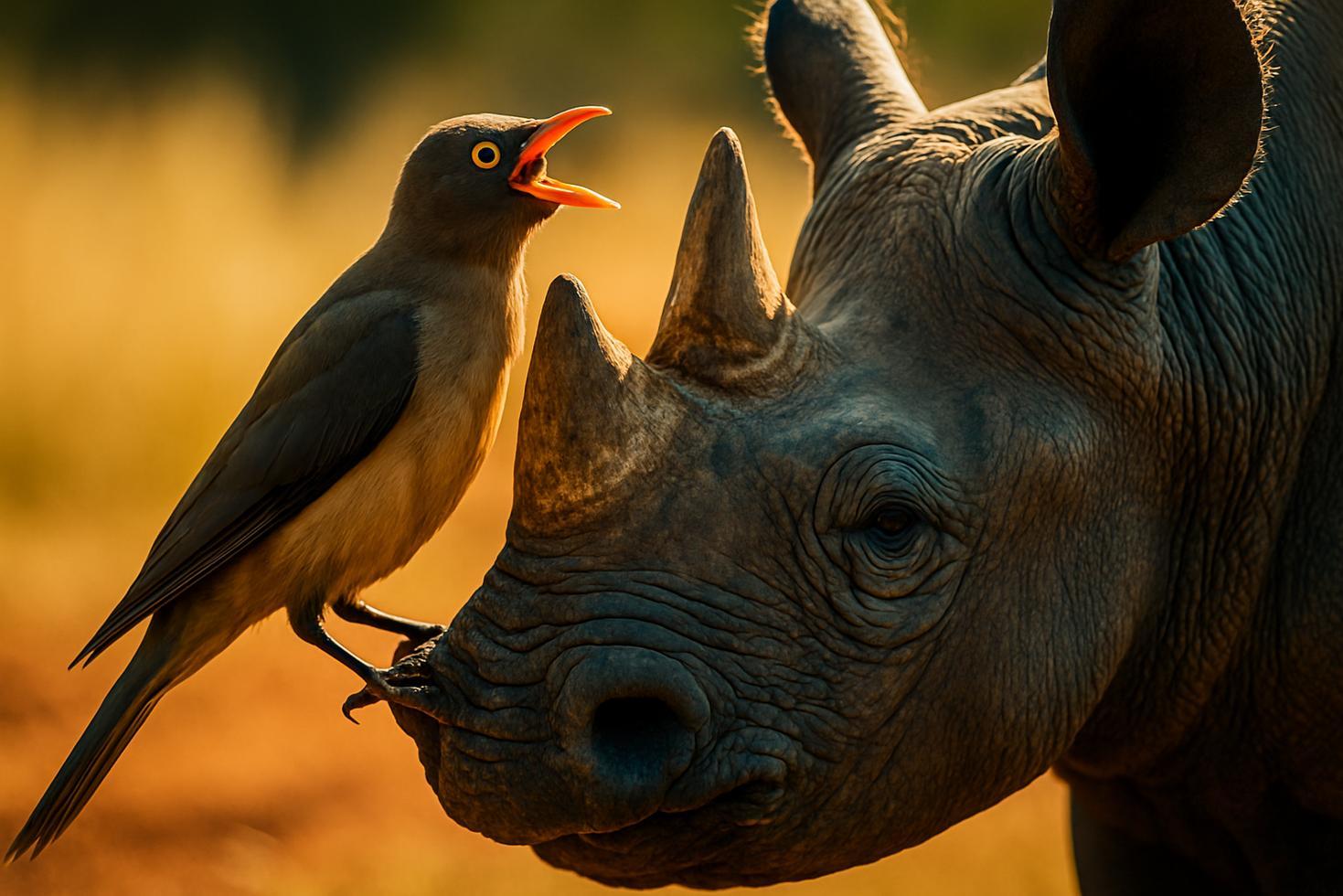
In 86 experimental approaches to 11 rhinos, oxpeckers pushed human-detection from 23% to 100% — adding 34 meters of warning distance and blocking nearly half of all possible encounters.
Red-billed oxpeckers function as living alarm systems for black rhinos, measurably transforming one of Africa’s largest animals into a far harder target to approach undetected. Black rhinos have notoriously poor eyesight. A standing human at close range can go completely unnoticed. That gap is precisely where the oxpecker operates.
Researchers at Hluhluwe-iMfolozi Park, South Africa, spent 27 months testing just how much the bird changes the equation. The numbers are striking enough to reframe how the partnership is understood.
What Oxpecker Alarm Calls Actually Do — and How Rhinos Respond
The oxpecker’s alert is a hiss or shrill call fired the moment a human approaches. What happens next reveals something unexpected. Alerted rhinos didn’t orient toward the source of the sound. They moved to face downwind instead.
That tells researchers the call conveys threat proximity, not threat direction — the bird signals danger is close, and the rhino defaults to using its strongest remaining sense, smell, to locate it. The partnership works precisely because each animal contributes what the other lacks.
The Scale of the Sentinel Effect in 86 Experimental Approaches
The study design was deliberate: 86 unconcealed approaches to 11 rhinos over 27 months, conditions controlled enough to isolate the oxpecker’s contribution. The detection distance gap — 27 meters without birds versus 61 meters with them — nearly doubled the window a rhino had to respond.
The Swahili name for the red-billed oxpecker, askari wa kifaru, translates as “the rhino’s guard.” That name predates the science. The study confirmed it.
Oxpeckers feed on ticks and ectoparasites across more than 20 mammal species, though research suggests the relationship isn’t purely mutualistic — the birds often consume already-fed ticks and may not reliably reduce parasite loads. The sentinel role, however, is documented and quantified.
What This Means for Black Rhino Conservation
Black rhinos remain critically endangered. The oxpecker adds a measurable anti-poaching buffer — not by design, but as a byproduct of the bird’s own self-interest in detecting anything unusual near its host. A rhino with oxpeckers aboard is effectively harder to approach without triggering an alert.
That 40%–50% encounter-blocking estimate applies to human approaches generally. The same mechanism that stopped researchers also applies to anyone approaching on foot.
The rhino is armored, horned, and heavy. Its sharpest defense weighs less than a handful of coins.
Frequently Asked Questions
How much did oxpeckers improve black rhino threat detection?
Detection success rose from 23% to 100% across 86 experimental approaches in Hluhluwe-iMfolozi Park, South Africa.
How far away can a black rhino detect a human with oxpeckers present?
Mean detection distance was 61 meters with oxpeckers, compared to 27 meters without them.
Do oxpeckers signal which direction a threat is coming from?
No — alerted rhinos moved downwind rather than toward the threat, indicating the call communicates proximity, not direction.
Do oxpeckers benefit the rhino beyond alarm calls?
Oxpeckers feed on ectoparasites, but research indicates they often eat already-fed ticks and may not reliably reduce parasite loads on large mammals.