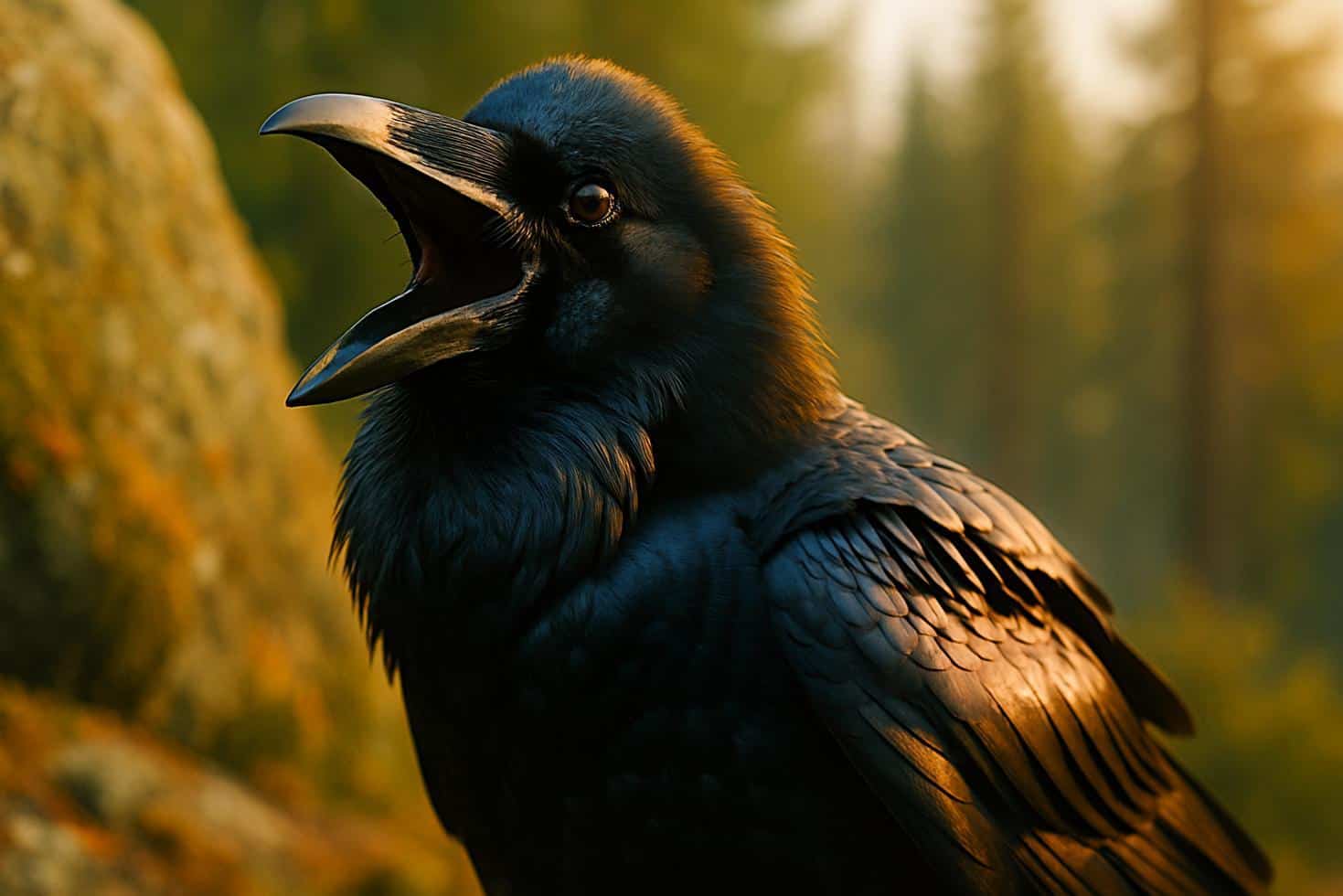
Scientists have documented 33 distinct raven vocalizations — and in captivity, some drop into registers so low and deliberate that listeners stop walking.
The common raven can mimic human speech in a voice so deep and guttural that observers consistently describe it as unsettling rather than charming. That quality isn’t random. It comes directly from the syrinx — a specialized vocal organ sitting at the base of the trachea — which ravens control on both sides independently, shaping airflow and membrane vibration with unusual flexibility compared to most bird species.
What comes out isn’t the bright, melodic impression of a parrot. It’s something lower. Rougher. The kind of sound that makes a person turn around.
How the Raven Syrinx Produces That Deep, Rough Sound
Bird vocal anatomy centers on the syrinx rather than a larynx. In ravens, the syrinx and its associated musculature are highly developed. Independent bilateral control of the syrinx lets a raven layer and modulate sounds in ways most birds cannot access. The result includes clicks, gurgles, croaks, and the kind of low, deliberate syllables that sound less like imitation and more like something chosen.
This mechanism explains why raven mimicry carries a different texture than parrot speech — not better articulated, but differently shaped, heavier in the lower registers.
What 33 Documented Vocalizations Actually Reveal About Raven Communication
Scientists studying raven communication have identified at least 33 distinct call types. These include territorial calls, alarm calls, social contact calls, and complex imitations of other sounds in the environment. In captivity, where ravens are exposed to human voices consistently, some individuals learn to reproduce words and short phrases. Reports describe words like “hello” and “hi” repeated in context — not random noise, but sounds associated with particular social situations.
Associating specific sounds with specific contexts is well-documented in captive ravens. Whether that constitutes semantic understanding is a different question, and one current evidence doesn’t resolve cleanly. The behavior is real. The interpretation of intention remains a human overlay.
Raven Mimicry in the Wild and Its Limits
Wild ravens primarily use their vocal range for intragroup functions: coordinating around food sources, signaling rivals, maintaining contact. They can mimic other birds and environmental sounds. Human speech mimicry, however, is documented almost entirely in captive individuals with consistent exposure to human voices.
The popular idea that wild ravens mimic wolf calls to deliberately lure predators to carcasses they cannot open on their own is ecologically appealing but not empirically established. What is well-documented is the raven-wolf relationship itself: ravens follow wolf packs, arrive quickly at kills, and benefit from carnivores opening hides they cannot penetrate alone. The vocal manipulation story is extrapolation, not confirmed field data.
The ecological relationship is real. The specific mimicry mechanism driving it is still speculative.
Ravens don’t need folklore to be interesting. Thirty-three distinct call types, bilateral syrinx control, and a mimicry register that stops people mid-step is a complete story on its own. The voice just makes it harder to leave it at that.
Frequently Asked Questions
How many vocalizations do ravens have?
Scientists have documented at least 33 distinct raven vocalizations, including territorial, alarm, social, and imitative calls.
Can ravens really mimic human speech?
Yes. Captive ravens can reproduce human words and short phrases, typically in a deep, raspy register that observers describe as distinctly different from parrot mimicry.
Are ravens better at talking than parrots?
No. Parrots — particularly African grey parrots — are more articulate and produce larger vocabularies. Ravens can mimic human speech, but parrots are the more capable talking birds by mainstream scientific consensus.
Do wild ravens mimic wolf calls to get food?
The raven-wolf ecological association is well-documented, but the specific claim that ravens mimic wolf vocalizations to lure predators to carcasses lacks empirical support in published research.