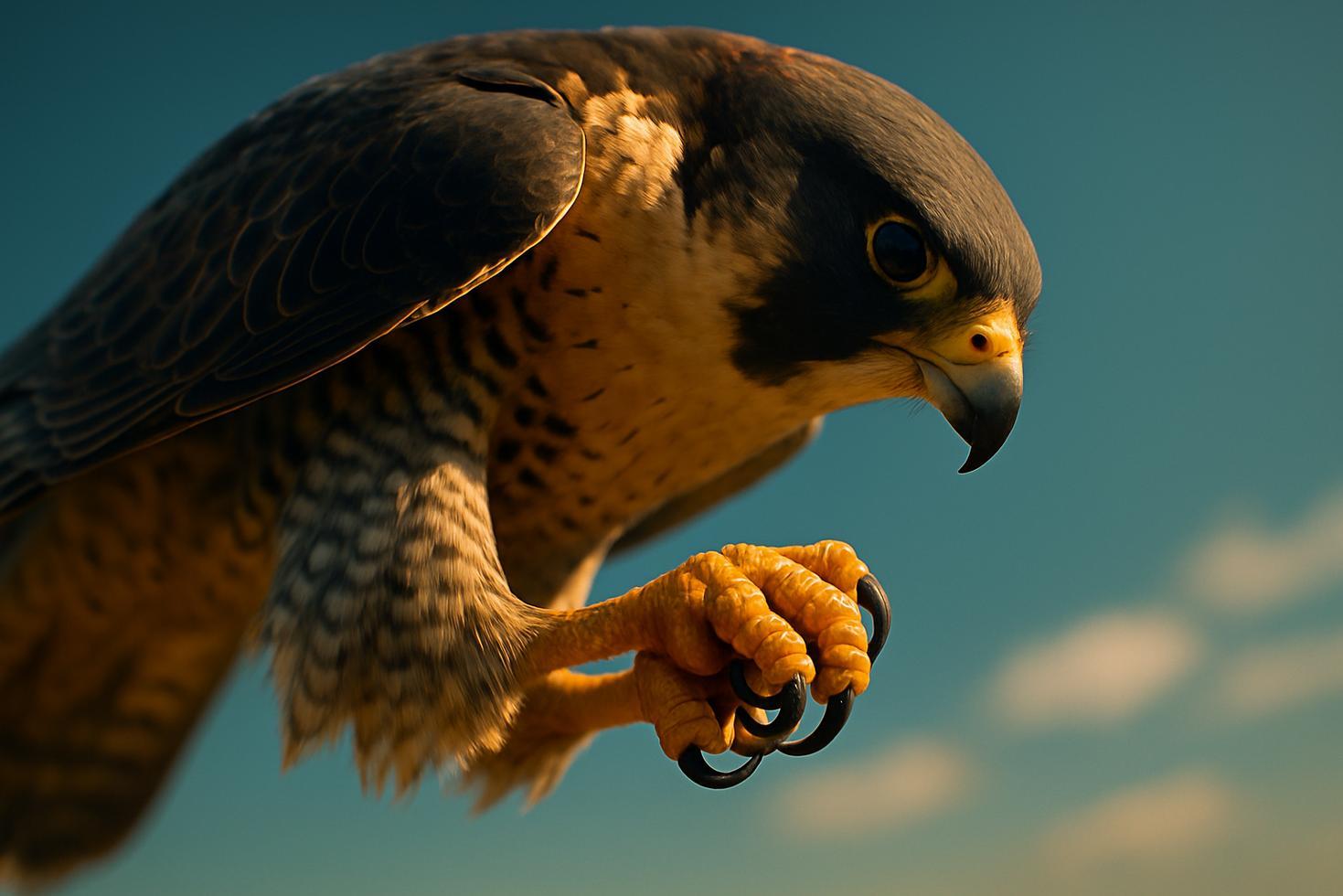
A 2005 controlled study logged 242 mph — then the falcon looped back to collect what it had already knocked unconscious. No chase required.
A peregrine falcon holds the verified record for the fastest dive of any animal on Earth, with a 2005 study recording a stoop speed of 242 mph (389 km/h). That number alone is startling. What makes it stranger is what the falcon does at that speed: it doesn’t grab. It punches.
During the stoop, the falcon balls its feet into a closed-fist shape and uses that mass to strike prey mid-air. The impact stuns or kills on contact. Then the bird circles back in a wide arc and descends calmly toward what already fell.
What the Peregrine Falcon’s Stoop Actually Looks Like
The stoop begins from height. The falcon folds its wings close and commits to a near-vertical descent. Its teardrop-shaped body, pointed long wings, and specialized nostril structure all reduce drag during the dive.
At the moment of contact, closed feet deliver the lethal kinetic blow. The prey — typically a smaller bird — is struck out of the sky. There’s no mid-air wrestling. The mechanics favor a single decisive impact over any sustained grip at speed.
Why 242 mph Is the Right Number to Use, and Where Variation Comes From
The 242 mph figure comes from Ken Franklin’s 2005 study tracking a peregrine named Frightful. It’s the most-cited directly recorded value and the one major popular science sources converge on.
Other published figures differ substantially. Some independently measured stoops have clocked closer to 114 mph (184 km/h). Theoretical aerodynamic models for an “ideal falcon” at high altitude reach even higher estimates, but those are calculated, not observed.
The gap between 114 mph and 242 mph reflects how measurement method changes the result — GPS tracking at altitude versus radar or video at lower elevations. Both numbers are real. Neither cancels the other.
The Anatomy That Makes Repeated High-Speed Strikes Possible
A stoop at 242 mph isn’t a single career event. Peregrine falcons hunt this way repeatedly. Their anatomy accommodates that reality.
Specialized nostrils manage airflow during extreme descent. A nictitating membrane — a transparent inner eyelid — protects the eyes at speed. The body’s musculature absorbs impact forces that would damage a less-adapted bird.
Dense chest muscle and aerodynamic wing shape work together across every stoop. None of it is decorative. Each feature maps to a specific physical demand of the dive.
The peregrine doesn’t chase. It removes the distance so completely that the outcome is settled before the prey processes a threat. Speed is the mechanism. The punch is the weapon.
Frequently Asked Questions
What is the fastest recorded speed of a peregrine falcon?
A 2005 study recorded 242 mph (389 km/h) during a controlled dive, making it the highest directly attributed figure in the scientific literature.
Does a peregrine falcon catch prey with open talons during a dive?
No. During the stoop, the falcon strikes with its feet balled closed. It retrieves fallen prey after the impact, rather than grasping mid-flight.
What is a peregrine falcon’s hunting stoop?
The stoop is a steep, high-speed dive from altitude used to strike prey in the air. It is the falcon’s primary hunting method.
Are all reported peregrine falcon speeds the same?
No. Independently measured speeds vary widely — some clocking around 114 mph — depending on altitude, measurement equipment, and conditions.