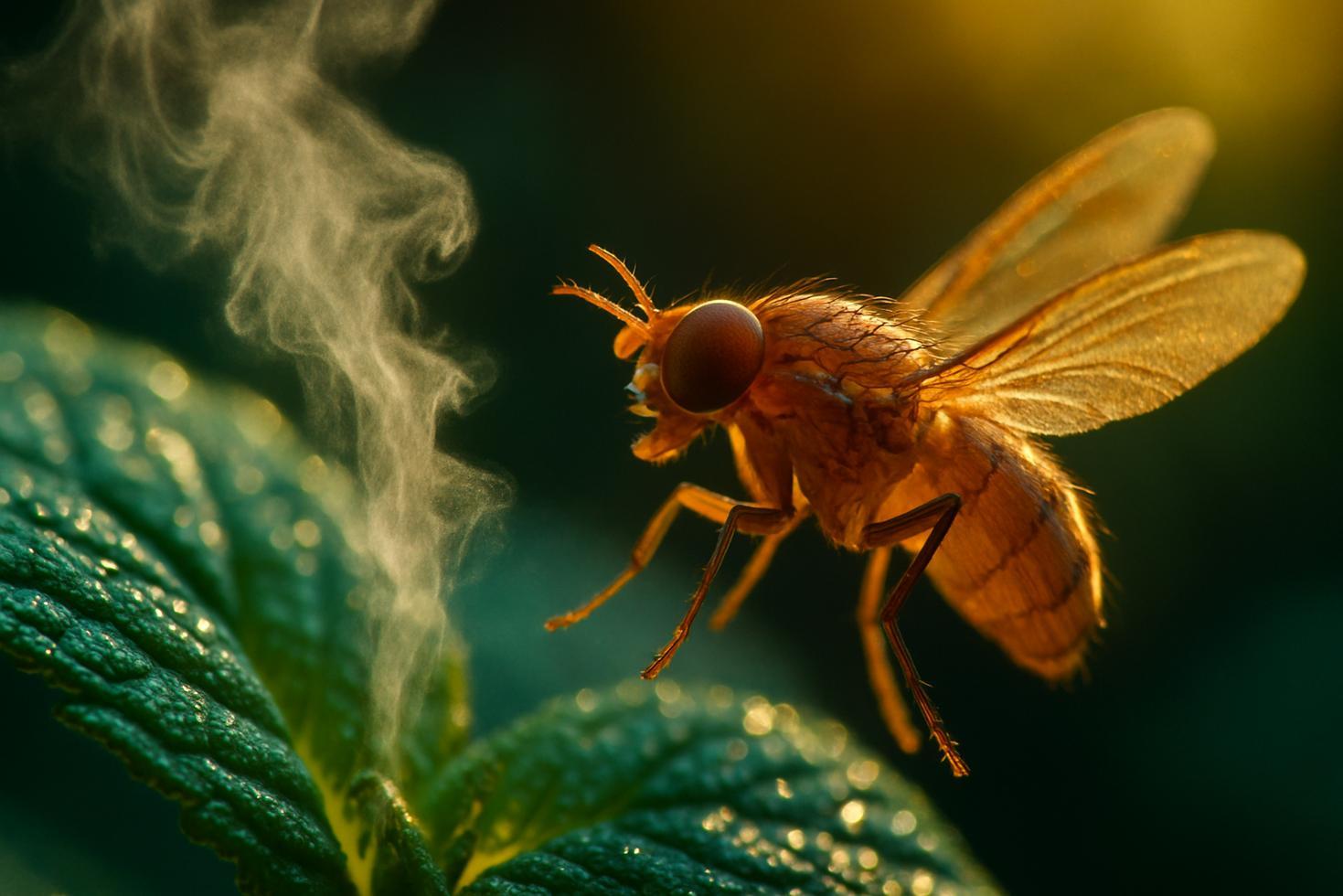
Menthol makes up 30–55% of peppermint oil — and in Drosophila lab tests, disabling the olfactory receptor co-receptor nearly erased the plant’s repellency entirely.
Peppermint (Mentha × piperita) repels insects not through toxins but through volatile compounds that overwhelm the olfactory receptors insects depend on to navigate. That distinction is the whole story. A plant that never touches an insect can still make the insect’s chemical world unreadable.
The mechanism showed up cleanly in Drosophila research. Mutant flies missing the odorant receptor co-receptor Orco showed dramatically reduced or abolished repellency responses to peppermint volatiles. The plant wasn’t repelling the insect directly — the insect’s own sensory system was doing the work.
What Peppermint Oil Actually Contains
Peppermint oil is not a single compound — it’s a mixture. Menthol leads at 30–55%, followed by menthone at 14–32%, isomenthone at 1.5–10%, and menthyl acetate, menthofuran, 1,8-cineole, and limonene rounding out the rest. Each constituent contributes separately to what insects detect.
Research on Drosophila tested individual volatiles — menthone, (-)-menthol, menthyl acetate, and (R)-(+)-limonene — and found dose-dependent repellency across multiple compounds, not a single active ingredient. The mixture matters as much as the menthol percentage.
How Olfactory Receptor Disruption Actually Works
Insects locate food, hosts, and mates primarily through chemical signals processed by olfactory receptor neurons. Peppermint volatiles activate multiple of those receptor neurons simultaneously, as electrophysiology in the Drosophila study confirmed.
When researchers knocked out Orco — the co-receptor required for most odorant receptor function — repellency dropped sharply. The same study found some Or-independent effects as well, meaning olfactory receptor pathways drive most, not all, of the response. The mechanism is receptor-mediated disruption, not a simple overwhelming of the nose.
What Concentration and Delivery Actually Determine
Repellency is not automatic. The 85% repellency index and fumigant activity figures come from controlled lab conditions with measured concentrations — as high as 2–16 µL per 30 cm² in repellency trials. Cornell’s profile documents peppermint oil as an effective mosquito larvicide at 3 ml/m² applied to water.
Effectiveness depends on concentration, formulation, target species, and delivery method — not proximity alone. A potted plant near a door does not replicate those concentrations. The research supports oil-based application and volatile emissions at sufficient levels, not passive placement as a barrier.
Closing
Peppermint’s defense is genuinely strange when examined closely. A plant that wins by making the chemical environment illegible to the insects searching it — no venom, no contact required. The Drosophila Orco experiments gave that mechanism a molecular address.
The repellency disappears almost entirely when the receptor pathway is removed. That single finding says more about how plant chemistry and insect neurology are tangled together than any field observation could.
Frequently Asked Questions
Does peppermint kill insects or just repel them?
Peppermint oil primarily repels insects through olfactory disruption; at sufficient concentrations it also shows fumigant and larvicidal activity against specific species including aphids and mosquito larvae.
Which compound in peppermint oil causes repellency?
Multiple volatiles contribute — menthol, menthone, menthyl acetate, and limonene each produced dose-dependent repellency in Drosophila testing, not menthol alone.
How was the olfactory mechanism confirmed in research?
Drosophila mutants lacking the odorant receptor co-receptor Orco showed dramatically reduced or eliminated repellency to peppermint volatiles, directly linking the effect to olfactory receptor pathways.
Does placing a peppermint plant near a door repel insects?
Research supports repellency from peppermint oil at measured concentrations; evidence does not support a potted plant creating an immediate or universal insect barrier at an entrance.