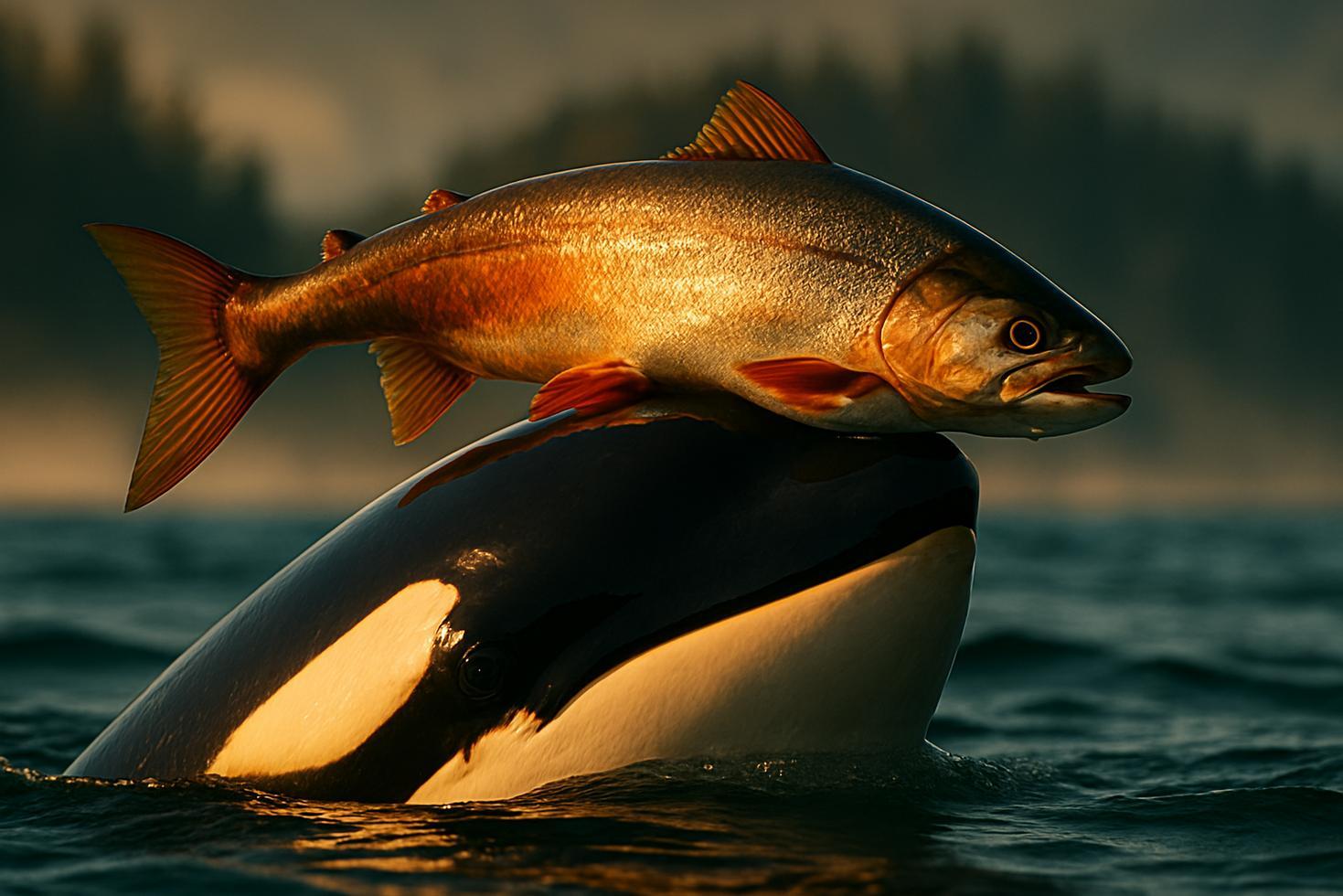
One female in K-Pod started balancing a dead salmon on her nose. Within 5–6 weeks, all three southern resident pods were doing it. Then it stopped — and stayed stopped for 37 years before returning in 2024.
A single female orca in K-Pod began balancing a dead salmon on her nose in the summer of 1987, and within 5–6 weeks the behavior had spread across K-Pod, J-Pod, and L-Pod — all three southern resident orca pods in Puget Sound. Then it vanished. The behavior sat dormant for 37 years before reappearing in 2024, once again rippling through the same population. Researchers still have no confirmed explanation for why it starts, why it stops, or why it returns.
That gap — nearly four decades of silence — is what makes the 2024 return so striking. These are not impulsive animals. Southern resident orcas carry distinct dialects, hunting traditions, and learned behaviors passed through generations. A fad that disappears and then resurfaces fits cleanly into a picture of deep cultural memory.
Quick Facts:
– One female in K-Pod originated the 1987 behavior; it spread across all 3 pods within 5–6 weeks
– The behavior faded by the end of that summer and was not observed again until 2024
– Researcher Deborah Giles, with 19 years of field work, had seen it only “a handful of times” before 2024
– No survival function has been confirmed; current hypotheses include play, social display, and food storage
– Salmon are too small and slippery to hold under a pectoral flipper, making nose-balancing a distinct technique
What Researchers Actually Know About the Salmon-Balancing Behavior
The mechanics are straightforward. An orca carries a dead salmon balanced on its rostrum — the nose — while swimming. Salmon are too slippery for pectoral-flipper storage, which orcas use for other prey, so nose-balancing is a separate technique with no obvious feeding advantage.
Hypotheses in the scientific literature remain explicitly speculative. Researchers have proposed play, social signaling, and food storage. The leading candidate in 2024 involved food abundance: South Puget Sound was teeming with chum salmon, raising the possibility that orcas were temporarily holding fish while navigating. But no hypothesis has been confirmed.
How Cultural Transmission Spreads a Behavior Across Three Orca Pods
Southern resident orcas are documented social learners. CBC reporting notes that orcas are skilled mimics, and that younger animals appear to pick up behaviors by watching pod-mates. The 1987 spread — from one individual to members of three distinct pods within weeks — matches the pattern of social copying rather than independent invention.
The 2024 return follows the same shape. One or two individuals initiated it. Others followed. Social mimicry accelerating across pod boundaries is consistent with what researchers already know about how orca culture propagates. The mystery is not the mechanism. The mystery is what triggers the cycle.
Why the 37-Year Gap Makes This Behavior Scientifically Unusual
Most documented animal fads fade and stay gone. A behavior disappearing for 37 years and then re-emerging in the same population is rare enough that researchers have no established framework for it. National Geographic and Smithsonian both quote scientists describing the situation flatly: “it’s all speculation” and “we don’t know.”
The return in 2024 gives researchers a second data set to work with — something the 1987 event never produced. Whether the gap closes to a pattern or remains an outlier depends entirely on what happens next.
The salmon hats came back. The explanation hasn’t.
Frequently Asked Questions
When did southern resident orcas first start balancing salmon on their noses?
The first documented occurrence was the summer of 1987, when one female in K-Pod initiated the behavior and it spread across all three southern resident pods within 5–6 weeks.
Did orca salmon-balancing return in 2024?
Yes. The behavior reappeared in 2024 in the same southern resident population, representing the first confirmed return since 1987.
Do orcas get any benefit from balancing salmon on their noses?
No survival function has been confirmed. Current hypotheses — play, social display, food storage — remain speculative, according to researchers quoted by National Geographic and Smithsonian.
How do orca behaviors spread between pods?
Southern resident orcas are documented social learners and mimics. Younger animals appear to copy pod-mates, and behaviors can propagate across pod boundaries through direct observation and imitation.