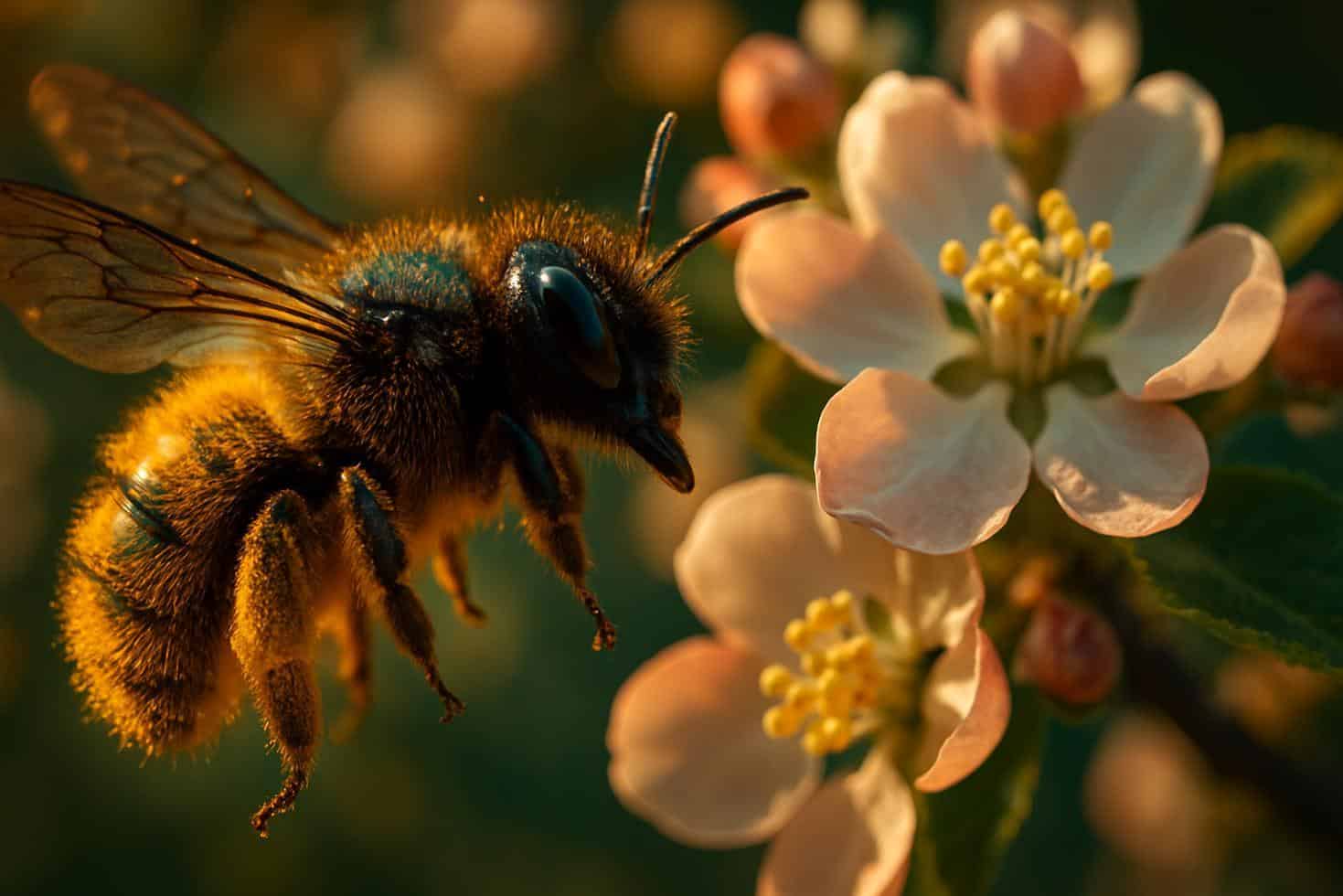
95% of every flower an Osmia lignaria touches gets pollinated — and it achieves that rate dry, loose, and fast, not by being careful about it.
The blue-black orchard mason bee (Osmia lignaria) achieves roughly the pollination work of 100 honey bees — because of where it carries pollen, not how hard it tries. Honey bees pack pollen into smooth, waxy leg pouches called corbiculae, where it stays compressed and rarely escapes onto a stigma. Mason bees carry it dry, pressed against dense abdominal hairs called scopa. Every landing scatters it.
That anatomical difference translates directly into numbers. Roughly 95% of mason bee flower visits result in successful pollination, compared to a much smaller fraction for honey bees making the same rounds.
Why Mason Bee Pollen Transport Produces Such High Transfer Rates
Honey bee corbiculae are engineered for storage. The pollen arrives at the hive intact and packaged. That’s efficient for the colony — but it means the flower rarely gets what it needs.
Mason bee scopa work the opposite way. Loose pollen on abdominal hairs scatters passively at each landing. The bee isn’t trying to pollinate anything. The transfer happens because the mechanism is inherently leaky, and that messiness is exactly what the flower requires.
What Osmia lignaria Does During Its 6-Week Active Window
The adult mason bee emerges in early spring, timed to coincide with orchard bloom. The active season runs approximately 6 weeks. During that window, a single bee can visit a large number of flowers daily, moving quickly between blossoms.
Females spend that time foraging and provisioning nest cells. Each cell receives a pollen-and-nectar mass, a single egg, and a mud cap. Mud-sealed chambers harden into protective cocoons that hold the developing larvae through summer, fall, and winter.
What Happens Inside the Nest for the Remaining 11 Months
Once the nest is sealed, the next generation enters a development and diapause period lasting roughly 11 months. This is not inactivity in a simple sense. The larva consumes its pollen provision, pupates, and eventually hardens into an adult — all inside a chamber no larger than a fingertip.
The adult is fully formed by late summer but remains inside until the following spring’s temperature cues trigger emergence. Timing is the entire strategy. Emerging too early means no bloom; too late means missed opportunity.
The 6-week active season and the 11-month nest period are not opposites. They are one continuous mechanism, split across two very different environments.
Six weeks of flight. Eleven months of stillness. The orchard runs on both.
Frequently Asked Questions
What makes mason bees better pollinators than honey bees?
Mason bees carry pollen dry against abdominal hairs (scopa), so it transfers passively on nearly every flower contact — roughly 95% of visits result in pollination, compared to far fewer for honey bees using waxy leg pouches.
Are mason bees a type of wasp or hornet?
No. Mason bees are in the family Megachilidae; wasps belong to Vespidae and related families, and hornets are large social wasps in genus Vespa — taxonomically distinct from bees.
How long does an Osmia lignaria live outside the nest?
The adult active season is approximately 6 weeks, concentrated in early spring during orchard bloom.
What is the mason bee doing for 11 months inside the nest?
The larva develops, pupates, and matures into a hardened adult, then waits in diapause until spring temperature cues signal it’s time to emerge.