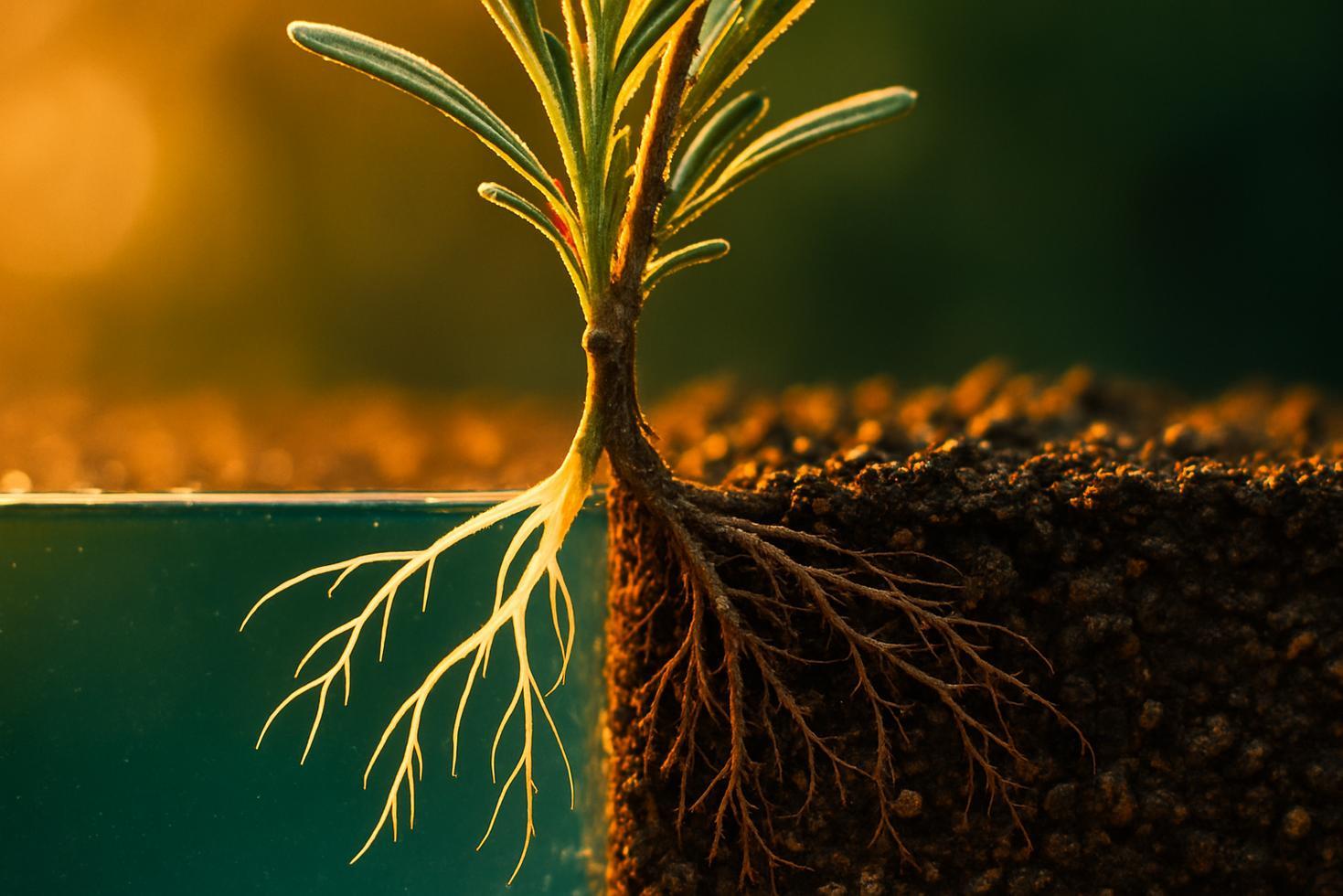
Soil-rooted lavender forms a fibrous network in 2–3 weeks. Water-rooted cuttings take up to 6 weeks — and still arrive in soil less prepared to survive it.
Lavender cuttings rooted in soil consistently outperform water-rooted cuttings at transplant time, because the two methods produce structurally different roots. That difference isn’t cosmetic. A root formed in water develops thinner, more brittle walls adapted to a high-moisture environment. A root formed in soil threads through particles from the start, building the density it will need for the rest of its life.
The gap shows up in the numbers, too. Soil-rooted cuttings can form a fibrous root network in 2 to 3 weeks. Water-rooted cuttings commonly take 4 to 6 weeks — and still carry a higher transplant failure risk when they finally meet soil.
Why Water Roots and Soil Roots Have Different Structures
When a cutting sits in water, the roots that emerge are adapted to pulling nutrients from liquid. Cell walls stay soft. The architecture stays loose. Nothing about that structure prepares the root for the friction and lower moisture of a solid medium.
Extension horticulture guidance flags this directly: water roots struggle to adjust to lower moisture once the cutting moves to soil. Truleaf’s horticulture guidance describes these roots as thinner, more brittle, and frequently unreliable at soil transition. The plant isn’t doing anything wrong — it built exactly what the environment asked for. That environment just stopped existing.
What Happens to Water Roots at Transplant
The transition is where the structural gap becomes a survival problem. Roots formed in water have no prior experience with soil particles, pressure variation, or moisture that fluctuates rather than surrounds. Some gardening sources report that water roots die outright during the adjustment period.
Soil-rooted cuttings never face that reset. From the first days, roots are threading through a solid propagation medium, building the density and structure they will carry permanently. There is no acclimation phase because there is no mismatch.
Water propagation does offer one practical advantage: it’s easy to see when rooting has occurred. But that visual clarity comes with trade-offs — higher rot risk if leaves contact the water, and a longer wait before the cutting is genuinely transplant-ready.
Closing
The biology here is straightforward. A root grows toward the conditions it expects to persist. Change those conditions late, and the plant spends resources adapting rather than establishing.
Soil-rooted lavender skips that cost entirely — arriving in the garden already at home.
Frequently Asked Questions
Can lavender cuttings be rooted in water?
Yes, lavender cuttings can root in water in roughly 4–6 weeks, but extension horticulture guidance warns they may struggle to adjust to soil afterward.
How long do lavender cuttings take to root in soil?
Soil-rooted lavender cuttings can form a fibrous network in approximately 2–3 weeks under favorable conditions.
Why do water roots fail in soil?
Water roots develop thinner, less rigid cell walls adapted to constant moisture. When transplanted, they often cannot adjust to the lower, variable moisture levels in soil.
Which propagation method is recommended for lavender?
Horticulture sources consistently recommend rooting lavender in soil or a well-aerated propagation mix for stronger, more durable roots and better post-transplant performance.