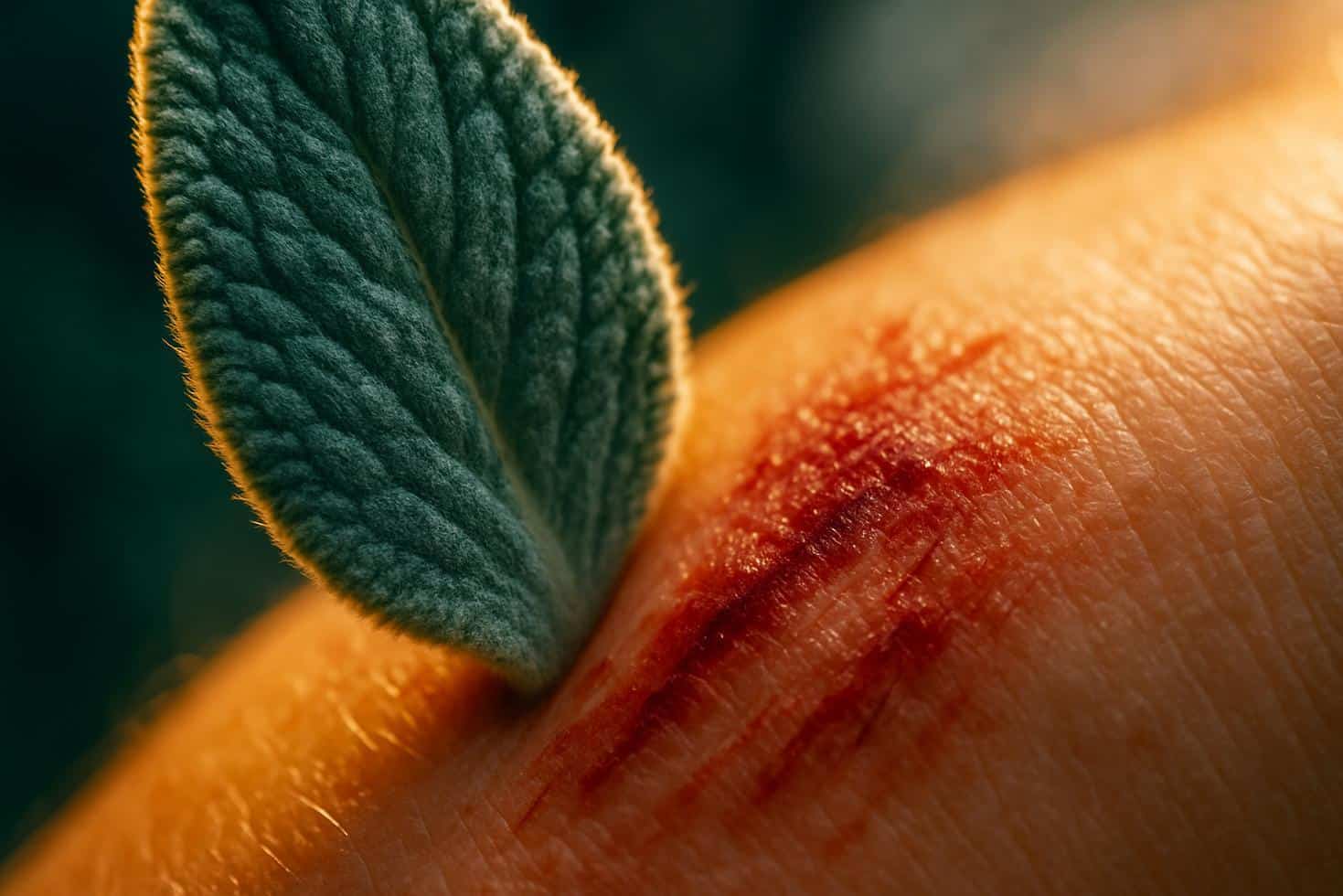
Lamb’s ear leaves are blanketed in dense trichomes that press moisture against broken skin — while tannins from the same Stachys genus precipitate surface proteins, tightening tissue and slowing minor bleeding.
Stachys byzantina leaves function as a wound covering through two overlapping mechanisms: dense trichomes that hold the leaf flush against irregular skin, and astringent tannins that cause surface proteins to contract. That combination is what gives the plant biological credibility beyond its soft, decorative appearance.
The trichomes are not uniformly spaced. They create a layered, felted mat — thick enough to maintain contact across a wound edge. The chemistry underneath that mat belongs to a genus with a documented phytochemical profile, including phenolic compounds, flavonoids, and tannins, all well-represented across Stachys species.
How Stachys Tannins Create an Astringent Response at a Wound Surface
Tannins work by binding to proteins and pulling them into a tighter conformation. At a wound surface, this means the outermost tissue layer contracts, forming a superficial barrier. That barrier is what slows minor bleeding.
This mechanism is not unique to lamb’s ear. It is consistent across tannin-rich plants and is the same chemistry that makes strong tea taste dry. Tannins precipitating proteins to form a surface barrier is a straightforward phytochemical mechanism, not a folk claim.
Reviews of Stachys phytochemistry confirm that many species in this genus are rich in phenolic compounds, including tannins and phenylethanoid glycosides, with documented anti-inflammatory and wound-healing activity in laboratory and preclinical models.
What Genus-Level Antibacterial Evidence Actually Shows for Stachys
Multiple species in the Stachys genus — including S. officinalis, S. lavandulifolia, and S. sylvatica — have demonstrated antibacterial activity against both gram-positive and gram-negative bacteria in laboratory assays. The phenolic compounds driving this activity are widely shared across the genus.
Applying those genus-level results directly to S. byzantina is an extrapolation. Species-specific antibacterial data for lamb’s ear remain scarce. The leaf likely shares some phytochemical features with its relatives, but rigorous quantification has not been published for this species specifically.
S. officinalis, wood betony, holds the clearest historical record for wound care within the genus. Historical texts and modern herbal reviews describe it as a vulnerary herb used in poultices for cuts, wounds, and bruises. The battlefield bandage lore frequently attached to lamb’s ear traces to gardening blogs rather than primary historical or pharmacological sources.
Closing
The woolly texture of Stachys byzantina is a delivery mechanism for a real phytochemical event. The trichomes create surface contact; the tannins do the work. Whether the same potency demonstrated across other Stachys species holds true specifically for lamb’s ear awaits more direct investigation.
A plant that most people walk past in the ornamental border turns out to carry genus-level chemistry worth a second look.
Frequently Asked Questions
Does lamb’s ear actually stop bleeding?
Tannins in Stachys species can slow minor bleeding by precipitating surface proteins, but no clinical data exist measuring this effect specifically for S. byzantina leaves applied to wounds.
Did medieval soldiers really use lamb’s ear as a bandage?
Historical wound-care records within Stachys point to S. officinalis (wood betony), not S. byzantina. The lamb’s ear battlefield claim circulates widely online but lacks primary historical or peer-reviewed support.
Is lamb’s ear antibacterial?
Antibacterial activity is documented in lab assays for multiple Stachys species. Direct testing on S. byzantina specifically is limited; genus-level results support the plausibility but not a confirmed species-specific claim.
Is lamb’s ear safe for children and pets to touch?
No toxicity from ordinary contact has been reported in medical or veterinary literature, and lamb’s ear is absent from major toxic plant lists, though this reflects a lack of reported poisonings rather than a formal toxicology study.