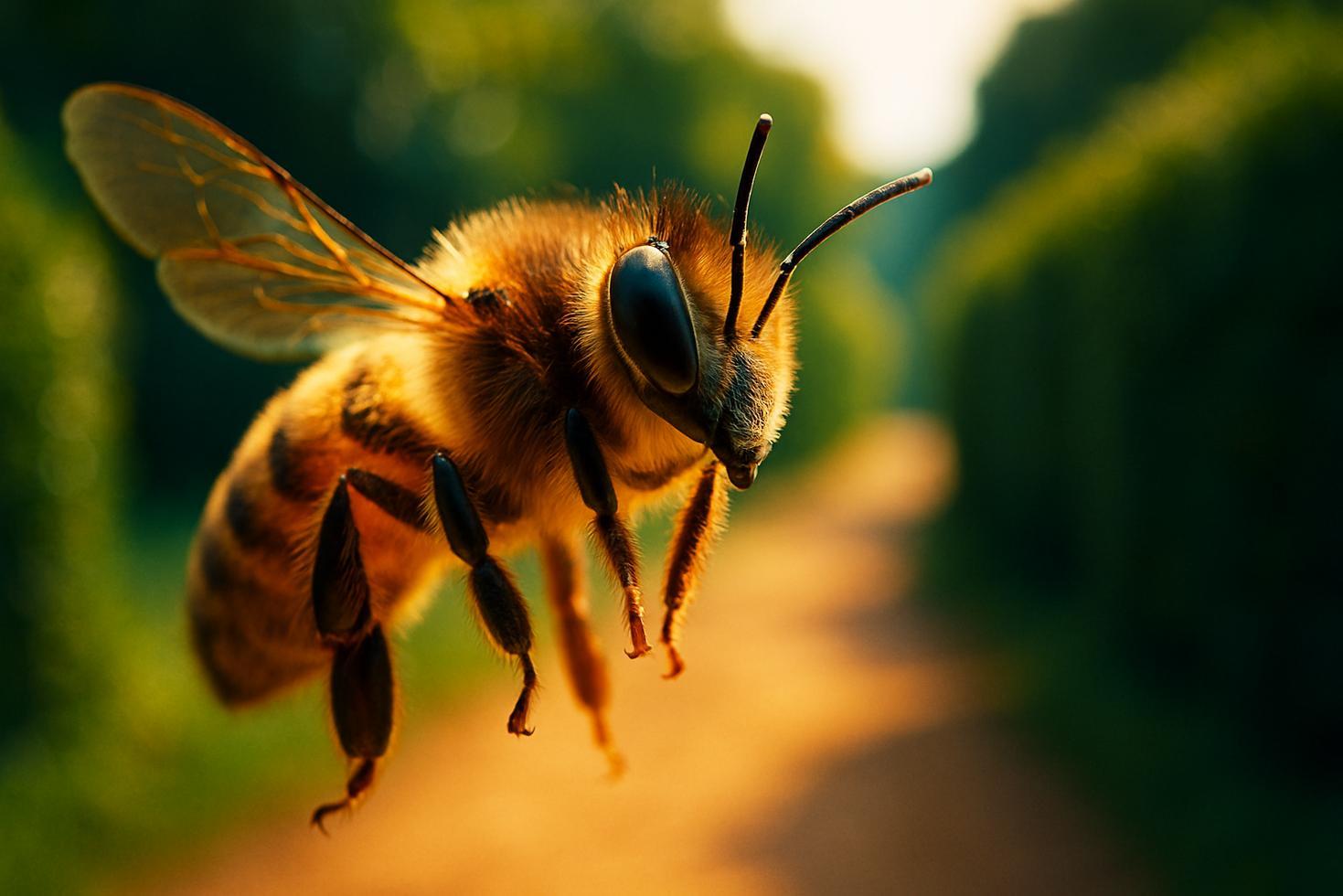
Three cues — sun angle, polarized skylight, and a live internal odometer — run simultaneously. Disrupt one, and the whole route can drift.
Two yards sharing every flower, color, and height can still be completely different worlds to an insect. The navigation system insects use doesn’t read the scene a human sees. It reads angles, light polarization, and accumulated motion across the retina.
That gap between what gardeners observe and what insects actually track is where interesting things happen — and where routes break down.
How the Insect Odometer Actually Works
Path integration is a dead-reckoning system. It continuously updates the insect’s direction and distance from its start point, enabling a straight-line return even when the outbound path twisted repeatedly.
Flying insects don’t use GPS or landmarks for distance. They use optic flow — image motion accumulated across the retina during flight — as their odometer. Two yards that look the same to a gardener can record differently in this system if subtle visual textures, sun orientation, or polarized skylight differ between them.
Four Landmark Strategies, Running at Once
Insects don’t rely on a single landmark approach. Research documents at least four distinct strategies: scene recognition, beacon-aiming toward a prominent object, biased detours around known features, and combinations of these with dead-reckoning on stereotyped routes.
In visually cluttered environments, experience shifts control toward landmark cues while path integration keeps running underneath. The two systems cross-check each other constantly rather than handing off cleanly.
Where Garden Navigation Breaks Down
The seam in the system is cue reliability. When one signal shifts — a new fence, a reflective surface, a canopy gap that scrambles polarized skylight — the integrated calculation can drift.
Leaf-cutter ants demonstrate the stakes. They forage hundreds of yards from the colony, sometimes climbing trees, then return home. When dislodged from their trail, they reorient using a magnetic compass combined with soil contact, though the exact mechanism remains unresolved. The point is that multiple systems are engaged, and losing one forces a shift to another.
The biological bottleneck in a garden isn’t what it looks like. It’s whether a stable directional signal can be extracted from landmark layout, optic flow, and path integration when the visible scene is perturbed.
A garden is always two places at once — the version a person sees and the layered signal environment an insect actually navigates. The difference between a legible route and a broken one often lives in a layer of light no human eye registers.
That invisible map is the real habitat.
Frequently Asked Questions
How do insects find their way home without retracing their path?
Path integration continuously tracks direction and distance from the nest, allowing insects to compute a direct return route regardless of how the outbound path twisted.
What is optic flow in insect navigation?
Optic flow is the accumulation of image motion across the retina during flight. Flying insects use it as an odometer to measure distance traveled.
Can a change in a garden actually disrupt insect navigation?
Yes. Shifting a landmark, adding a reflective surface, or opening a canopy gap can alter the polarized light pattern insects use as a compass, causing route drift.
Do insects use landmarks or dead-reckoning?
Both run simultaneously. In familiar terrain, landmarks can override path integration; in unfamiliar terrain, dead-reckoning may operate alone.