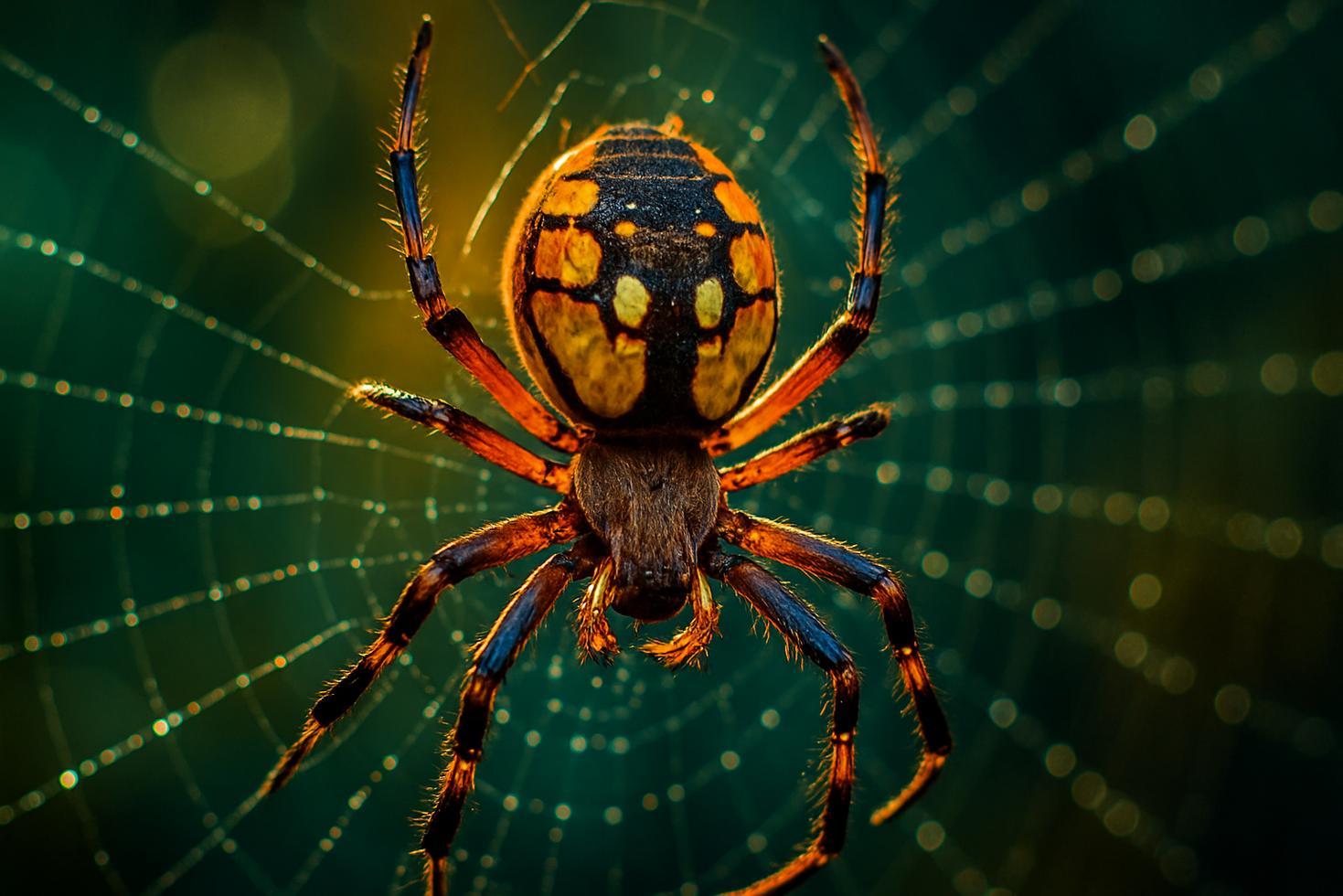
Argiope silk stiffness drops from 3440 MPa to 680 MPa at 70% humidity — and wet webs actually catch more prey than dry ones.
Argiope orb-weaver silk undergoes supercontraction at 70% relative humidity, transforming the web from a stiff structure into a highly extensible one that outperforms its dry-condition baseline. That’s not a flaw in the material. It’s what the silk does when moisture unlocks tightly coiled protein chains, letting radial threads stretch rather than snap under impact.
A flying insect hitting a dry web sometimes bounces free. The same insect hitting a supercontracted web meets silk that yields, absorbs the momentum, and holds.
What Supercontraction Actually Does to Argiope Silk Mechanics
Major ampullate silk is the structural backbone of orb-web radii and frame threads. Below 70% RH it behaves like a stiff engineering material. Above that threshold, water molecules penetrate the protein matrix and unlock tightly coiled amorphous chain regions, dropping stiffness by roughly 80% and pushing maximum strain from 0.27 to over 1.0.
Fixed-length MA silk from Argiope aurantia generates around 50 MPa of supercontraction stress when humidity rises. That tension, built into anchored radial threads, pre-loads the web without any action from the spider.
Why Wet Webs Catch More Prey Than Dry Ones
Modeling and experimental work both point to the same conclusion: webs tested above 70% RH intercept prey better without breaking than webs tested at 30–35% RH. Greater web deflection after prey impact — measured directly in Argiope — confirms that the softer silk dissipates more kinetic energy per strike.
Radial silk shrinking and becoming more compliant is the mechanism the research attributes this to. The web trades rigidity for energy absorption, and that trade pays off in capture rate.
Extremely high or extremely low humidity both carry costs. The research notes direct negative effects on capture performance at the far ends of the humidity range, with temperature adding a secondary influence through web architecture and thread stickiness.
Closing
Argiope silk encodes a humidity response directly into its protein structure. The spider spins it once. Every humid afternoon re-tunes the tension and compliance without further input.
That’s not passivity. It’s a material doing exactly what 400 million years of selection pressure shaped it to do.
Frequently Asked Questions
What humidity level triggers spider silk supercontraction?
Major ampullate silk transitions to the supercontracted state at approximately 70% relative humidity, where stiffness drops sharply and extensibility increases.
Do wet orb webs actually catch more insects than dry ones?
Yes — controlled experiments with Argiope showed significantly better prey capture at high humidity than at low humidity, linked to increased web compliance from supercontraction.
Can spider silk shrink when it gets wet?
Unrestrained dragline silk can shorten by up to 60% upon wetting. When the same silk is anchored in a web, that contractile force increases radial tension and extensibility instead.
Does every orb-weaving spider benefit equally from humidity?
No. Argiope shows a larger prey-capture improvement at high humidity than Nephila, suggesting species-level differences in how much supercontraction affects web performance.