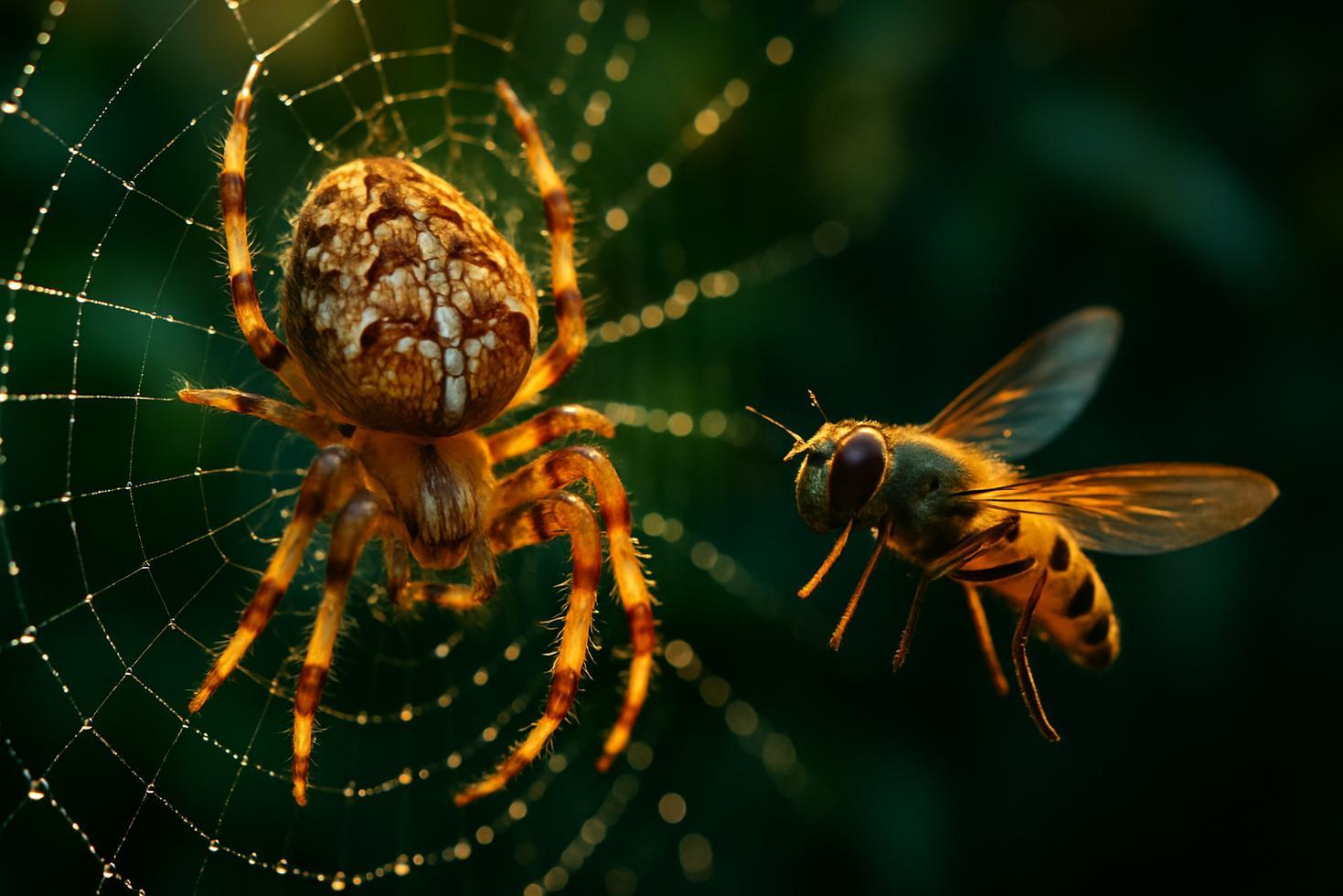
Spiral silk threads on an orb-weaver web deform 1–2 mm toward a charged insect, moving at nearly 2 m/s — the web extends its own capture zone before contact.
Orb-weaver spider webs actively deform toward approaching insects before any physical contact occurs, thanks to electrostatic attraction between negatively charged silk and positively charged flying prey. That single fact rewrites the mental image of a spider web as a passive net. The trap is already moving when the insect arrives.
Flying insects accumulate positive charge simply by moving through the air — friction between wings and air molecules drives the buildup. Spider silk, particularly the spiral capture threads of Araneus diadematus, carries negative or neutral charge. Opposite charges attract, and the result is measurable, mechanical motion.
How Electrostatic Attraction Physically Moves Orb-Web Silk
Laboratory tests on Araneus diadematus webs used charged honeybees, fruit flies, aphids, and even water droplets as targets. High-speed video captured the spiral capture silk bending visibly toward each target before impact. Uncharged versions of the same objects produced no comparable response.
The displacement is 1–2 mm of thread movement toward prey — small in absolute terms, but significant for an insect flying along the outer edge of the web’s geometric footprint. An insect that would have passed just outside the web’s boundary can be intercepted by silk that closes the gap first.
Thread speed during deformation approaches 2 m/s. That is rapid enough to make the contact happen sooner and hold the insect long enough for the spider to respond.
What This Means for the Web’s Effective Capture Zone
A purely passive web catches what hits it. A web that deforms toward prey extends its functional reach. Researchers describe this as the web’s active capture zone expanding beyond its physical boundaries at the moment of an insect’s approach.
The spider itself is uninvolved in this step. No neural signal triggers the silk’s response. The motion is a direct consequence of the material’s charge interacting with the insect’s charge — a physics-level mechanism operating without input from the animal at the center.
Separately, studies on ballooning silk — the threads spiders use to travel on air currents — document at least 1.15 nC of electrostatic charge per launch event, confirming that electrostatics are biologically relevant to spider silk behavior well beyond prey capture alone.
Closing
Spider webs have been studied for centuries, yet the electrostatic deformation behavior of Araneus diadematus capture silk was only quantified recently through high-speed video and controlled charge experiments. A 2 mm deflection at 2 m/s is easy to miss with the naked eye.
The web is not waiting. The geometry of the trap changes the moment charged prey enters the field.
Frequently Asked Questions
Does this electrostatic effect work on all insects?
Lab tests confirmed the effect with honeybees, green bottle flies, fruit flies, and aphids — all of which accumulate positive charge during flight.
Does the spider control the web’s movement toward prey?
No. The deformation is a passive electrostatic response of the silk material itself, requiring no signal from the spider.
How far does the silk actually move?
Spiral capture threads deform 1–2 mm toward a charged target, at speeds approaching 2 m/s.
Is electrostatic charge relevant to spider silk outside of prey capture?
Yes. Ballooning silk carries at least 1.15 nC of charge per launch event, suggesting electrostatics play a broader role in spider silk behavior.