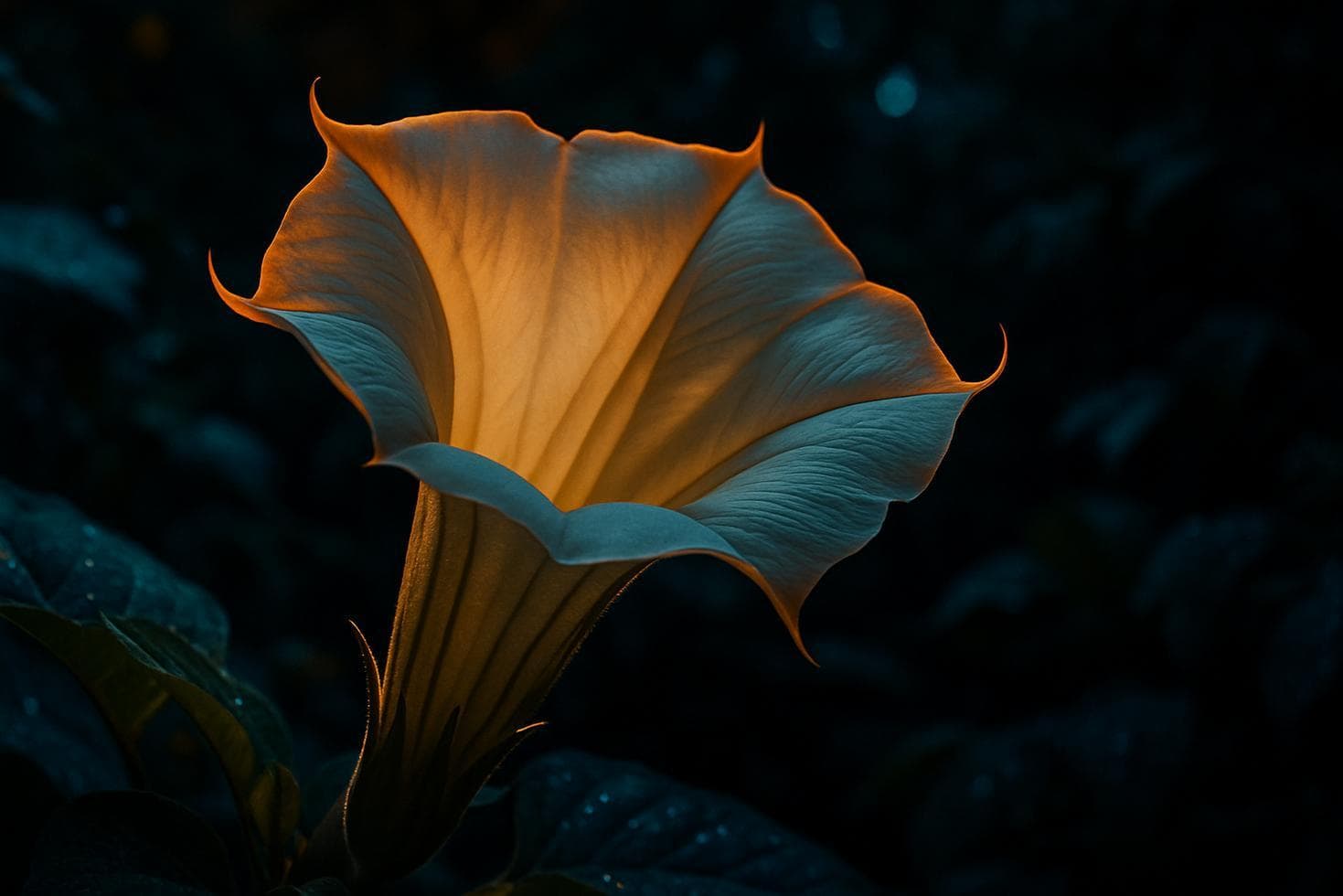
A 10–15 cm corolla tube. One moth with the tongue to match. A deal struck only after dark, every single night.
Moonflower (Ipomoea alba) opens at dusk, emits fragrance through the night, and closes by morning — a full pollination cycle completed entirely in darkness. That rhythm isn’t accidental. It’s a circadian-controlled strategy that sidesteps daytime competition entirely.
Most flowers compete for bees, butterflies, and beetles under the same sun. Moonflower opted out. It claimed the nocturnal niche, and everything about its anatomy reflects that choice.
How Moonflower’s Circadian Clock Controls Its Opening and Scent
Ipomoea alba operates on a strict internal schedule. Buds open in late afternoon or early evening, governed by circadian rhythms and environmental cues including light and temperature.
Fragrance emission follows the same clock. Nocturnal flowers modulate volatile output across hours, with emission rates rising when pollinators are active and dropping during the day. The scent profile includes compounds like linalool and benzyl acetate — aromatic volatiles characteristic of moth-pollinated plants.
Circadian-controlled scent emission means the flower isn’t broadcasting constantly and wasting energy. It concentrates output during the window that matters.
Why the 10–15 cm Corolla Tube Limits Access to Sphinx Moths
The moonflower’s trumpet shape is its most consequential feature. The corolla tube runs approximately 10–15 cm deep. That depth excludes bees, most butterflies, and virtually every short-tongued insect.
Sphinx moths (family Sphingidae) carry proboscises that match or exceed that reach — often similar to or somewhat longer than their own body length, depending on species. The moth hovers in front of the bloom, unrolls its proboscis into the tube, and contacts anthers and stigma during the seconds-long feeding visit. Pollen transfer happens during hover-feeding, not through any prolonged contact.
This is the moth-pollination syndrome in concentrated form: pale flower, deep tube, nocturnal scent, one functional visitor.
What Happens After Pollination at Dawn
As light returns, the moonflower closes. Closure is driven by circadian mechanisms and environmental signals — a gradual process over minutes to hours, not an instantaneous response.
Fertilization follows pollen deposition within hours. Visible seed maturation, however, takes days to weeks inside the capsule at the flower’s base. The bloom’s brief window is enough to complete its role.
The night-blooming niche carries real ecological logic. Fewer visual competitors, a specialized pollinator, and a morphology that makes pollen transfer nearly exclusive.
Every dusk, a bloom opens that wasn’t there an hour before. By sunrise, it’s gone — but the work is done.
Frequently Asked Questions
Why does moonflower only bloom at night?
Ipomoea alba is adapted to sphinx moth pollination; opening at night reduces competition from daytime pollinators and aligns with its primary pollinator’s activity period.
How long is a sphinx moth’s tongue compared to the moonflower’s tube?
Sphinx moth proboscises are typically similar to or somewhat longer than the moth’s body and are matched to corolla tubes in the 10–15 cm range found in Ipomoea alba.
Does moonflower scent pulse in waves, or emit continuously?
Fragrance emission is continuous but varies by time of day — higher at night when moths are active, lower during daylight hours, following a circadian rhythm.
Do seeds form inside the moonflower by morning?
Fertilization can occur within hours of pollination, but full seed maturation inside the capsule takes days to weeks, not a single night.