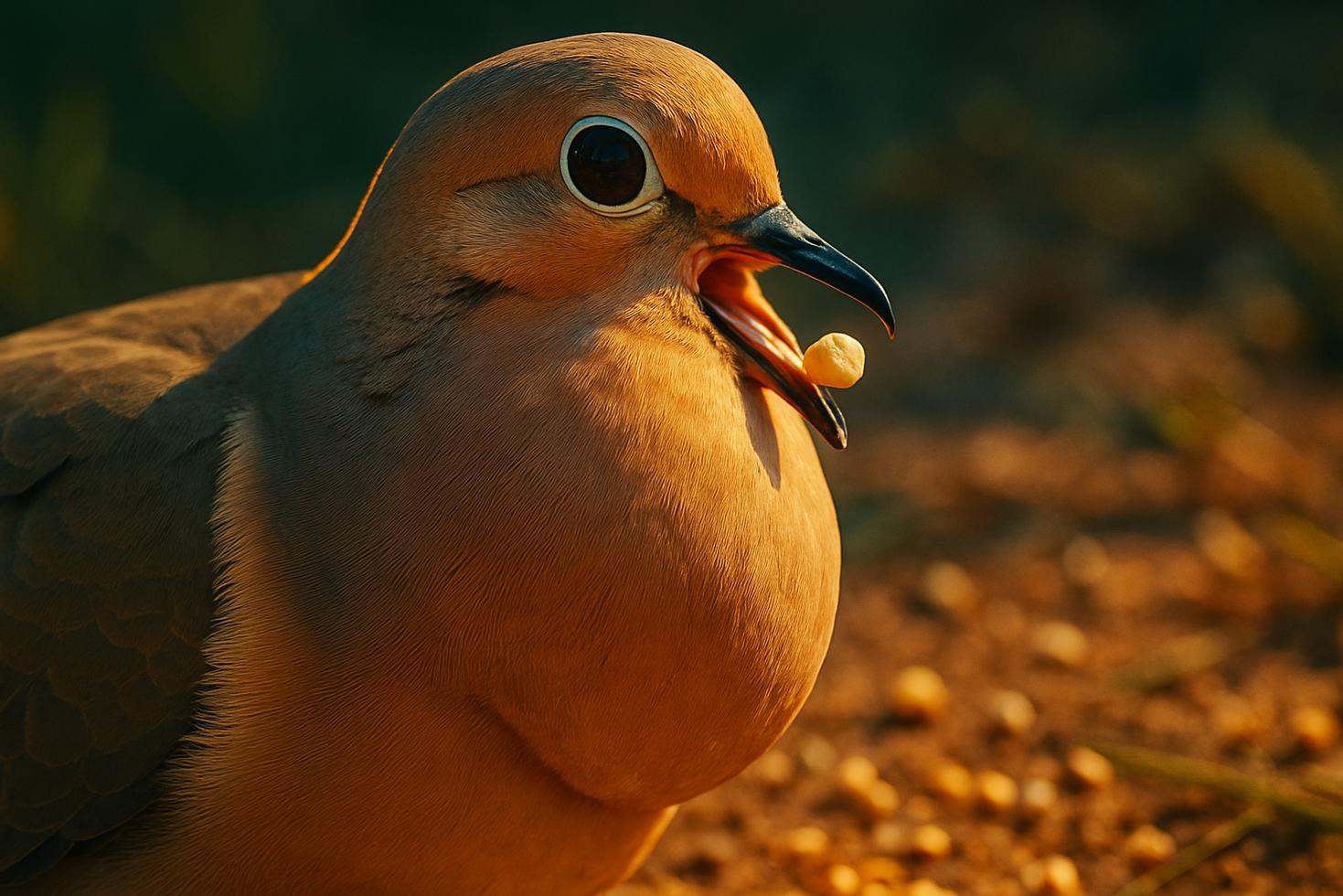
One mourning dove crop held 17,200 bluegrass seeds — swallowed whole, stored in a throat pouch, carried to safety before digestion began.
A single mourning dove crop has been recorded holding 17,200 bluegrass seeds at once. That number comes from Cornell Lab of Ornithology, and it stops most people mid-sentence. The dove didn’t crack a single one open. It loaded them whole, sealed them in an expandable esophageal pouch, and flew.
The crop isn’t a stomach. It’s a holding chamber — seeds sit there, sometimes for hours, while the bird moves to a quieter spot. Digestion happens later, with grit doing the grinding work that a bill never performs.
How the Mourning Dove Crop Works as a Seed Storage Mechanism
The crop is an enlargement of the esophagus, not a separate organ. Seeds accumulate there in bulk while the bird feeds, allowing a dove to load up quickly at an exposed spot and relocate before a predator closes in.
Grit-assisted grinding in the gizzard does the mechanical work that bill-cracking does for other birds. The dove trades speed at the feeding site for processing time after departure — a different trade-off than a cardinal or chickadee makes, but an effective one.
What Mourning Doves Actually Eat: Seed Preferences by the Numbers
Peer-reviewed feeding trials show browntop millet and black-oil sunflower are the clear leaders. In one trial, adult doves showed mean consumption of 4.22 for browntop millet versus 0.46 for switchgrass and 1.14 for deertongue. A second trial confirmed the pattern: browntop millet at 3.31, black-oil sunflower at 2.94, switchgrass at 1.33, deertongue at 0.56.
Diet composition shifts by region and season. Conifer seed dominated one Maine study, making up 54.6% of total crop volume across 120 birds, with red and white pine together accounting for 37.6%. Corn and goosefoot added another 30.9% by volume in those same crops — a reminder that “seed eater” covers more territory than a backyard feeder suggests.
Mourning Doves as Seed Dispersers: What Whole-Seed Swallowing Means for Plants
Because doves swallow seeds intact, some portion passes through undamaged. Every flight after a meal is a potential dispersal event. The dove didn’t evolve to serve plants, but the mechanism produces that result anyway.
The 12%–20% daily intake — applied to a 4.2-ounce bird — means a mourning dove is moving a substantial seed volume across the landscape every day, seed by ungerminated seed.
That 17,200-seed record isn’t just a curiosity. It’s a window into how ground-feeding birds operate: fast loading, mobile digestion, no wasted effort at the source. The dove at the feeder spillage isn’t lingering — it’s executing a system refined over millions of years.
Frequently Asked Questions
How many seeds can a mourning dove hold in its crop?
Cornell Lab of Ornithology records a single mourning dove crop containing 17,200 bluegrass seeds, all swallowed whole.
Do mourning doves crack seeds open like other birds?
No. Mourning doves swallow seeds whole and rely on grit in the gizzard to grind them after the bird has moved to a safe location.
What seeds do mourning doves prefer at feeders?
Peer-reviewed trials show browntop millet and black-oil sunflower are consumed significantly more than switchgrass, deertongue, or other tested seeds.
How much do mourning doves eat per day?
Mourning doves eat 12%–20% of their body weight in seeds daily, averaging approximately 71 calories per day.