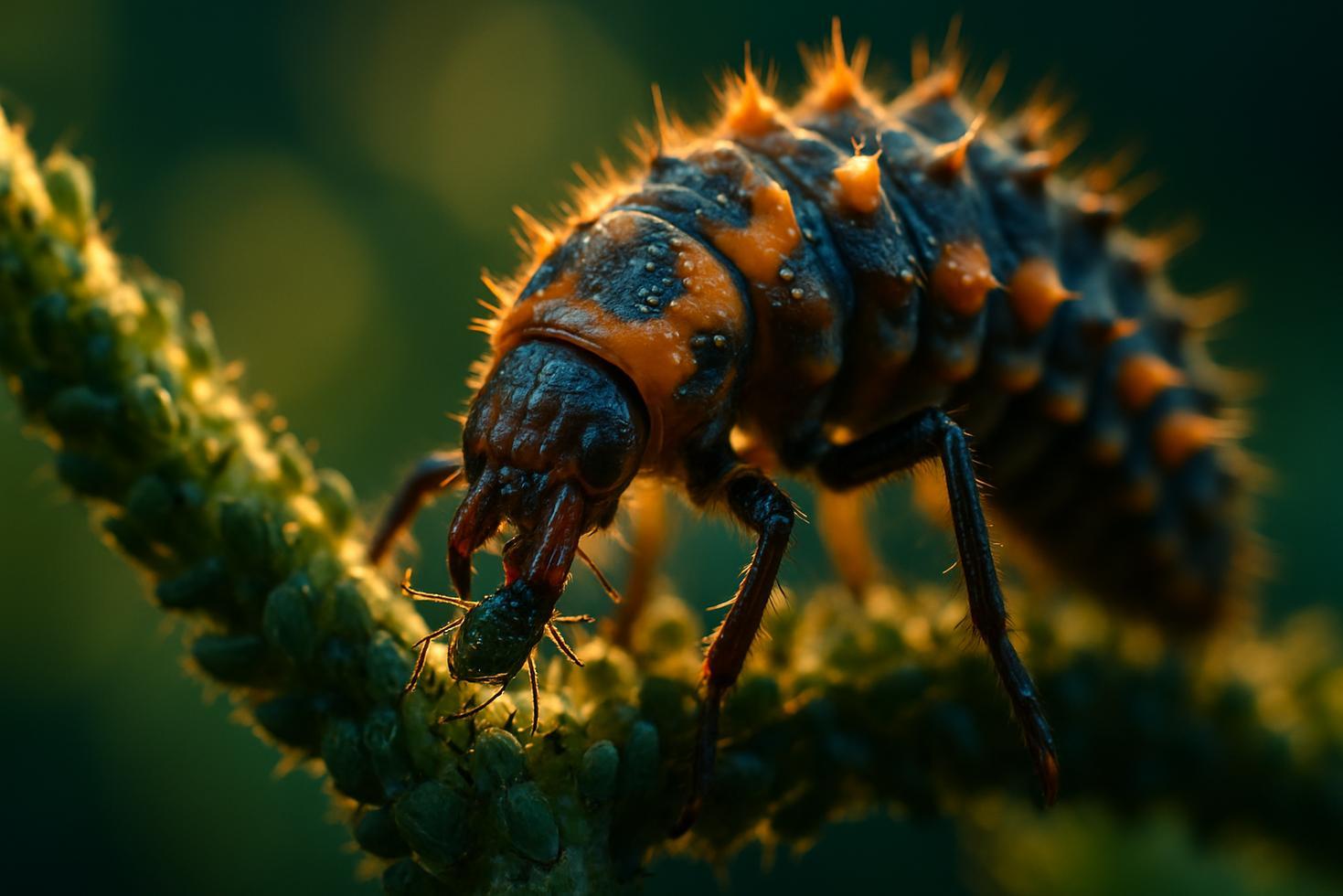
One adult ladybug eats 50 aphids a day and 5,000 in a lifetime — but larvae quietly consume 400 aphids in just 2.5 weeks without ever leaving the plant.
A single adult ladybug consumes roughly 50 aphids per day and approximately 5,000 over its lifetime, figures verified by both University of California Cooperative Extension and North Dakota State University. That lifetime number sounds remarkable until the larva enters the picture. The larval stage — two and a half weeks of continuous, stationary feeding — accounts for around 400 of those aphids before the insect ever develops its familiar spotted shell.
Most people walk past the larva without recognizing it. It looks nothing like its adult form: dark, spiny, resembling a tiny armored insect from a different era entirely.
How Ladybug Adults and Larvae Actually Feed on Aphids
Ladybugs are direct predators. There is no venom, no trap, no chemical relay — just straightforward contact feeding on soft-bodied prey located on plant surfaces. The adult’s daily rate of 50 aphids holds across UC ANR and NDSU sources, though species, temperature, and prey availability all shift that number.
The larval rate runs 30 to 60 aphids consumed per day, comparable to the adult on a per-day basis. What makes the larval stage distinct is persistence. Larvae do not fly. They remain on the plant and feed without interruption through their entire 2.5-week development window.
Why the Larval Stage Matters for Aphid Population Control
Aphid colonies grow fast. A larva hatching into an active colony encounters prey in dense, accessible clusters — conditions that push consumption toward the higher end of reported rates. The larva works through that concentration continuously, without the dispersal behavior that takes adult ladybugs off a plant entirely.
Extension sources consistently describe larvae as at least equally important as adults for actual pest suppression, and in some assessments more effective precisely because they stay put. Eggs are laid in clusters of 10 to 50 on the undersides of leaves, positioning newly hatched larvae directly inside the colonies they will feed on.
What the Verified Numbers Actually Show
The 5,000-lifetime figure is the most widely cited and best-supported number across university extension sources. The larval 400-aphid figure comes from educational materials consistent with those sources. Daily rates carry more variation — 10 to 50 aphids per day appears across different species and conditions — so 50 per day represents the high end of the confirmed range, not a universal constant.
The two stages together describe a two-phase predation sequence: larvae suppress an active colony from within, adults continue feeding and dispersing across the season.
The arithmetic is simple and the biology is direct. One insect, two bodies, two different feeding strategies — and roughly 5,000 aphids that don’t make it through the season.
Nature didn’t engineer this. It just left the hungry ones alive.
Frequently Asked Questions
How many aphids does a ladybug eat per day?
University extension sources report approximately 50 aphids per day for adult ladybugs, with a species-dependent range of 10 to 50.
Do ladybug larvae eat more aphids than adults?
Larvae consume around 400 aphids over a 2.5-week larval period at rates of 30 to 60 per day, comparable to adults and significant because larvae feed continuously without leaving the plant.
How long does a ladybug live, and how does that affect total aphid consumption?
Adult ladybugs live approximately one year, which is the timeframe over which the roughly 5,000-aphid lifetime total accumulates.
Where do ladybugs lay their eggs relative to aphid colonies?
Ladybugs lay yellow eggs in clusters of 10 to 50 on the undersides of leaves, typically near aphid colonies, placing newly hatched larvae immediately among their prey.