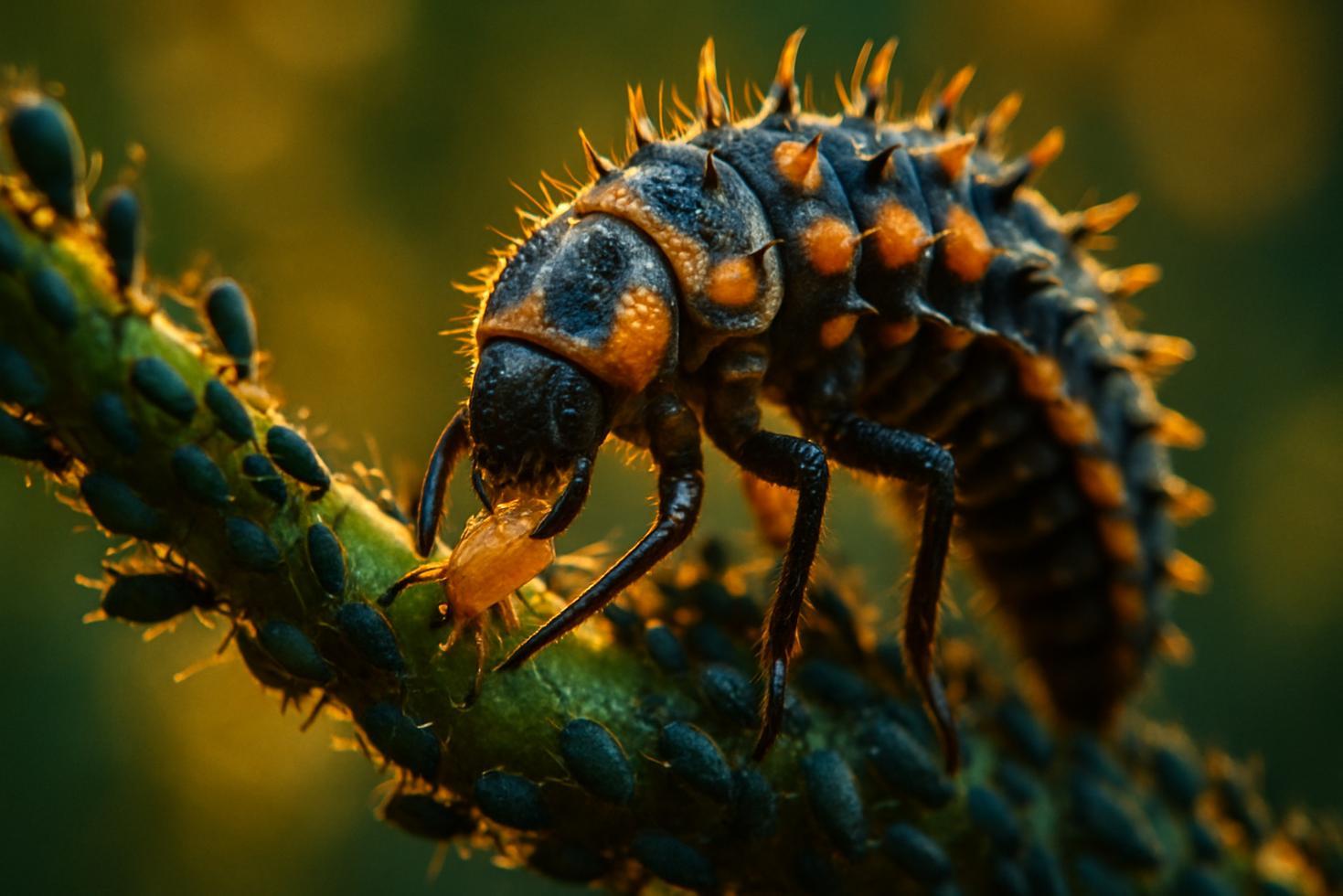
A single lady beetle may consume up to 5,000 aphids across its lifetime — but the spotted adult familiar to gardeners is far outpaced by the larva, which tears through aphids before it ever grows its first spot.
A lady beetle can consume up to 5,000 aphids across its lifetime, according to University of Kentucky Extension and North Dakota State University Extension. That number carries a quiet surprise inside it. Most of that total is built not by the familiar red-and-black adult, but by a spiky, alien-looking larva that most people would never recognize as a ladybug at all.
The larva hatches on the underside of leaves and begins feeding almost immediately. It is the more intense aphid predator at every stage of its development, a fact documented by UC Agriculture and Natural Resources alongside the same lifetime estimate.
Quick facts:
– Up to 5,000 aphids consumed across one lady beetle’s lifetime
– Adults eat roughly 50 aphids per day, per NDSU Extension
– Larvae are the more intense aphid predators during development
– Adult lady beetles also feed heavily on pollen, especially to fuel reproduction
– The 5,000 figure is a rounded upper-end estimate, not a guaranteed count for every individual
What Lady Beetle Larvae Actually Do Before Pupation
The larva does not look like its adult form. It is dark, spiky, and slow-moving — easy to mistake for a pest rather than a predator. Yet this stage drives the majority of a lady beetle’s lifetime aphid consumption.
Some sources place larval consumption at around 400 aphids before pupation; others estimate closer to 2,000 depending on conditions and species. The range is wide, but larvae consistently outpace adults as aphid predators across every source that distinguishes the two stages.
Aphid colonies reproduce fast. A single aphid can clone itself repeatedly within days without mating. The larva hits that growing colony early, before it compounds into a larger infestation.
How the Adult Lady Beetle Feeds Differently
Once a lady beetle reaches adulthood, its diet shifts. UC Agriculture and Natural Resources notes that adults feed heavily on pollen in addition to aphids. That pollen feeding is not incidental — it fuels reproduction, which means more eggs, more larvae, and more aphid predation downstream.
At roughly 50 aphids per day, the adult is still a meaningful predator. But pollen consumption supporting reproduction is what makes the adult’s ecological role distinct from the larva’s straightforward predation role.
Together, the two stages form a system. The larva suppresses an active infestation. The adult sustains the next generation of suppressors.
Closing
The ladybug gardeners stop to photograph is doing real work. It just is not doing the heaviest work. That already happened in the larval stage, quietly, on the underside of a leaf.
The most productive predator in the garden is the one that looks nothing like what people came to see.
Frequently Asked Questions
How many aphids does a ladybug eat per day?
Adult lady beetles eat roughly 50 aphids per day, according to NDSU Extension and UC Agriculture and Natural Resources.
Do ladybug larvae eat more aphids than adults?
Yes. Larvae are documented as the more intense aphid predators, consuming the majority of a lady beetle’s lifetime total before pupation.
Is the 5,000 aphid lifetime figure accurate?
It is a credible rounded upper-end estimate supported by University of Kentucky Extension, NDSU Extension, and UC Agriculture and Natural Resources — not a precise guaranteed count for every individual.
Do adult ladybugs eat anything besides aphids?
Yes. Adults feed heavily on pollen, particularly to fuel reproduction, in addition to aphids and other soft-bodied insects.