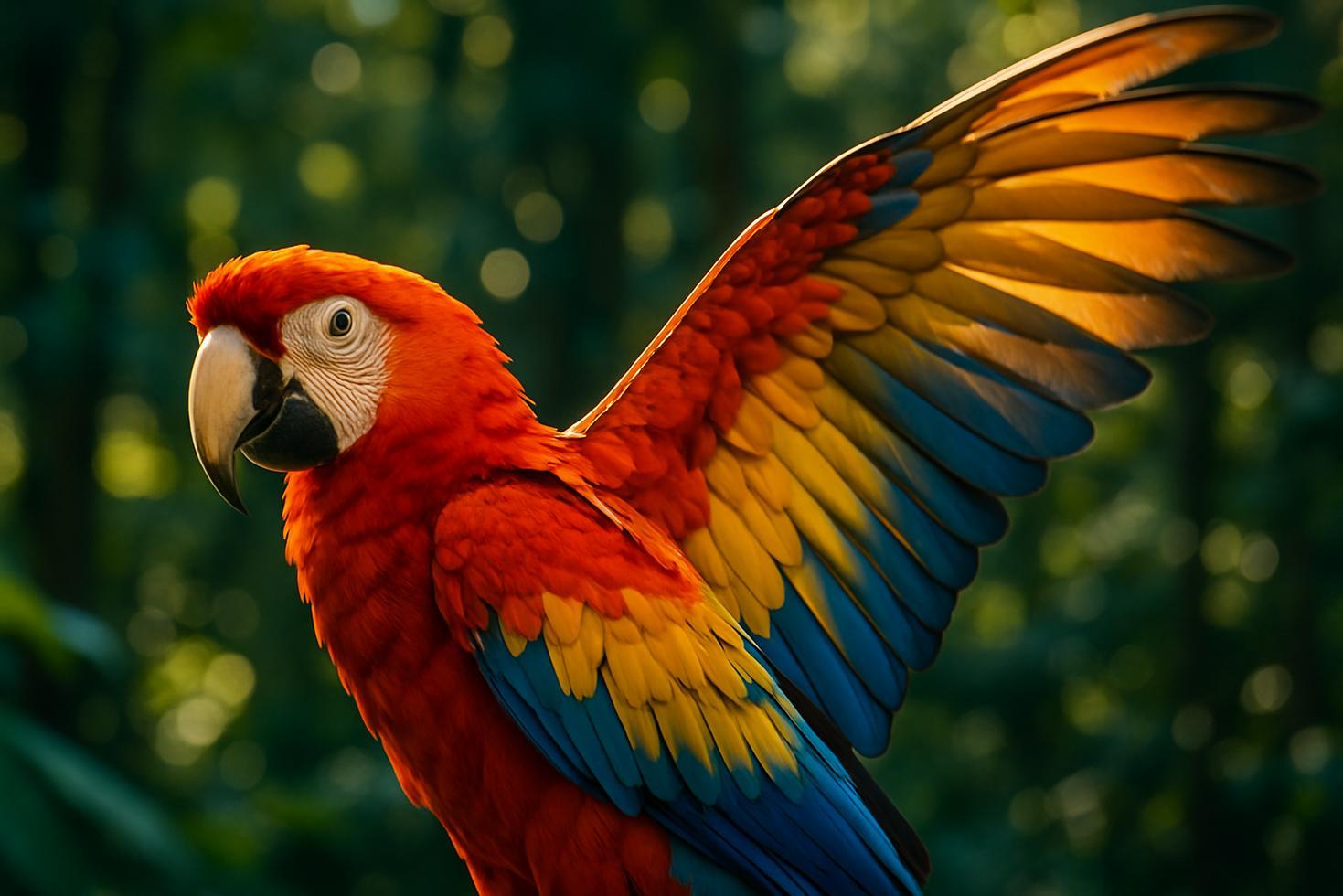
Macaws manufacture their own red and yellow pigments — found in no other bird family on Earth — while blue feathers contain no pigment whatsoever.
A macaw’s red and yellow feathers owe nothing to fruit. The bird synthesizes them internally from a unique class of pigments called psittacofulvins, found nowhere in the body except the feathers themselves. That single fact separates macaws — and all parrots — from nearly every other colorful bird on the planet.
What makes it stranger is the blue. Those feathers carry no pigment at all. The color exists only because of microscopic feather architecture that scatters specific wavelengths of light back outward. Destroy that structure, and the blue doesn’t fade. It disappears.
How Macaws Synthesize Psittacofulvins for Red and Yellow Plumage
Psittacofulvins are chemically unique to parrots. More than 350 parrot species produce them, and no other bird family has independently evolved the same pathway. The pigments are deposited directly into feathers during growth and do not circulate detectably in the blood.
Psittacofulvin concentration controls color intensity — more pigment produces richer, deeper color. The same pigment class can shift hue across a wide range, from deep magenta to pale lemon, depending on how the feather organizes the molecules. That single chemistry handles most of what looks like multiple distinct warm colors on one bird.
Many birds get their reds and oranges from dietary carotenoids — compounds acquired by eating pigment-rich plants. Macaws circulate carotenoids too, but the available evidence shows they typically do not deposit those carotenoids into red feathers. Psittacofulvins do that work instead.
How Macaw Blue Feathers Produce Color Without Any Pigment
Blue feathers in macaws are a structural phenomenon. Microscopic architecture within the feather — not any chemical dye — intercepts incoming light and scatters blue wavelengths back toward the observer while others pass through or are absorbed.
This is not a surface effect. It depends entirely on the internal geometry of the feather staying intact. Flattening the feather microstructure eliminates the color — not gradually, but completely. The blue ceases to exist as a perceptible color the moment the architecture that creates it is gone.
The warm and cool halves of a macaw’s plumage are therefore products of two entirely unrelated systems. One is chemical manufacturing. The other is applied optics.
Closing
Pat has spent decades watching people assume a bird’s color reflects what it ate. Macaws are a clean counterexample. The red was built, not borrowed. The blue was never a substance at all.
One bird. Two mechanisms. Neither one works the way intuition suggests.
Frequently Asked Questions
Do macaws get their red color from eating red fruit?
No. Macaw red plumage is produced by psittacofulvins, pigments the bird synthesizes internally, not from dietary carotenoids absorbed through food.
What are psittacofulvins?
Psittacofulvins are a class of pigments unique to parrots, found in feathers but not elsewhere in the bird’s body, and produced by more than 350 parrot species.
Why does crushing a blue macaw feather remove the color?
Blue is a structural color created by feather microarchitecture scattering light. Destroying that structure eliminates the optical effect entirely — there is no pigment underneath to fall back on.
Can psittacofulvins produce colors other than red?
Yes. Depending on concentration and feather organization, psittacofulvins can produce hues ranging from magenta to lemon yellow.