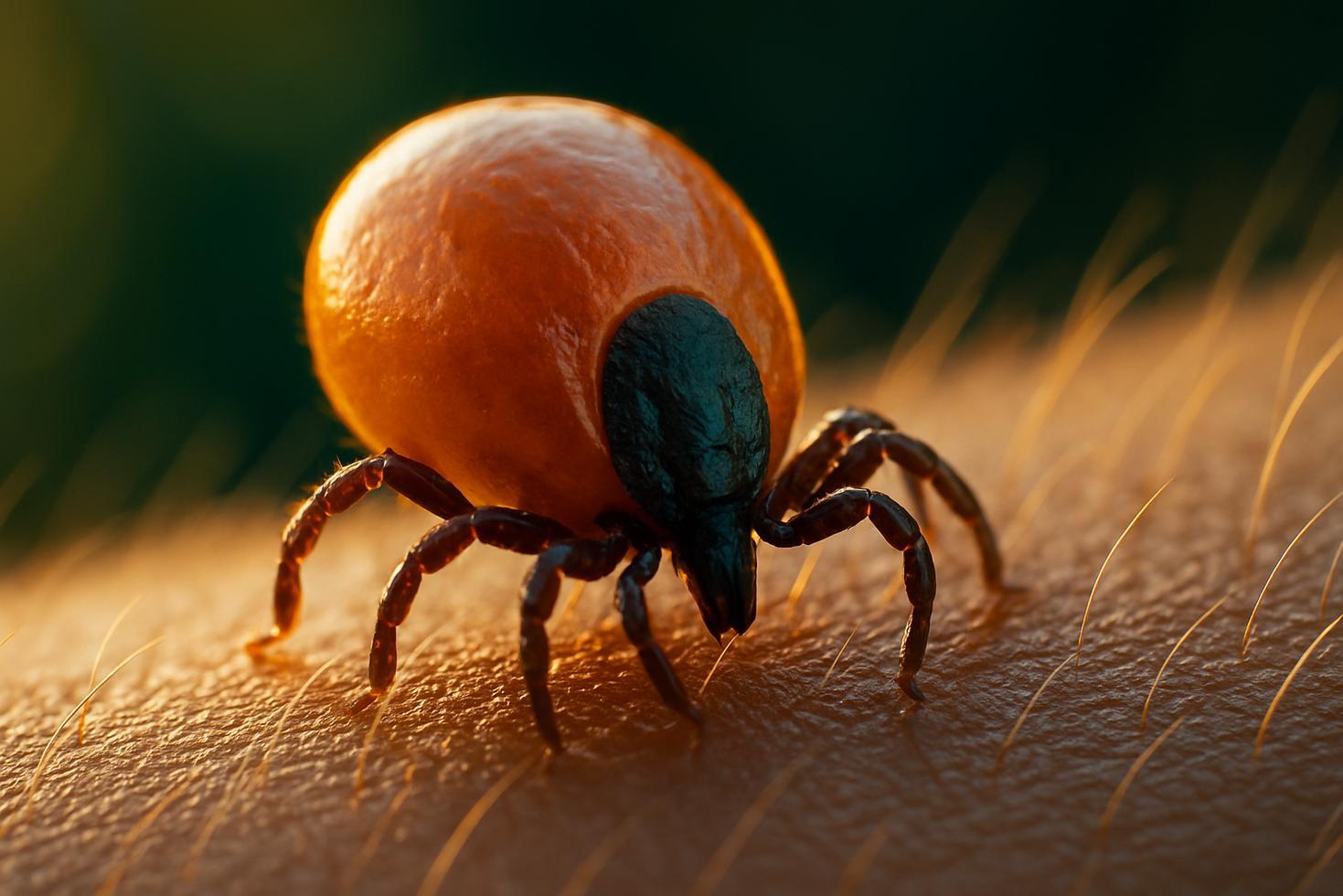
Blacklegged tick nymphs measure just 1–1.5 mm — barely visible on skin — yet Borrelia burgdorferi needs roughly 36–48 hours of continuous feeding to complete its migration and cross over.
Blacklegged tick nymphs must stay attached for at least 36 to 48 hours before Borrelia burgdorferi can transfer from tick to host. That window exists because of a specific biological delay, not luck. The bacteria spend the early hours of feeding tucked inside the tick’s gut, and only migrate toward the tick’s mouthparts as the tick fills with blood. The journey takes time, and that lag is the only reason early removal works.
What makes nymphs so consequential is their size. Sources from University of Maine Extension and Ohio State University Extension place nymphs at roughly 1 to 1.5 mm — poppy-seed scale — nearly colorless and flat against skin. There is no itch, no immediate signal. The tick simply feeds, and the clock runs quietly.
Why the Borrelia burgdorferi Migration Delay Determines the Transmission Window
During the first hours of feeding, Borrelia burgdorferi stays confined to the tick’s gut. As feeding continues, the bacteria multiply and begin shifting toward the salivary pathway. this gut-to-mouthpart bacterial migration is what makes the 36-to-48-hour window real and not arbitrary. Removing the tick before feeding is well established cuts the migration short.
Some sources place the minimum threshold as low as 24 hours. The consistent finding across university extension and medical sources is that the longer the tick feeds past that first day, the greater the transmission risk becomes.
Why Nymph Size Makes Detection the Central Challenge
An adult blacklegged tick runs 2 to 3 mm — already small, but visible. A nymph at 1 to 1.5 mm is a different problem entirely. University of Maine Extension notes that nymphs are difficult to see even on close inspection. Their bodies are nearly transparent before feeding.
Nymphs also prefer leaf litter, low brush, and ground-level vegetation — environments that look unremarkable. the nymph’s preferred low-brush habitat is precisely where humans brush past without thinking to check afterward. A daily body scan after outdoor exposure remains the primary mechanism for catching a nymph before the transmission window closes.
Closing
The 36-to-48-hour transmission window is only useful if the tick is actually found. That makes the size of a nymph — not the bacteria itself — the practical obstacle. At 1 to 1.5 mm, poppy-seed scale on skin, the nymph’s best advantage is invisibility. The biology gives a window. Noticing the tick is what opens it.
Frequently Asked Questions
How small is a blacklegged tick nymph?
Nymphs measure roughly 1 to 1.5 mm — approximately the size of a poppy seed — and are nearly transparent before feeding.
How long does a tick need to be attached to transmit Lyme disease?
Most sources cite 36 to 48 hours of continuous attachment as the typical transmission threshold, with 24 hours as a lower minimum in some sources.
Why does removing a tick early prevent Lyme disease?
Borrelia burgdorferi lives in the tick’s gut early in feeding and takes 36 to 48 hours to migrate to the mouthparts, so removal before that window interrupts the process.
Where are blacklegged tick nymphs most commonly encountered?
Nymphs favor leaf litter, low brush, and ground-level vegetation rather than open grass or tall trees.