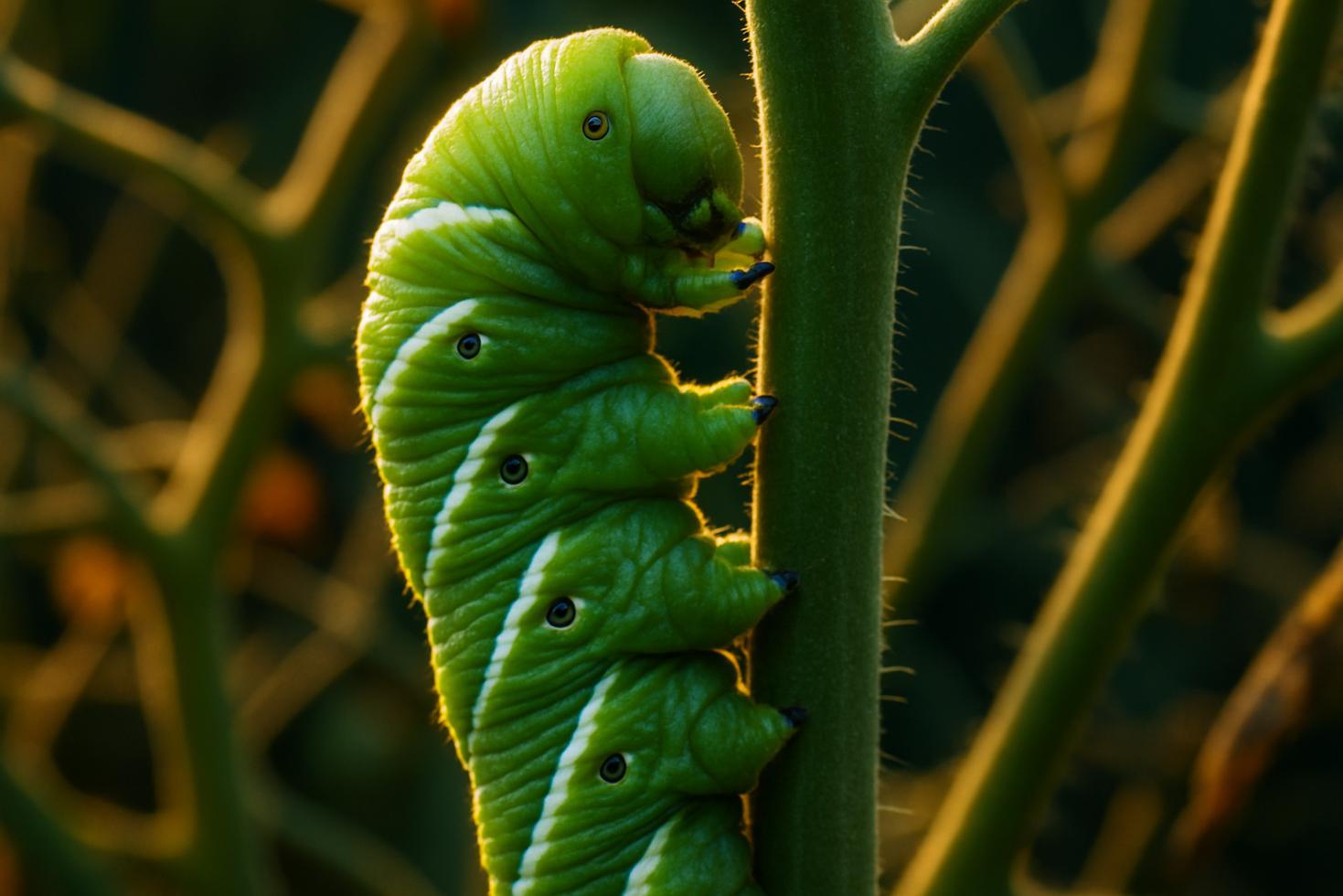
One caterpillar, two completely different worlds: a slow daylight search finds nothing — a black light at night turns the same body into a small green beacon.
Tomato hornworms conceal themselves by pressing against inner stems and leaf undersides, where the green of their skin matches the plant so closely that even a careful daylight search often finds nothing. It is a positioning strategy, not just a color match. The caterpillar reads the plant’s structure and disappears inside it.
What breaks that concealment are two things operating on entirely different principles: direct contact with soapy water, and ultraviolet light after dark.
Why Tomato Hornworm Camouflage Works So Well in Daylight
The hornworm’s concealment relies on two things working together: color and position. Its green skin mirrors tomato foliage closely enough that visible-light inspection — even slow and deliberate — routinely misses them. The inner-stem and underside locations mean a gardener’s sightline almost never arrives at the right angle.
Color matching, however, only defends against visible wavelengths. UV light bypasses the visible-spectrum camouflage entirely, causing compounds in the caterpillar’s outer skin layer to fluoresce. Under a black light at night, the hornworm that was architecturally invisible becomes the brightest thing in the frame.
How Soapy Water Forces Hidden Hornworms Into View
Insecticidal soap works by disrupting the insect’s waxy cuticle on direct contact. That disruption removes the protective layer that keeps the body sealed, breaks surface tension so the solution can reach the spiracles, and causes dehydration. The University of California Agriculture and Natural Resources and University of Georgia Extension both confirm the same constraint: the spray must physically coat the insect body to do anything at all.
For hornworms specifically, the practical value of a soapy spray is that these caterpillars are large enough to be knocked from their concealed positions once wetted — flushing them into view rather than killing them outright through the spray alone. Once the solution dries, no protective or lethal effect remains on leaves or stems.
One caution: dish detergent concentrations that are too high can injure tomato plants. Extension guidance on insecticidal soaps refers to properly diluted formulations, not full-strength detergent mixtures.
Frequently Asked Questions
Why do tomato hornworms glow under a black light?
Compounds in the hornworm’s outer skin layer react to UV wavelengths and fluoresce, making the caterpillar visible at night even when its green coloring perfectly conceals it by day.
Does soapy water kill tomato hornworms?
Soap can harm or kill hornworms through direct cuticle disruption and dehydration, but only during the moment of contact. Anecdotal claims of complete kills within 48 hours are not independently verified.
How do I find hornworms on tomato plants during the day?
Check the undersides of leaves and along inner stems from multiple angles. Even a slow, deliberate search in full sun misses them frequently because their coloring matches the foliage closely.
Can soap spray protect tomato plants from future hornworm damage?
No. Soap has no residual activity. Once dry, it provides zero protection against hornworms that were not contacted during application.