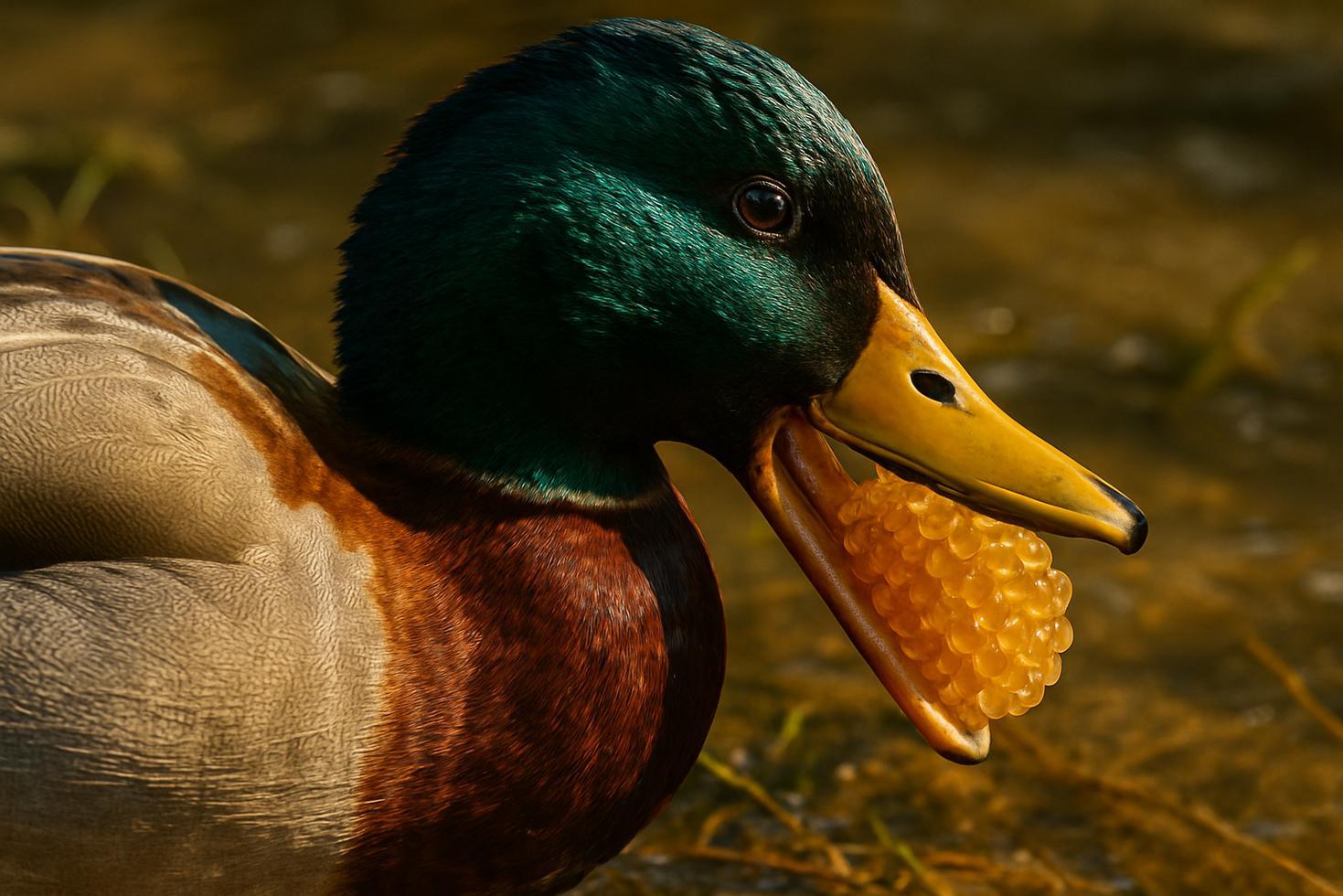
18 eggs survived the full gut passage of a mallard. 3 hatched. One egg took over 4 hours — enough flight time to cross dozens of kilometers.
Mallard ducks can transport viable fish eggs through their digestive systems and deposit them, intact, into entirely separate bodies of water. That finding, published in PNAS and confirmed across multiple independent science outlets, gives isolated ponds a biological stocking mechanism that requires no rivers and no human hands. The mechanism is called endozoochory — dispersal through ingestion — and for fish, it turns out to be rare but real.
Most eggs fed to captive mallards in a controlled study did not survive. That part was expected. What wasn’t expected was how many did.
How Carp Eggs Survive a Mallard’s Digestive System
The study used two invasive carp species — common carp and Prussian carp — under controlled lab conditions. Eggs were fed in 3-gram servings to captive birds. Most viable eggs were excreted within an hour. The gizzard crushes, and digestive acids degrade. egg membrane structure determining survival odds appears to be the key variable — the same thick-membrane logic later confirmed in killifish surviving swan gut passage.
The killifish result is striking on its own. One egg endured 30 hours of digestion inside a swan before being excreted. It hatched 49 days later. Four other recovered killifish eggs died from fungal infection, but one was enough.
What This Means for Isolated Ponds and Invasive Fish
The lab study proves biological possibility, not wild frequency. But the ecological math is still striking. A duck migrating along a flyway doesn’t stop at connected waterways. It lands on isolated ponds, retention basins, farm ponds — water bodies that no tributary reaches. waterfowl moving viable propagules between disconnected wetlands is now a documented non-human dispersal route for both native and invasive species.
That 0.2 percent survival rate looks negligible. Across millions of migratory movements per season, it isn’t.
Fish appearing in sealed-off ponds with no stocking records and no hydrological connections now have a plausible explanation that doesn’t require coincidence. A bird ate, flew, and landed somewhere new. The math took care of the rest.
The seeds just had fins.
Frequently Asked Questions
How do fish get into ponds with no river or stream connection?
Waterfowl, particularly ducks and swans, can ingest fertilized fish eggs and excrete viable ones hours later into a different body of water — a process called endozoochory.
What percentage of fish eggs survive passage through a duck?
In a controlled study, approximately 0.2 percent of fertilized carp eggs — 18 of roughly 8,000 — survived intact, and 3 of those hatched.
How far can a duck carry a fish egg before excreting it?
One egg took over 4 hours to pass through a mallard’s gut; a duck in flight can cover dozens of kilometers in that window.
Does this happen with species other than carp?
Yes. A related study found a killifish egg survived 30 hours inside a swan and hatched successfully 49 days after being excreted.