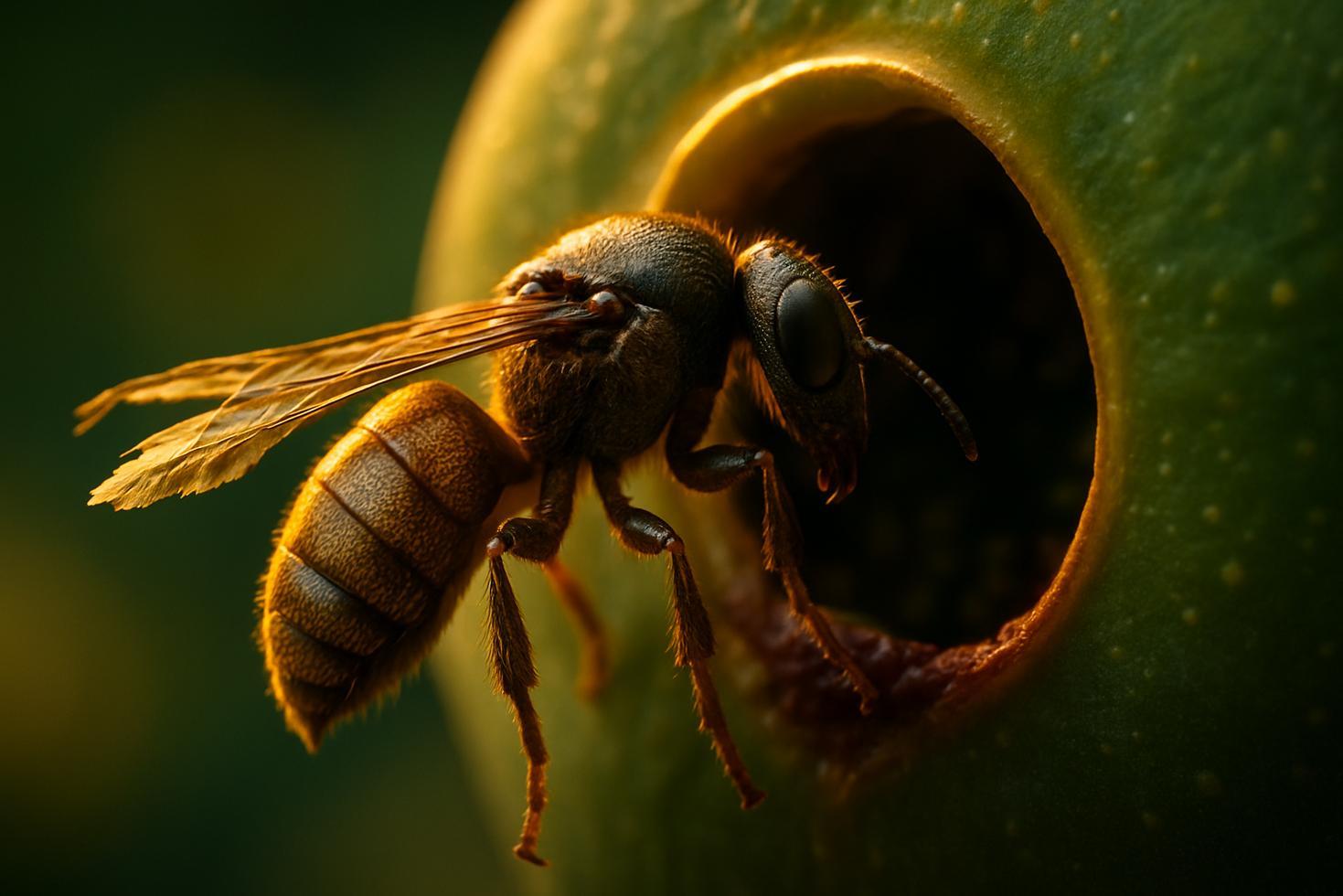
A female fig wasp enters through an opening the size of a needle, losing her wings permanently. She pollinates up to a few hundred flowers in under 48 hours — then the fig’s own ficin enzyme breaks her down and recycles her as nutrients.
The fig is not a fruit in the conventional sense — it is a syconium, an enclosed chamber lined on the inside with hundreds of tiny flowers that no bee or wind current can ever reach. That architectural fact drives one of the most specialized mutualisms in the plant world. The only pollinator that fits is a wasp smaller than a grain of rice, and the only entrance is a narrow, bract-lined tunnel called the ostiole.
Getting through that tunnel costs the wasp her wings and part of her antennae, stripped away by the friction of the passage. She enters anyway, moves through the dark interior, and pollinates the fig’s female flowers while laying eggs in others. Within roughly 48 hours, she is dead inside the chamber she just fertilized.
What Happens Inside the Fig Syconium During Pollination
The female wasp carries pollen from the fig she hatched in. Once inside the new syconium, she moves among the internal flowers, dusting them with that pollen. Some flowers develop fertilized seeds. Others become nursery sites where her eggs develop into larvae over the following weeks.
Male offspring hatch first. Wingless males mate with females inside the fig, then chew exit tunnels through the fig wall. Newly mated females collect pollen and leave through those tunnels to find another receptive fig — traveling up to 10 kilometers within their short lifespan to do so. The cycle then begins again.
How the Fig Recycles the Dead Wasp Through Ficin
The female wasp that entered never leaves. After she dies, the fig releases ficin, an enzyme it produces naturally, which digests protein. Her remains are broken down and the nutrients are absorbed back into the developing fruit tissue. This is a real biochemical process, not a metaphor — though it is worth noting that she does not “dissolve into the flesh” in any dramatic sense. The recycling is gradual and structural, part of the syconium’s normal nutrient economy.
The fig benefits twice: it receives pollen and recovers nutrients from the pollinator’s body.
Which Fig Varieties Actually Require Wasp Pollination
The wasp-pollination story applies to wild fig species and specific cultivated varieties — caprifigs, Smyrna figs, and San Pedro figs all require it. Commercial common figs, the variety most widely sold in grocery stores, do not require wasp pollination to produce edible fruit. The mutualism is real and widespread, but the “every fig you eat” framing overstates which varieties depend on it.
The fig–wasp relationship is ancient, host-specific, and tightly locked together by scent. Each fig species produces a chemical signature that attracts only its matching wasp species — a specificity that has held the partnership in place across millions of years of coevolution. The needle-sized door has always been exactly the right size for exactly one visitor.
Frequently Asked Questions
Does eating a fig mean eating a wasp?
The ficin enzyme breaks down wasp remains inside the fig, so there is no intact wasp body in a ripe fig. Trace proteins may remain, but no whole wasp tissue.
Why does the fig wasp lose her wings entering the fig?
The ostiole is a very narrow, bract-lined tunnel. The friction of squeezing through strips the wasp’s wings and part of her antennae — she cannot exit the way she entered.
How long does a fig wasp live inside a fig?
The female wasp’s lifespan inside the fig is approximately two days, during which she pollinates flowers, lays eggs, and dies.
Do all figs need wasps to produce fruit?
No. Caprifigs, Smyrna figs, and San Pedro figs require wasp pollination. Commercial common figs do not require it to produce edible fruit.