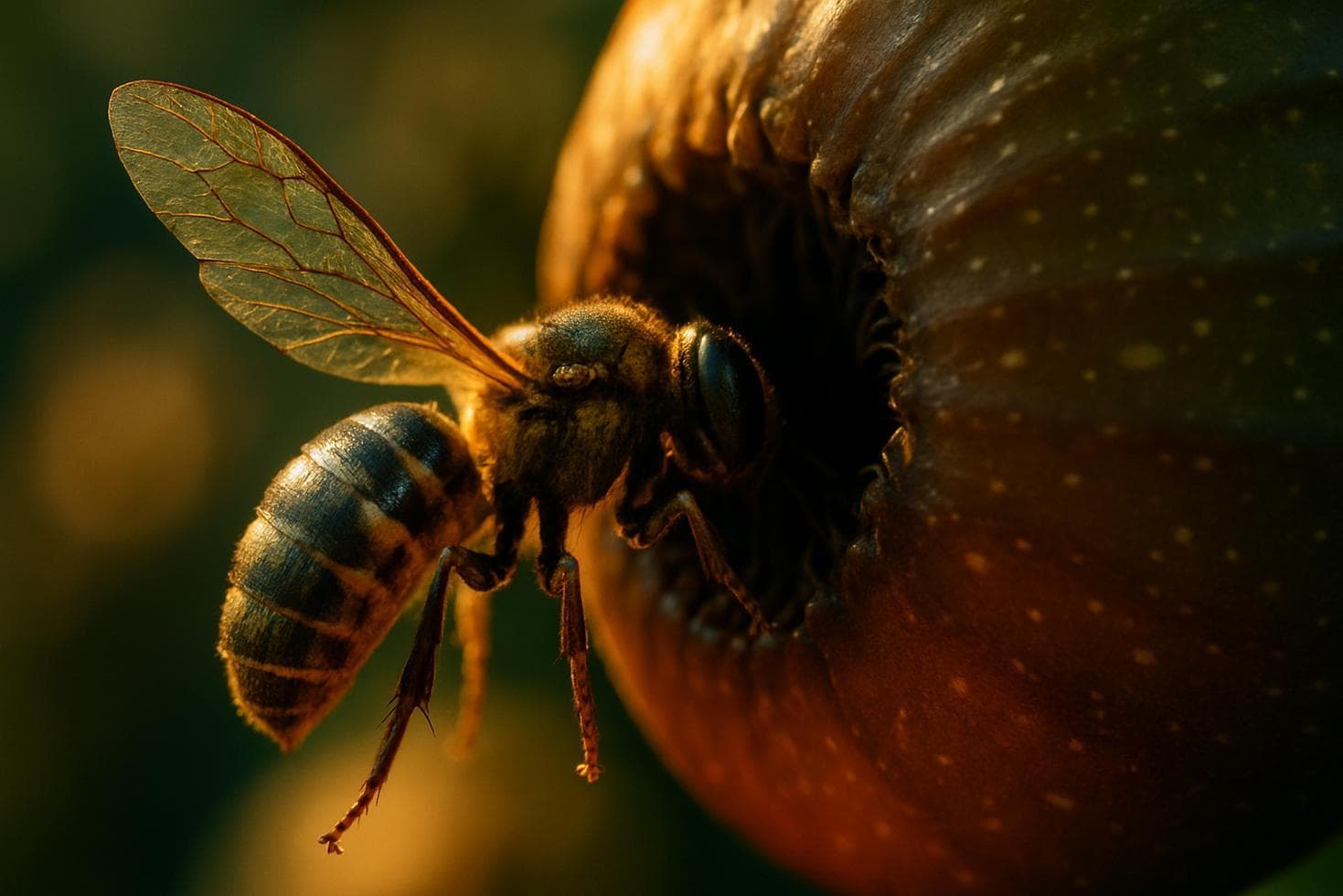
A female fig wasp forces her body through an opening so tight it tears off her wings and antennae. She pollinates, lays eggs, and dies inside — in under 2 days as an adult. The fig’s own enzymes dissolve her completely before the fruit is ripe.
The fig–wasp mutualism is one of the most specific biological partnerships on Earth, with molecular evidence placing its origin around 80 million years ago. What makes it strange isn’t just the age — it’s the mechanics. A female fig wasp enters a syconium, the hollow fig structure lined with tiny flowers, through a pinhole opening called the ostiole. The passage is so narrow that entry costs her wings and large portions of her antennae.
She never leaves. But the cycle she sets in motion does.
- Each wild fig species has its own specific fig wasp species for pollination.
- The fig structure is a syconium — a hollow stem lined inside with hundreds of tiny flowers.
- The ostiole opening is so small that entry tears off the female wasp’s wings and antennae.
- Adult female fig wasps live only 1–2 days; they may fly up to 6 miles to find a receptive fig.
- After she dies inside, the fig’s enzymes break her body down into unrecognizable organic material.
What the Female Wasp Does Inside the Syconium
She uses chemical scent cues to locate a fig at exactly the right developmental stage. Once inside, she moves through the dark interior and deposits pollen — carried from the fig where she herself hatched — onto the flowers lining the chamber walls. She also lays her eggs into short-styled flowers, which develop into galls that will nourish her larvae.
Then she dies. The fig’s enzymatic digestion then begins, breaking her soft body down into nutrients absorbed by the developing syconium. No recognizable insect remains by the time the fig ripens.
How the Next Generation Escapes — and Who Doesn’t
Her eggs develop over several weeks into larvae, then pupae, then adults. Male wasps hatch first. They are wingless and spend their entire lives inside the fig. They mate with females before the females fully emerge, then chew tunnels through the fig wall. After that, the males die inside.
Winged females crawl out through those tunnels, picking up pollen from male flowers as they exit. Once outside, they disperse — potentially up to 6 miles — to find new receptive figs and repeat the cycle.
Why This Mutualism Matters Beyond One Fig and One Wasp
Figs are keystone resources in tropical ecosystems. Birds, bats, and primates depend on fig fruit, which many species produce across multiple seasons rather than in a single annual flush. That reliable fruiting depends entirely on fig wasps completing their reproductive cycle across the landscape.
The species-specificity of the relationship drives this home. Nearly every wild fig species has its own matched wasp species — a product of roughly 80 million years of reciprocal adaptation in body size, ostiole structure, ovipositor length, and floral arrangement inside the syconium.
A wasp that lives two days as an adult, flies miles on chemical signals alone, and enters a space that destroys her ability to leave — that is the mechanism the mutualism runs on. It has been running that way since the late Cretaceous.
Frequently Asked Questions
Do all figs contain a dead wasp?
No. Many commercial fig varieties are parthenocarpic and ripen without any wasp pollination. Wild figs pollinated by wasps do contain digested wasp material, but it is fully broken down before the fruit ripens.
How long does a female fig wasp live?
University of Maryland sources document an adult lifespan of 1–2 days for pollinating female fig wasps.
How far can a fig wasp fly to find a fig?
Arizona State University’s Ask A Biologist reports female fig wasps can fly up to 6 miles to locate a receptive fig.
How long has the fig–wasp mutualism existed?
Molecular and fossil evidence places the origin of the Ficus–Agaonidae mutualism at approximately 80 million years ago, in the late Cretaceous period.