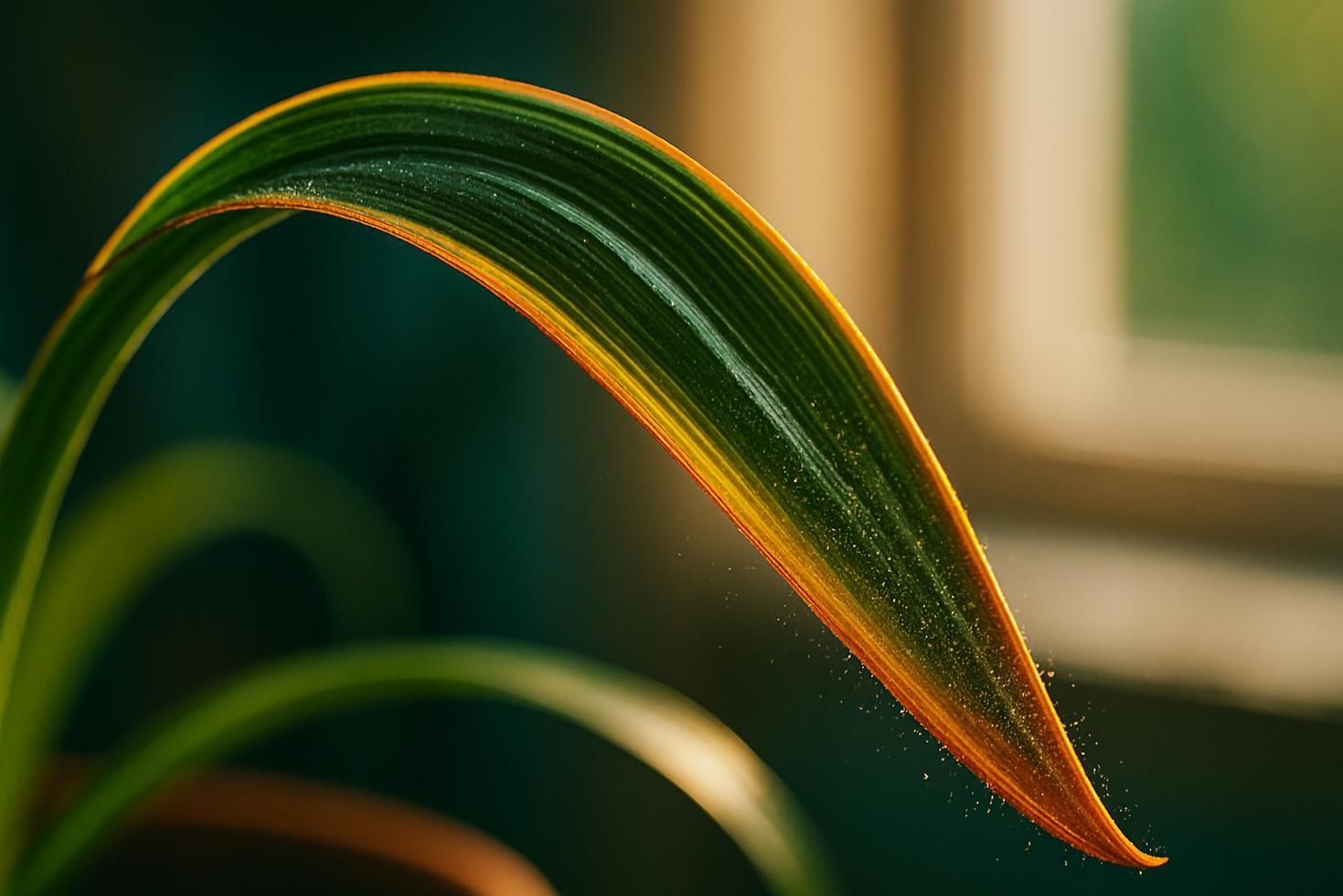
Spider plant leaves hold dust on both faces — 65% on top, 35% underneath — through physical interception, not static magnetism.
A spider plant collects dust the way a net collects debris: by sitting in the path of moving air and letting particles do the work. That’s the mechanism. No charge, no magnetism — just surface, contact, and adhesion.
Airborne particles in still indoor air don’t simply fall straight down like snow. Particles in the 10–100 micron range drift laterally, bounce off obstacles, and arrive at leaf surfaces from multiple angles — including from below. That’s why the undersides of spider plant leaves carry measurable dust loads, not just the tops.
How Spider Plant Leaf Surfaces Physically Trap Dust Particles
Dust sticks when a particle collides with a surface and adhesion forces outweigh the momentum carrying it away. Spider plant leaves have a faint waxy texture and fine surface variation that give particles something to grip the moment contact happens.
Physical surface adhesion on first contact is what keeps a particle from bouncing off. The leaf doesn’t move. The air delivers the particle, and the surface holds it.
Dense, arching foliage also intercepts more simply because more surface area sits in the air’s path. A mature spider plant can carry dozens of long leaves, each one presenting two faces to the room continuously.
Why the Underside Collects 35% of Total Dust — Not Zero
The 35% figure is what makes dust accumulation on spider plants genuinely strange to think about. Gravity alone would concentrate everything on top.
What brings particles to the underside is lateral and upward particle drift in still air. Convection currents from heating systems, body heat, or minor air movement keep fine particles suspended long enough to reach undersurfaces. Once there, the same adhesion forces hold them in place.
This means cleaning only the top surface leaves more than a third of the plant’s dust load untouched.
Closing
Spider plants aren’t doing anything unusual — they’re just existing in the path of the air, on both faces, all the time. The 35% number is a reminder that dust in a room is three-dimensional, not a flat layer settling on flat things.
Stillness, it turns out, is its own kind of net.
Frequently Asked Questions
Why do spider plant leaves collect dust so visibly?
Spider plant leaves have a broad, long surface area and a slightly textured, waxy face that promotes particle adhesion on contact. More surface in the air’s path means more interception.
Does static electricity cause dust to stick to spider plant leaves?
The evidence does not support static as the primary mechanism. Physical interception and surface adhesion in still air account for how particles accumulate on spider plant leaves.
How do you clean dust off spider plant leaves effectively?
Wiping or rinsing leaves with water, or water with a small amount of dish soap as a surfactant, helps loosen and remove accumulated dust from both surfaces.
Why does the underside of a spider plant leaf have dust on it?
Fine airborne particles drift laterally and upward in still indoor air, reaching undersurfaces through mid-air collision before adhering — accounting for roughly 35% of total leaf dust load.