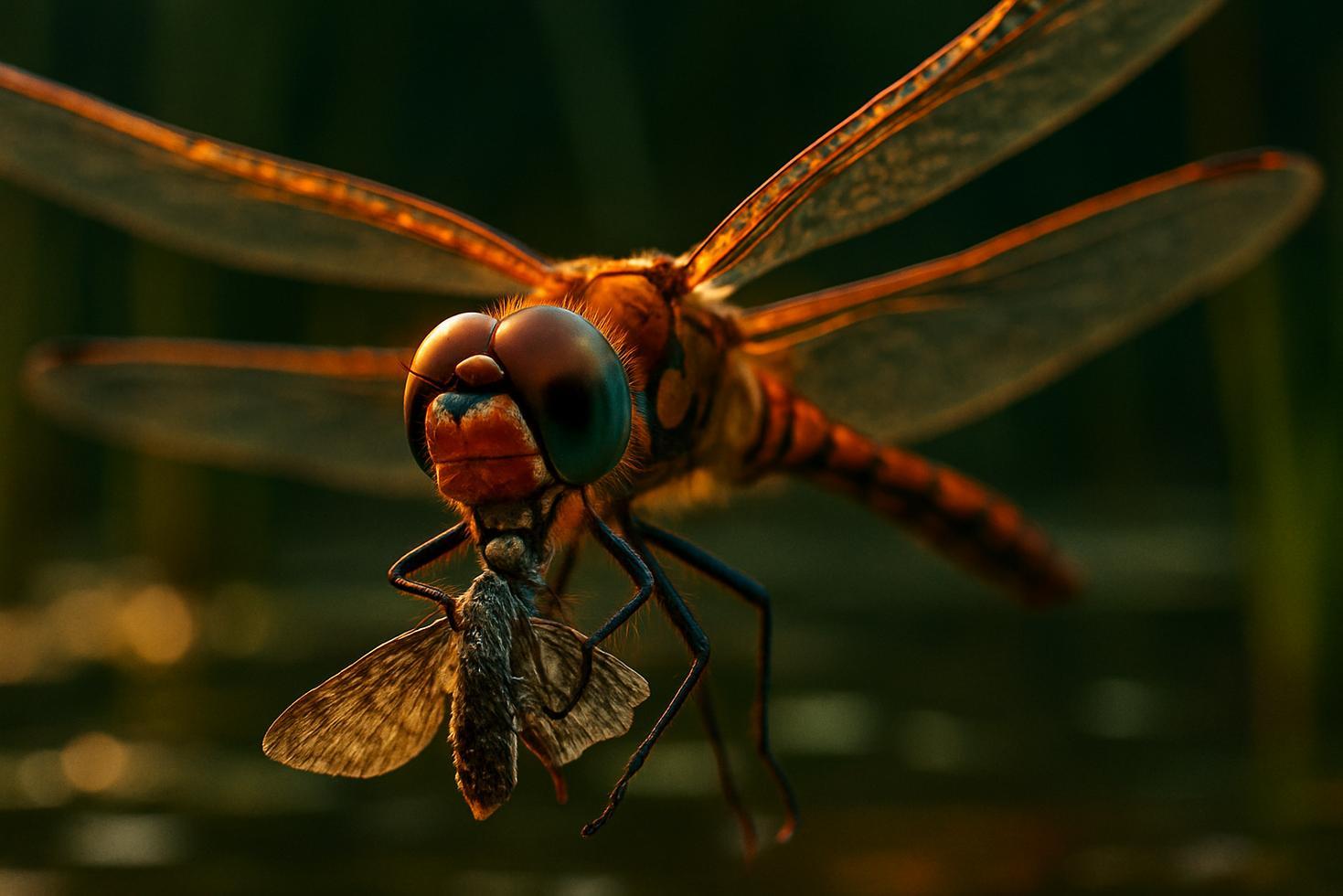
Dragonflies don’t chase prey — they predict it. With nearly 80% of the brain dedicated to vision and a capture rate up to 97%, the interception happens before most animals register a threat.
Dragonflies intercept prey by calculating a future position in space, not by following the prey’s current location. That single behavioral distinction separates them from almost every other aerial predator alive. The target isn’t chased — it’s already solved for, geometrically, before the wings even adjust.
The system behind that geometry runs remarkably fast. A dragonfly begins responding to a prey maneuver in roughly 50 milliseconds — enough time for information to cross approximately three neurons.
How Dragonfly Vision Drives the Interception
Nearly 80% of a dragonfly’s brain is dedicated to processing sight, and that investment shows up directly in performance. Their visual system processes around 200 images per second, compared to roughly 60 for a human eye under ideal conditions.
That processing speed makes predictive flight possible. The dragonfly maintains a stable angular relationship to the target mid-pursuit, continuously updating its course while steering toward where the prey will arrive rather than where it is.
Quick Answer:
– Capture rates reach up to 97% in studied species under experimental conditions
– Reaction to a prey maneuver begins in approximately 50 milliseconds
– That 50 ms window spans roughly three neurons firing in sequence
– Nearly 80% of the dragonfly brain is dedicated to vision
– Visual processing runs at around 200 images per second
What Dragonfly Flight Mechanics Actually Look Like
The wings make the geometry executable. Each pair moves independently, allowing tight mid-air pivots with turning radii as small as 4.1 centimeters. Studied species like Libellula cyanea hit accelerations around 1.52 g and maximum pursuit speeds near 2.28 meters per second.
The legs function as a capture net, spread forward at the moment of contact. The legs-as-net mechanism works because the intercept point is already calculated — the dragonfly arrives at a location in space and the prey flies into the trap.
What Dragonflies Actually Eat
Mosquitoes are on the menu, but so are midges, moths, damselflies, and smaller dragonflies. A dragonfly may consume roughly one-fifth of its body weight in a single day of hunting.
The diet range matters because the 97% capture rate reflects a generalist predator, not a mosquito specialist. The same predictive interception system works regardless of which insect fills the target position.
A predator that solves geometry instead of giving chase represents one of the more elegant mechanisms in animal flight. The mosquito’s evasive maneuver is simply additional data in a calculation already running.
Frequently Asked Questions
What is a dragonfly’s prey capture rate?
Studies on specific species report capture success rates of 95% to 97%, measured under experimental conditions rather than across all dragonfly species universally.
How fast does a dragonfly react to a prey movement?
The response begins in approximately 50 milliseconds — the time for a signal to cross roughly three neurons, not a jaw-closing time as sometimes reported.
Do dragonflies chase prey or predict where it will be?
Dragonflies use predictive interception, steering toward the prey’s anticipated future position rather than tracking its current path.
How much of a dragonfly’s brain handles vision?
Nearly 80% of the dragonfly brain is dedicated to visual processing, supporting a visual system that captures around 200 images per second.
Sources:
Natural History Museum
PMC/NIH
Sandia National Laboratories
IEEE Spectrum
Defense News