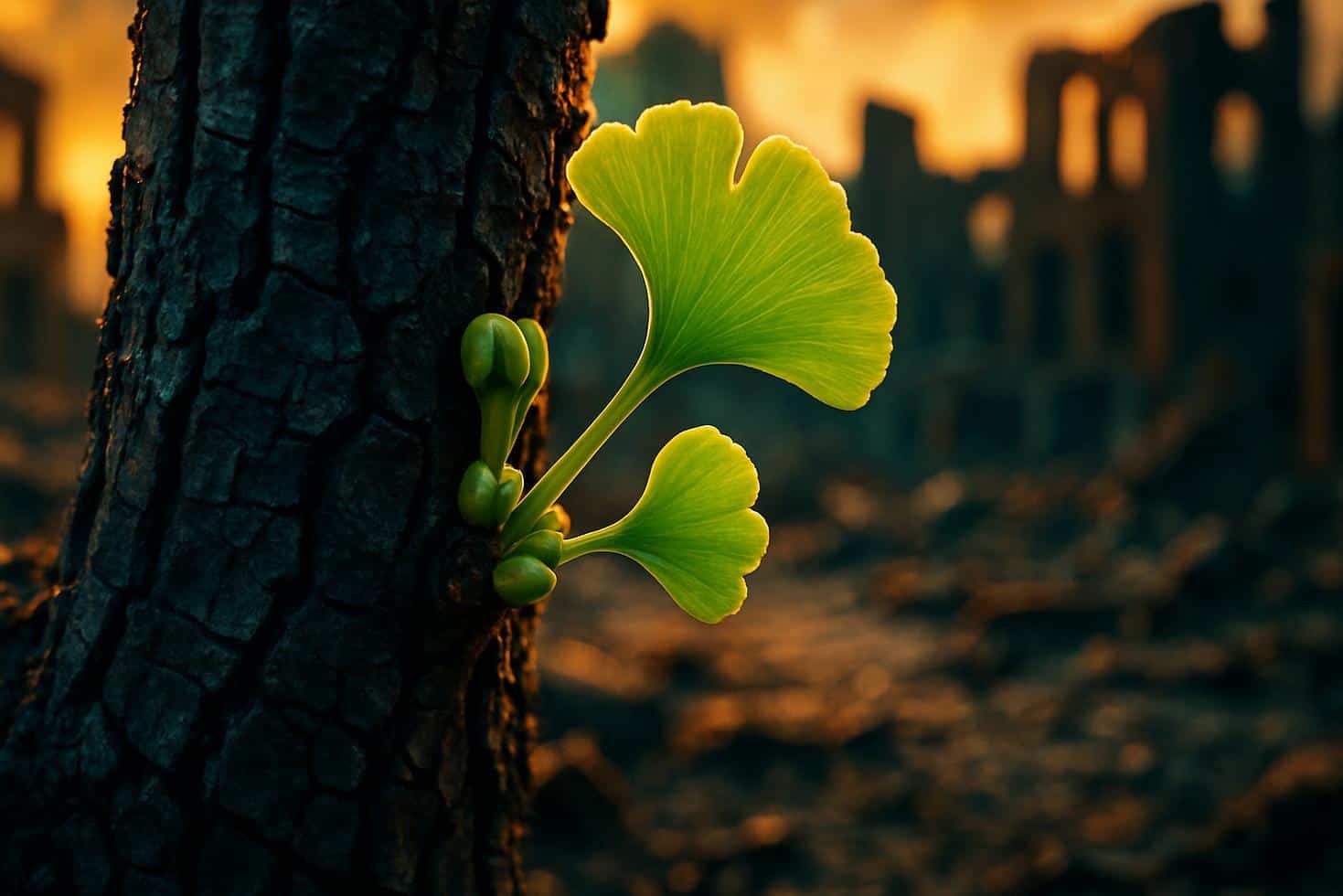
Six ginkgo trees stood within 1–2 km of the Hiroshima hypocenter. Their cambium kept dividing. By the following spring, green shoots pushed through blackened trunks.
Six ginkgo trees survived the 1945 Hiroshima atomic bombing within 1–2 km of the hypocenter — and by the following growing season, new buds were already pushing through their scorched trunks. That detail sits somewhere between biology and disbelief. The outer bark was gone. The branches were stripped. Yet something inside kept working.
That something was the cambium: a layer of dividing cells, just a few cells thick, sandwiched between dead bark and solid heartwood. While everything on the surface was destroyed, the cambium underneath kept producing new tissue.
What the Ginkgo Cambium Actually Does After Severe Damage
The cambium is the growth engine of any tree. In ginkgo, it appears to be unusually persistent. SciShow’s examination of the Hiroshima survivors describes a cambium still dividing without measurable slowdown, producing leaves of the same size and seeds of the same weight as before 1945.
Ginkgo bark is dense and layered in a way that absorbs surface heat. When the blast wave hit, the outer bark absorbed much of the thermal damage. The cambium, sheltered beneath, remained viable.
Defense-related genes — called R genes — also remain active deep in the wood, producing compounds that attack infection and seal damaged tissue. That biochemical response likely helped prevent the scorched wounds from becoming lethal.
Where the Six Survivor Trees Stand Today
Four of the six trees are located at temples: Housenbou, Anraku-ji, Myōjin, and Jōsei-ji. One grows in Shukkei-en garden. One stands at the former Senda Elementary School site. All six are still alive.
At Anraku-ji, the tree’s branches were entirely burned away, but the trunk held. When the temple gate was later rebuilt, the roof was designed with a hole to allow the ginkgo to keep growing through it. The tree had outlasted the architecture that once surrounded it.
These trees are now marked, monitored, and cared for as living memorials. They are not wild survivors left untended — they are formally commemorated, with plaques recording their distances from the hypocenter.
How the Ginkgo Lineage Factors Into Survival
Ginkgo’s broader lineage traces back roughly 200–250 million years, to the late Permian or early Triassic. The ginkgo lineage survived the end-Triassic and end-Cretaceous mass extinctions. Ginkgo biloba as the modern species is considerably younger than the lineage itself — the claim that the exact species has been “unchanged for 270 million years” is not supported by the fossil record.
What the lineage does suggest is deep-time maintenance of stress-tolerance traits: thick bark, persistent cambial activity, constitutive defense chemistry, and deep root systems that can access water and nutrients below heavily damaged surface soil.
The Hiroshima ginkgos didn’t survive because they were exceptional that August. They survived because of what they were already built to do — divide, seal, regrow — repeated across millions of years before anyone was watching.
Six trees. One surviving layer of cells. The rest follows from biology.
Frequently Asked Questions
How far were the ginkgo trees from the Hiroshima blast?
The six recognized survivor trees stood between roughly 1,100 and 1,780 meters from the hypocenter.
Were ginkgos the only trees to survive the Hiroshima bombing?
No. Approximately 170 hibakujumoku (A-bombed trees) of multiple species are currently marked in Hiroshima, all within 2,200 m of the blast center. Ginkgos became the most well-known survivors.
How long did it take for the Hiroshima ginkgo trees to regrow after the blast?
New buds appeared within months, with green shoots pushing through blackened wood by the following spring after the August 1945 bombing.
What happened to seeds from the Hiroshima ginkgo survivor trees?
Seeds were collected and grown as second-generation saplings, which have been sent to more than 100 cities worldwide as part of a peace and resilience project.