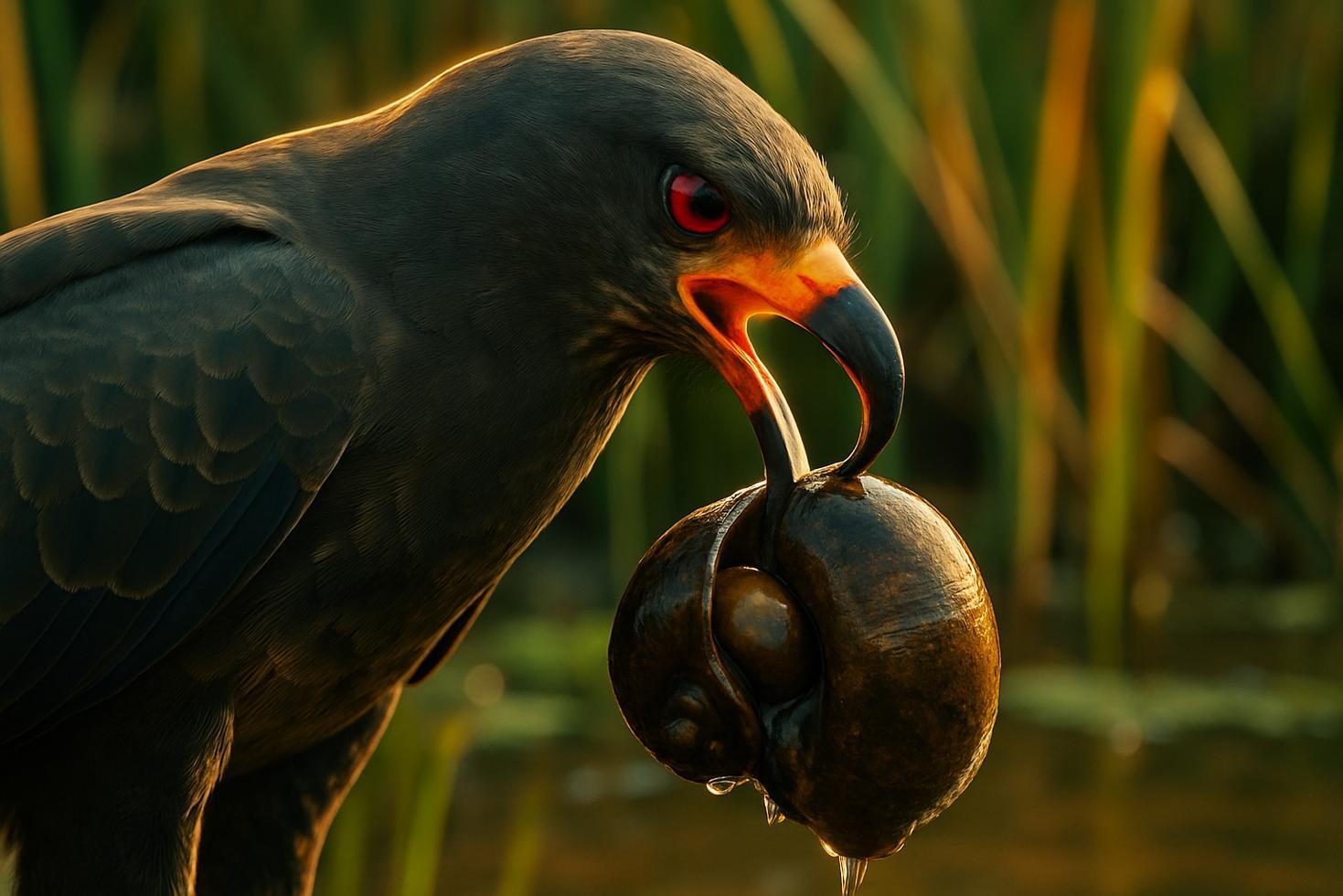
A prey snail roughly 4 times larger than anything snail kites were built to handle arrived in Florida wetlands — and bill length and body mass each shifted by about 1 standard deviation in just 8 years.
Florida snail kites measurably increased in bill length and body mass within 8 years of encountering an invasive prey snail far larger than their native food source. That kind of shift — roughly 1 standard deviation in each trait — across a wild, endangered bird population is the sort of thing researchers usually only read about in theoretical models.
The island apple snail (Pomacea maculata) established itself in Lake Tohopekaliga in late 2004. Snail kites use a deeply curved, hooked bill to extract snails from their shells. The new prey was approximately 4 times larger than the native snails these birds had built their entire anatomy around handling.
How Larger Bills Spread Through the Snail Kite Population
Snail kites with bigger bills and heavier bodies handled the oversized prey more successfully. selection acting through juvenile survival rates is the verified mechanism: larger-billed fledglings were more likely to reach adulthood, contributing more to the next generation.
Smaller birds didn’t vanish. They simply contributed proportionally less to the breeding population over successive seasons. The arithmetic compounded quietly over 8 years into a visible population-wide shift.
Plasticity vs. Genetic Change: What Actually Drove the Shift
The Cattau et al. 2017 study in Nature Ecology & Evolution concludes the morphological shift was driven primarily by phenotypic plasticity — the capacity of individual birds to develop differently in response to environmental conditions — rather than microevolution in the strict genetic sense.
That distinction matters. The birds weren’t rapidly evolving new DNA. They were expressing a range of body sizes that already existed within the population, with the larger end of that range rewarded by better survival odds.
The same study does note that additive genetic variation in bill size increased following the invasion, which means evolutionary change through inheritance may be building toward a future shift.
What the Numbers From Cattau et al. 2017 Actually Show
The study tracked 4,014 fledglings from 2,057 nests between 2002 and 2020. Population growth rates increased following the invasion, and more than 2,000 birds were documented in population counts — though the evidence does not support the stronger claim that the species was rescued from certain extinction.
The 8-year window represents 1 to 1.4 generations for this species. A change of 1 standard deviation in a morphological trait across that span is unusually fast by any ecological measure.
Within a single human decade, a wild bird population restructured two separate physical traits around a food source that didn’t exist in that ecosystem before 2004. The mechanism wasn’t mysterious — pressure, survival, and arithmetic. It just moved faster than most people expect biology to move.
Frequently Asked Questions
What caused Florida snail kites to develop larger bills?
The invasion of the island apple snail (Pomacea maculata), roughly 4 times larger than native prey, created survival advantages for larger-billed birds, shifting the population’s average bill size and body mass within 8 years.
Was the snail kite bill change evolution or plasticity?
The Cattau et al. 2017 study found the primary driver was phenotypic plasticity, not microevolution, though additive genetic variation in bill size did increase after the invasion.
How fast did the snail kite body change happen?
Bill length and body mass each increased by approximately 1 standard deviation over 8 years — about 1 to 1.4 snail kite generations after the invasive snail established in Lake Tohopekaliga.
Did the invasive apple snail help or hurt snail kite populations?
Population growth rates increased following the invasion, and counts exceeded 2,000 birds, though the evidence does not confirm the species would otherwise have gone extinct.